
Blue Jays Saw Something Change With Trey Yesavage After 7 Starts
In this story:
Trey Yesavage went from having a 2.19 ERA and a 2.45 FIP in his first seven starts and 37 innings between April 28 and May 30, 2026, to a 4.77 ERA and a 5.16 FIP in ten starts and 54 2/3 innings between June and July 2026.
Of course, we cannot forget that he has not been healthy enough to judge his performance by comparing it with his best version when he became a revelation in the Toronto Blue Jays rotation during last season.
Yesavage began the season on the injured list with a right shoulder impingement injury, which he had already reported upon arriving at camp and which delayed his preparation.
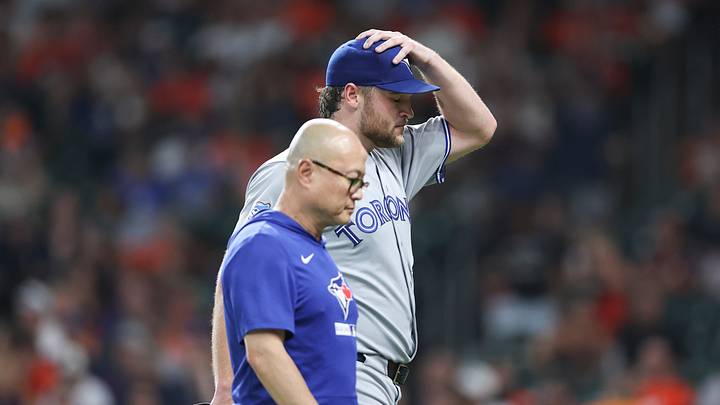
Then, on August 4, he suffered a left knee injury while warming up against the Astros. He was diagnosed with a meniscus injury and needed surgery, which kept him out of action until returning last September 21 in Baltimore.
So both stretches of this comparison in both versions of Yesavage were affected by injuries. However, he allowed nine earned runs and no home runs in his seven starts as a starter in the first period, but was then punished for 29 earned runs and 10 home runs in the second.
The differences in the opponents’ performance were not due only to a decrease in strikeout percentage, but rather to the hitters’ ability to get better contact.
In any case, the expectations around Yesavage have not gone away. He earned them, as he went from being a prospect selected in the first round of the 2024 Draft to reaching the Major Leagues and becoming an important piece of the Blue Jays during their run to the World Series, where he had a historic performance in Game 5.
The Most Concerning Signs Started in His Arsenal

In his seven starts before June 5, Yesavage found the effective mix that allowed him to show the type of variety Toronto would love: the splitter was the hardest pitch to make contact against, generating a 42.0% whiffs rate, the sliders provided the highest strikeout percentage (28.1%), and his four-seam fastball left the league with an average of just .203 and only a .080 ISO.
Starting with his eighth game, the dominant mix of his arsenal began to lose consistency, but it was not simply that hitters were making more contact. The highest average was .205 against the slider.
So, what made the difference were Yesavage’s command errors when executing his pitches, to the point of allowing 10 home runs in that second stretch. Hitters elevated the hard contact against his pitches inside the strike zone, recording a .500 or higher slugging percentage in four of the nine parts of the strike zone.

Five of the 10 home runs he allowed came against the fastballs, which lost 2.56 inches of vertical movement during that stretch of the problem. Yesavage’s splitter usage percentage decreased from 32.5% to 26.7%, while the proportion of sliders increased from 20.6% to 27.3%. However, that change in pitch selection did not produce all of the expected effect, as the slugging percentage went from .379 to .477, and he allowed three home runs.
Yesavage’s splitter remained his hardest weapon to make contact against with a .111 average, and more than half of the contact ended in ground balls (51.5%), while the other 34.5% in strikeouts.
So Yesavage’s problem was not his velocity, nor a considerable loss of vertical or horizontal movement, even though in the second stretch of 10 starts many of his pitches on the corners could have shown greater dominance with his usual break. I still wonder if Yesavage’s best adjustment could be in adding a new weapon, or in returning to the best part of his mix with more work on his command.
This season, his pitches have generated 6.1% less chase outside the zone, while hitters continue adjusting against his arsenal, and they achieved a 4.4% increase in contact against his pitches inside the strike zone. We have already seen that much of that contact frequency resulted in 10 home runs allowed, and that is one of the most concerning enigmas that Yesavage’s second season with the Blue Jays leaves us.
 Add us as a preferred source on Google
Yirsandy is a baseball writer specializing in MLB coverage with experience across multiple teams and storylines. He currently writes for Diamond Centric, where he covers the New York Mets, San Diego Padres, Chicago Cubs, Milwaukee Brewers, and Kansas City Royals. My work focuses on game coverage, player analysis, and storytelling that connects performance with context. My Substack has also been an important part of my writing development, where I’ve built much of my baseball coverage and storytelling voice over time. I’m passionate about combining reporting, research, and thoughtful analysis to produce engaging baseball content for readers.
Follow Yirsandy