
Brett Bateman’s Contact Ability Is Exceeding Expectations for Blue Jays
In this story:
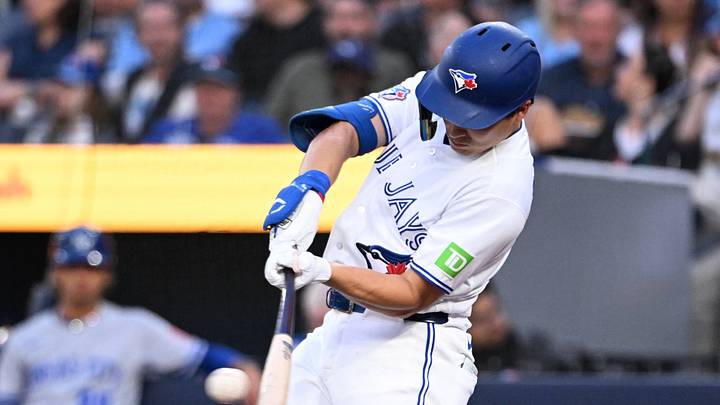
Often, it is not a 400-foot blast that you expect to see come out of Brett Bateman’s swing. It is usually a quick movement of the wrists like lightning, and lightning and almost certainly soft contact that will put the infield in trouble with his lurking speed.
You can also expect a short line drive, the kind that flies over the infield and falls while trying to find a gap in the outfield.
That is how Bateman survives against the best pitchers in baseball, and his formula in search of contact has been a boost from the leadoff spot in the Toronto Blue Jays’ lineup.
After his debut last Aug. 7, Bateman has recorded at least one hit in 24 of the first 30 games of his career, and multiple hits in 12 of them. On Saturday, he extended his streak to 10 consecutive games, reaching base after going 1-for-4, scoring a pair of runs and doing something unexpected: hitting a solo home run, his second in consecutive days against Baltimore Orioles pitchers.
Through the first 30 games of his career, he has an offensive line of .336/.401/.443, which places him with the fifth-highest batting average in franchise history during that span, behind Aaron Hill (.381, 2005), Al Woods (.367, 1977), Ed Sprague (.344, 1991), and Bo Bichette (.338, 2019). His impact has been immediate, and he has undoubtedly exceeded expectations after arriving in Toronto on Aug. 2 in a trade that sent Kevin Gausman to the Chicago Cubs.
POWER HITTER 💪
— Toronto Blue Jays (@BlueJays) September 12, 2026
Back-to-back games for Bateman! pic.twitter.com/7k9GLAHOdw
Bateman was selected by the Cubs in the eighth round of the 2023 MLB Draft and always stood out in the minors for his ability to put the ball in play and get on base. Yes, he is the type of hitter who offers the complete opposite of what teams are looking for today.
Even so, Bateman continues to show that his talent can also contribute. Of course, this final stretch of the season will not be enough to see how consistent he can be when his sample of plate appearances increases, but Bateman is responding at a key moment when the Blue Jays are fighting to reach the postseason.
The Contact That Sustains Bateman’s Profile

When I enjoy an interesting offensive line over a small sample, I often remember a phrase from Hall of Fame third baseman Adrián Beltré: “If you can do it once, you can do it many times.” That is what I feel when I watch Bateman hit. Obviously, his numbers are going to come down from that .336 batting average and .401 OBP, but his hitting philosophy can survive if his ability to put the ball in play does not suffer major regressions. Since his debut, only one hitter in all of the majors has posted a higher batting average than Bateman, Marlins infielder Javier Sanoja (.357).
Over that same span, since last Aug. 7, Bateman is in the Top 10 among hitters with the lowest FastSw% per Statcast. Who appears there? All of the names are very familiar when the conversation is about contact: Steven Kwan (0.0%), Chandler Simpson (0.0%), Chase Meidroth (0.5%), Luis Arraez (0.5%), Nico Hoerner (0.9%). None of them, so far, has had more success than Bateman, who is already beginning to stand out as part of the group of elite contact hitters.
Now, what is catching my attention the most is how he is doing it. And this is where Bateman differs a little. Among all qualified hitters since his debut, there is only one who has produced a ground-ball rate above 55%. Bateman leads that small group with the highest line-drive rate (21.6%), and the second-highest opposite-field percentage (33.7%), behind Simpson (36.3%). In other words, so far, his profile has been built as that of a hitter skilled at a slow swing, looking for contact, who mostly hits ground balls and distributes the other major part of his batted-ball percentage with short line drives.
When he hits ground balls, his batting average on ground balls has been .346, and when he reaches base, the Blue Jays have had a great opportunity to score. It is not a large group that survives on ground balls and succeeds, but Bateman, so far, has been able to survive against the defense.
Exploring the Wonder of Bateman’s Swing

It is not a mistake: Bateman is batting .400+ in four of the nine sections of the strike zone, according to this BrooksBaseball graph. He has punished pitches up, in the middle, and in the inner parts of the strike zone. Notice that the only place where pitchers have really been able to survive against his eagle eye is the lower-inside part of the zone, where he is batting .191.
So far, Bateman has declared himself a fastball hitter: 74% of his swings are aligned, he has just 2% flawed swings, and 32% end in perfect contact. His whiff rate is 13.2%, and his production has improved in September: .360/.400 compared with .326/.391 in August, with a .371 xwOBA. However, breaking balls are creating problems for him at the plate. Bateman has a whiff rate that rises to 20.8%, and sliders and cutters have produced +5.9 and +3.5 RV/100 against him, respectively.
That said, in September he has produced a .300 batting average and .600 slugging percentage against breaking pitches, but with just 79.5 mph of EV. His whiff rate has also jumped against offspeed pitches to 32%, which shows us a preview of how the opposition could begin to attack him, especially if the Blue Jays reach the postseason.
I know it has only been 30 games, but Bateman’s dynamism and ability to hit have become one of the most interesting stories in Toronto, in a season in which the offense has fallen short of expectations.
 Add us as a preferred source on Google
Yirsandy is a baseball writer specializing in MLB coverage with experience across multiple teams and storylines. He currently writes for Diamond Centric, where he covers the New York Mets, San Diego Padres, Chicago Cubs, Milwaukee Brewers, and Kansas City Royals. My work focuses on game coverage, player analysis, and storytelling that connects performance with context. My Substack has also been an important part of my writing development, where I’ve built much of my baseball coverage and storytelling voice over time. I’m passionate about combining reporting, research, and thoughtful analysis to produce engaging baseball content for readers.
Follow Yirsandy