
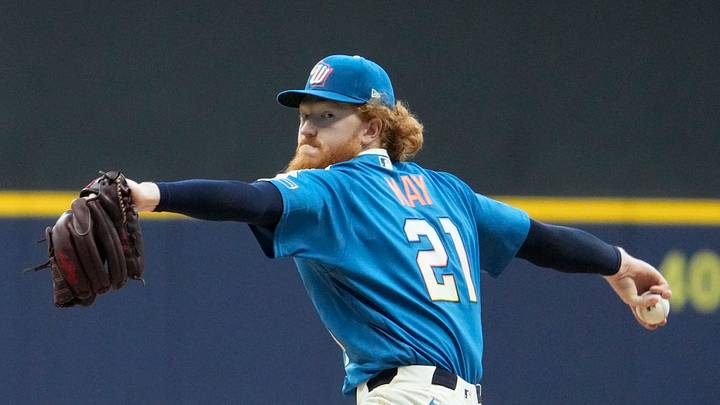
Why Dustin May Still Doesn’t Offer the Guarantees Toronto Needs in Its Rotation
In this story:
I have not had him in my ranking of pitchers I would most like to see with the Blue Jays for next season, mainly because, given the pressing need to improve the offense, the most viable options for reinforcing the starting rotation should be pitchers capable of preventing runs.
Even so, according to recent reports by Jim Bowden in The Athletic, Toronto is among the multiple teams interested in right-handed free agent Dustin May. Bowden mentioned the Chicago Cubs, Washington Nationals, Baltimore Orioles, San Francisco Giants, Cincinnati Reds, Cleveland Guardians, Miami Marlins, and the Chicago White Sox.

May is coming off recovering from multiple injuries and finally being able to offer stability as a pitcher, in addition to increasing his value a little, with two seasons in which he has recorded a high workload, averaging 27 starts and 137 innings while pitching for four different teams: the Los Angeles Dodgers, the Boston Red Sox, the St. Louis Cardinals, and the Milwaukee Brewers, and being part of the bullpen that helped win the World Series this year. However, despite durability being one of the best signs of his return over the last two campaigns, he finished with a 14-20 record, a 4.82 ERA (85 ERA+), a 4.22 FIP, and -0.3 bWAR.
FanGraphs’ fWAR, which gives more credit to May’s 3.96 xFIP, the best of his career in qualified seasons with at least 100 innings — his last two — assigned him a value of 3.5, with 2.8 in his 31 starts and 145 ⅔ innings, his personal best this year.
Why Isn’t May Among My Top Options for the Jays?

I think it is not very difficult to see some of May’s major problems throughout his career. If you scroll through his percentile rankings, you will see that he finished in the 22nd and 21st Pitching percentiles over the last two seasons, respectively.
Of course, he has had ups and downs during that span that, as we saw earlier here, helped him recover part of his value, and he finished with an fWAR higher than the 0.7 he recorded last year. Now, there were only four aspects in which May really took a small step forward: he improved his fastball velocity (moving from the 58th to the 85th percentile in 2026), returned to the 98th percentile in Curve Spin as he did in 2019, raised his strikeout rate (from the 38th to the 55th percentile), and reduced walks (from the 22nd to the 55th percentile).

Even so, his improvements in fastball velocity, from 94.3 mph to 95.6 mph, did not entirely translate into assured dominance, as May allowed 10 of his 14 home runs on those pitches and, although his xSLG dropped from .528 to .405, the opposition’s production continued to cause a lot of trouble. Within his fastball group, which includes the four-seam fastball (-2 Run Value since 2025), which he threw 24.8% of the time in 2026, the sinker (its usage dropped from 33.5% to 20.1%), and the cutter (its usage increased from 9.7% to 23.7%), May will have to choose whether he continues to give the four-seam the same space in his repertoire, since it was the most vulnerable pitch of the three.
This year, hitters finished with 147 plate appearances against the four-seam and increased their Hard Hit% rate from 44.2 to 54.3 and, although the xSLG remained in a similar range (.369 in 2025 and .372 this year), May saw his Whiffs% rate drop somewhat from 25.0 to 22.8 and recorded fewer strikeouts, as K% also dropped from 29.3 to 25.9.

On the other hand, his cutter improved its Run Value from -4 last year to +6 this season, and the sinker, which was coming off allowing a .609 xSLG in 2025, also improved considerably, from -5 RV to +1. The rest of May’s problems came from his sweeper and changeup mix, two pitches who were at the worst point of his career and that, if recoverable, would bring a major change to May’s situation. That said, when you are looking for pitchers capable of “preventing” runs, and not a profile that remains in a constant struggle to avoid high-pressure situations, May is not the best option available on the free-agent market right now, coming off a 5.18 xERA in 2025 and 4.43 this year.
For now, the Jays have many more attainable options, and I think the most compelling proof was May’s recent performance when he moved to the Brewers in the second half of the season. Before being moved to the bullpen during the postseason, May saw his HR/FB rate explode from 6.3% over his 21-start stretch with St. Louis to 17.1% in Milwaukee. He struck out more hitters, but also gave up more walks, and his ability to generate ground balls could not save him from difficult situations as it used to with the Cardinals.

Pitchers do not have to depend on strikeouts all the time, but May is going to have to improve his pitch mix, as he does not get enough chase. This may not have been a bigger problem when he was a reliever, but now that he has become a full-time starter, his inconsistency has been an obvious breakdown. May has allowed a .342 slugging percentage in his career when facing the lineup for the first time, but in his second and third times through, the averages rise to .406 and .410, with a 4.07 and 5.35 xERA, respectively.
 Add us as a preferred source on Google

Yirsandy is a baseball writer specializing in MLB coverage with experience across multiple teams and storylines. He currently writes for Diamond Centric, where he covers the New York Mets, San Diego Padres, Chicago Cubs, Milwaukee Brewers, and Kansas City Royals. My work focuses on game coverage, player analysis, and storytelling that connects performance with context. My Substack has also been an important part of my writing development, where I’ve built much of my baseball coverage and storytelling voice over time. I’m passionate about combining reporting, research, and thoughtful analysis to produce engaging baseball content for readers.
Follow Yirsandy