%20%20--%3E%0A%3Csvg%20version%3D%221.1%22%20id%3D%22Layer_1%22%20xmlns%3D%22http%3A%2F%2Fwww.w3.org%2F2000%2Fsvg%22%20xmlns%3Axlink%3D%22http%3A%2F%2Fwww.w3.org%2F1999%2Fxlink%22%20x%3D%220px%22%20y%3D%220px%22%0A%09%20width%3D%2239px%22%20height%3D%2240px%22%20viewBox%3D%220%200%2039%2040%22%20enable-background%3D%22new%200%200%2039%2040%22%20xml%3Aspace%3D%22preserve%22%3E%0A%3Cpath%20fill%3D%22%23FFFFFF%22%20d%3D%22M38.5%2C7H28.2v26h10.3V7z%22%2F%3E%0A%3Cpath%20fill-rule%3D%22evenodd%22%20clip-rule%3D%22evenodd%22%20fill%3D%22%23FFFFFF%22%20d%3D%22M26.1%2C25.5c0%2C5.8-4.1%2C7.5-12.9%2C7.5C3.9%2C33%2C0%2C31.2%2C0%2C25.2v-1.1h11.6%0A%09v2.4c0%2C0.7%2C0.1%2C1.4%2C1.2%2C1.4c1%2C0%2C1.2-0.4%2C1.2-1.3v-0.9c0-1.6-0.9-1.6-3.5-2.2C2.2%2C21.7%2C0%2C19.7%2C0%2C15.3v-0.9C0%2C9.3%2C5.5%2C7%2C12.9%2C7%0A%09c10.2%2C0%2C12.8%2C2.6%2C12.8%2C7.4v1.8h-11v-2.9c0-0.6-0.4-1.1-1.2-1.1c-0.6%2C0-1.2%2C0.4-1.2%2C1.1v0.9c0%2C1.5%2C0.9%2C2%2C3.3%2C2.5%0A%09c8%2C1.6%2C10.5%2C3.3%2C10.5%2C7.5V25.5z%22%2F%3E%0A%3C%2Fsvg%3E%0A)
Brewers Are Using Postseason Stage to Showcase MLB’s New Era
In this story:
Los Angeles — When dynasties fall, it is not insurrection, nor jealousy, nor sloth that bring them down. It is the undefeated champion of the world, Father Time. We are watching the Los Angeles Dodgers age out.
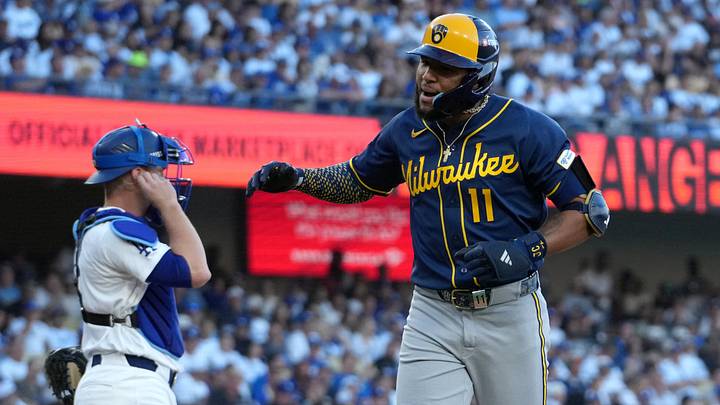
The Milwaukee Brewers proved for a third time in the National League Championship Series they are the better (and younger) team, completing a beautiful triptych of comebacks with a 6-2 win in Game 3 on Wednesday. In three successive games, the Dodgers had Tarik Skubal, Yoshinobu Yamamoto and Blake Snell on the mound with a lead and lost all three. Ninety-five million dollars, four Cy Young awards and a World Series MVP worth of pitching and they could not hold back Milwaukee any more than you can hold back water with your hands.
Start your morning with every pitch from Jake Bauers' 11-pitch AB pic.twitter.com/fzRD0r0VB9
— Milwaukee Brewers (@Brewers) October 15, 2026
But the most obvious reason why the Brewers have put the Dodger dynasty on the brink of extinction is this: the youngest pitching staff in baseball—and the hardest throwing staff in postseason history—has smothered the oldest team in baseball. Milwaukee is pushing around the aging Dodgers lineup with a barrage of fastballs in three versions, especially power sinkers. They are shoving 66.8% fastballs at the Dodgers at an average velocity of 97.9 mph. The Dodgers’ only path to victory is to slug and the Brewers simply won’t allow it.
“I just think they’re really good pitchers,” Dodgers infielder Miguel Rojas said. “A lot of their pitchers throw three different fastballs. They throw hard, and they’ve been locating the ball really well. They haven’t really given us too much of an opportunity to kind of build momentum.
“They’ve been attacking the zone. They throw their stuff in the zone—and with all three fastballs. A lot of guys have a cutter, a sinker and a four-seam fastball. It’s really hard to put barrels on the ball.
“At the end of the day, it’s just the velocity of their stuff. They throw the ball really hard. And we all know when you throw that hard, it’s really hard.”
The Brewers knew coming into the series that in today’s game older players don’t hit elite fastballs as well as younger players, and so the matchup was to their liking. But this? Who could have seen this in the NLCS? The Dodgers:
- Have two extra-base hits in 105 plate appearances
- Have been outhomered, 5-0
- Are the first team in franchise history to lose three straight games in one postseason with no home runs and no attempted stolen bases
- Are hitting .228 against fastballs
- Are 2-for-16 with runners in scoring position, part of a 3-for-32 postseason disaster in those spots
This has been the year in which baseball made a sharp turn when it comes to the speed of the game. Younger players thrive. Velocity, and the widespread adoption of the family of three fastballs, changed everything. You need fast-twitch athleticism, youthfulness. You need this generation of players who know velocity as a first language. You need rangy players on defense. The numbers bear out that younger players are the preferred way to go.
Players 30 and younger this year hit .247. Players in the 31-35 year-old demographic hit 10 points worse, .237, their worst showing ever. There was a time when front offices valued those 31-35 players because it seemed to be the peak intersection of experience and physical tools. Front offices were afraid to commit to younger players because of the lack of reps and track records. Those days are over.
The difference on the field in NLCS Game 3 was striking. The Brewers are the fastest team in baseball, as measured by sprint speed. The Dodgers are 24th.
The Brewers started a lineup and a pitcher with an average age of 26.1. They became the first team in history with a second postseason game starting three players 22 and younger: leftfielder Jackson Chourio, shortstop Cooper Pratt and rightfielder Luis Lara. Chourio opened the game with a first-pitch homer. Pratt smacked three hits, stole a base and scored a run. Lara flew around rightfield like a bird of prey, snaring anything that dared enter his airspace.
LARA RUNS ONE DOWN pic.twitter.com/g5hmqgPoSh
— Milwaukee Brewers (@Brewers) October 15, 2026
Watching Chourio, 22, Garrett Mitchell, 28, and Lara, 21, patrol the outfield was like watching an Olympic sprint relay team.
On the other side of the field, the Dodgers, especially their bats, looked old and slow. The average age of their starting 10 was 32.3 years old—more than six years older than Milwaukee’s fearless group. Only two starting Dodgers were in their 20s: centerfielder Andy Pages, 25, and Kyle Tucker, 29, who with his diminished range and baserunning has been trending older than his age.
By starting eight players 31 and older, these Dodgers joined the 2023 Dodgers, who got bounced by the Diamondbacks, as the only teams in the past 19 postseasons to trot out so many starting players that old in a game.
Fittingly, the old team played an outdated style of baseball, one from a generation ago. The ninth-place hitter, Tommy Edman, twice batted after the leadoff runner reached first base. Twice manager Dave Roberts did not ask him to bunt.
“I thought about it, but it’s just, he had a good pitch to hit. Flew out,” Roberts said. “I just didn’t feel giving up an out right there. Early in the game, I wanted Tommy to hit ...
“We haven’t been getting hits with runners in scoring position. To give up an out, to bank on getting a hit with runners in scoring position, I’d rather just try to maybe slug, hit a double.”
Edman was a below average hitter (97 OPS+) with a .385 slug this season.
Roberts and the Dodgers keep waiting for slug to show up at the expense of forfeiting the situational baseball as deployed by the other three remaining teams, the youthful Brewers, Guardians and Rays. The Dodgers still may be waiting Thanksgiving morning.
For instance, the Dodgers were down 1-0 in the sixth when Roberts sent 36-year-old Max Muncy to hit for Pages with runners on first and second and no outs. In that situation, the Brewers are bunting. Milwaukee plays get-em-over, get-em-in ball. The Dodgers? No way. Muncy is a three-true outcome guy. He is not going to bunt. Again, the Dodgers played for slug and got nothing. Muncy struck out. Will Smith, 31, did save the rally with a two-run double. But the Dodgers would go 1-for-12 after that against hard-throwing relievers D.L. Hall and Trevor Megill.
The lineup remained cold. Shohei Ohtani, 32, cannot pull a baseball because of lower-half injuries that won’t allow him to properly turn his hips and get to a firm front side. Freeman, 37, has three extra-base hits since Aug. 31.
“[Our] pitching staff has been great, to be honest,” Rojas said. “It’s really hard to put it into context when you have to pitch and have to play defense with a one run lead every single time. It’s like asking these guys to just throw a perfect inning every single time. It’s not sustainable. So, the blame is on the offense. We all know we could’ve done better, but nothing we can do now.”
How in the world has Milwaukee made Los Angeles look so bad?
“It’s pretty simple,” Muncy said. “We’ve played like [poop]. They’ve played great.”
Occam’s razor (or commode) aside, the one-sided NLCS is bigger than that. It stands as a changing of the guard, recalling the 1964 World Series, when the St. Louis Cardinals, emblematic of the National League embracing Black and Latin American players, ended the dynasty of an aging New York Yankees team, then the second oldest team in baseball. The younger, faster, harder-throwing, more creative team has been, beyond doubt, the better team.
 Add us as a preferred source on Google
Tom Verducci is a senior writer for Sports Illustrated who has covered Major League Baseball since 1981. He also serves as an analyst for FOX Sports and the MLB Network; is a New York Times best-selling author; and cohosts The Book of Joe podcast with Joe Maddon. A five-time Emmy Award winner across three categories (studio analyst, reporter, short form writing) and nominated in a fourth (game analyst), he is a three-time National Sportswriter of the Year winner, two-time National Magazine Award finalist, and a Penn State Distinguished Alumnus Award recipient. Verducci is a member of the National Sports Media Hall of Fame, Baseball Writers Association of America (including past New York chapter chairman) and a Baseball Hall of Fame voter since 1993. He also is the only writer to be a game analyst for World Series telecasts. He lives in New Jersey with his wife, with whom he has two children.