%20%20--%3E%0A%3Csvg%20version%3D%221.1%22%20id%3D%22Layer_1%22%20xmlns%3D%22http%3A%2F%2Fwww.w3.org%2F2000%2Fsvg%22%20xmlns%3Axlink%3D%22http%3A%2F%2Fwww.w3.org%2F1999%2Fxlink%22%20x%3D%220px%22%20y%3D%220px%22%0A%09%20width%3D%2239px%22%20height%3D%2240px%22%20viewBox%3D%220%200%2039%2040%22%20enable-background%3D%22new%200%200%2039%2040%22%20xml%3Aspace%3D%22preserve%22%3E%0A%3Cpath%20fill%3D%22%23FFFFFF%22%20d%3D%22M38.5%2C7H28.2v26h10.3V7z%22%2F%3E%0A%3Cpath%20fill-rule%3D%22evenodd%22%20clip-rule%3D%22evenodd%22%20fill%3D%22%23FFFFFF%22%20d%3D%22M26.1%2C25.5c0%2C5.8-4.1%2C7.5-12.9%2C7.5C3.9%2C33%2C0%2C31.2%2C0%2C25.2v-1.1h11.6%0A%09v2.4c0%2C0.7%2C0.1%2C1.4%2C1.2%2C1.4c1%2C0%2C1.2-0.4%2C1.2-1.3v-0.9c0-1.6-0.9-1.6-3.5-2.2C2.2%2C21.7%2C0%2C19.7%2C0%2C15.3v-0.9C0%2C9.3%2C5.5%2C7%2C12.9%2C7%0A%09c10.2%2C0%2C12.8%2C2.6%2C12.8%2C7.4v1.8h-11v-2.9c0-0.6-0.4-1.1-1.2-1.1c-0.6%2C0-1.2%2C0.4-1.2%2C1.1v0.9c0%2C1.5%2C0.9%2C2%2C3.3%2C2.5%0A%09c8%2C1.6%2C10.5%2C3.3%2C10.5%2C7.5V25.5z%22%2F%3E%0A%3C%2Fsvg%3E%0A)
Tom Verducci’s 10 Big Takeaways That Define the 2026 MLB Season
In this story:
The 2026 season began in San Francisco with Tony Vitello’s Giants losing 7–0 to the Yankees, the start of a three-game sweep in which the Giants scored one run on 13 hits. It was a prophetic series. The Giants will wind up with one of their five worst teams in franchise history while the Yankees are the top run prevention team in baseball.
From that start, most everything else about the season was hard to see coming.
The year especially was marked by historic performances (including machines overruling umpires) and amazing comebacks. How about three losing teams from last year, including one with 102 losses, making the playoffs this year? How about a guy who was hitting eighth and ninth in April and May being a runaway MVP? How about singles, bunts and stolen bases being not just cool again but also the foundation of the best teams in each league?
As the last chapter of the 2026 regular season is written this weekend, here are the top 10 stories that best define the season:
10. National League Superiority
The NL playoff field is loaded, starting with the No. 1 seed, the Milwaukee Brewers, trying to win its first World Series, and the No. 2 seed, the Los Angeles Dodgers, trying to become the first NL team to three-peat.
The AL? Ugly.
The AL West winner, either Houston or Texas, with a maximum of 82 wins, will set an AL record for fewest wins by a playoff team in a full season, displacing the 84 wins of the 1984 Royals. The Astros or Rangers could also get in at 81–81 or worse, a new MLB low in a full season.
For the first time in a full season, the AL will have three playoff teams with no more than 86 wins. But hey, as the 2006 Cardinals proved, just get into the tournament and anything can happen.
Fewest Wins by Playoff Team (Full Seasons)
Team | W-L | Playoffs W-L | Result |
|---|---|---|---|
1. 1973 Mets | 82–79 | 6–6 | Lost WS |
1. 2005 Padres | 82–80 | 0–3 | Lost NLDS |
3. 2006 Cardinals | 83–78 | 11–5 | Won WS |
3. 2025 Reds | 83–79 | 0–2 | Lost NLWC |
9. Chicago’s Two Teams Get On the Same Page
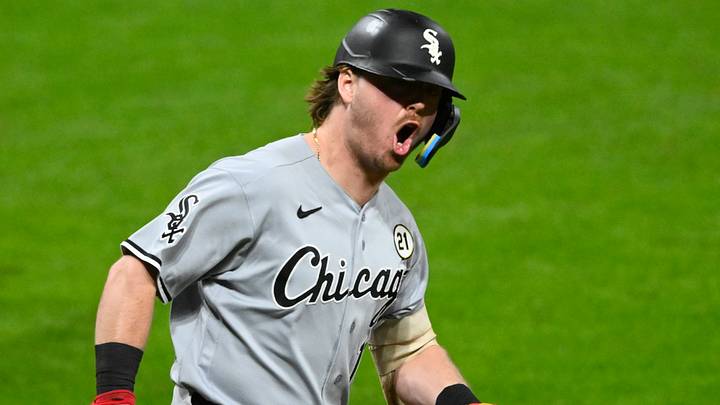
Chicago has fielded teams in the AL and NL for 126 seasons. On Thursday, the Cubs and White Sox clinched playoff spots within minutes of each other. It marks only the fourth time in those 126 seasons the Cubs and Sox made the playoffs in the same year, following 1906 (when the Sox beat the Cubs in the World Series, four games to two), 2008 and 2020.
The Cubs and Sox have never each won a playoff series in the same year. Both teams were one-and-done in ’08 and ’20, combining for a 2–10 record in playoff games.
Chicago fans have rarely had the extra pleasure of watching a postseason series clincher in their great city. The Cubs have played 10 possible clinchers at home, losing seven of them.
The White Sox? Let’s just say nobody on this planet has seen the Sox even host a possible home clincher. The Sox have played only one potential postseason clincher at home: the 8–3 victory over the Cubs in 1906 World Series Game 6. It was a game in which Doc White, who was born in 1879, outpitched Mordecai Brown, who was born in 1876.
The one and only time the White Sox celebrated a home clincher, owner Charlie Comiskey immediately cut a $15,000 check and handed it to manager Fielder Jones to share with the players (on top of their usual series share), then repaired to the Pompeian Room of the Auditorium Annex (later the Congress Hotel), where according to the Tribune “wine flowed like water in the fountain” and Comiskey flashed “a roll of bills big enough to choke a herd of cattle.” Meanwhile, 2,000 delirious Sox fans called upon Jones and Sox players at their homes around the South Side, thanking them, carrying them on their shoulders and calling for speeches from them.
Yep. It was a long time ago.

8. Expanding Pitch Menus
Not too long ago, pitchers such as Seth Lugo and Yu Darvish were outliers because of how many pitches they threw. In today’s pitch-shaping world, it’s not unusual to see Nolan McLean of the Mets, a rookie with a 96-mph four-seamer, moving the ball left, right, up and down with seven pitches. Many pitchers are throwing three fastballs, two breaking pitches and an off-speed pitch as their base package.
This season was the breakout year for throwing the family of three fastballs: four-seamer, sinker and cutter. No one did it better than Cam Schlittler of the Yankees, who threw 89% fastballs at an average velocity of 97 mph.
Making the ball move in three directions (ride, cut and run) at similar velocities has become common. Among the best practitioners along with Schlitter—and among only those who throw the three-fastball family at least 60% of their pitchers—are McLean, Drew Rasmussen and Nick Martinez of the Rays, Payton Tolle and Ranger Suarez of the Red Sox, Troy Melton of the Tigers, Zack Wheeler of the Phillies, Martin Perez of the Braves, Parker Messick of the Guardians, Eduardo Rodriguez of the Diamondbacks and Max Fried of the Yankees.
According to Statcast tracking, the number of pitchers who throw three fastballs has increased 36% in just five years:
Pitchers with Three Fastball Types
Year | Number | Total | Pct. |
|---|---|---|---|
2021 | 105 | 348 | 30.2% |
2022 | 108 | 352 | 30.7% |
2023 | 132 | 361 | 36.6% |
2024 | 140 | 360 | 41.7% |
2025 | 133 | 344 | 38.7% |
2026 | 143 | 330 | 43.4% |
7. A Young Man’s Game
The deepest rookie class in 50 years underscored how the faster pace of baseball (increased velocity, more stolen bases, more range needed without defensive shifts) and the rise of pitching and hitting labs is tilting the game more toward youth than experience.
Ten qualified rookies posted an OPS+ of at least 100, the most since 1977. Meanwhile, players aged 31–35 hit .237—not just well below the .246 average for players 30 and younger but the worst ever for the age group. It’s a trend you can see in the included ages in this next group.

6. Falling Stars
A weirdly high number of star players fell hard this year. Among those who failed to break above a 100 OPS+ were J.T. Realmuto, 35 (67), Marcus Semien, 35 (76), Trea Turner, 33 (80), Austin Riley, 29 (81), Xander Bogaerts, 33 (88), Ozzie Albies, 29 (91), Cal Raleigh, 29 (91), Christian Yelich, 34 (92), Vladimir Guerrero Jr., 27 (92), Matt Chapman, 33 (96), Bo Bichette, 28 (96), Jose Ramirez, 33 (97), Christian Walker, 35 (97), Manny Machado, 33 (98), Willy Adames, 30 (99), Jose Altuve, 36 (100), George Springer, 36 (100) and Kyle Tucker, 29 (100).
5. Small Ball
It was glorious to watch. The two best teams in baseball played a style of baseball that the analytics revolution tried to kill.
MLB Stat Rankings | Rays | Brewers |
|---|---|---|
Bunt Attempts | 1 | 2 |
Bunt Hits | 1 | 2 |
Batting Average | 1 | 3 |
Singles | 1 | 3 |
Sacrifice Hits | 1 | 6 |
SO% | 1 | 17 |
Stolen Bases | 2 | 5 |
Opposite Field% | 2 | 1 |
Groundball% | 7 | 1 |
Runs Per Game | 10 | 2 |
Home Runs | 21 | 28 |
The past six world champions have all ranked in the top four in home runs. The Rays and Brewers are finding another way. They are the best at leveraging rules changes in recent years (no shifts, limits on pickoffs) and the rise of lab-grown pitches (the five full seasons with the fewest balls in play per game all have come in the past seven seasons). You must go back to the 2015 Royals to find a world champion that ranked so low in home runs.

4. The Comeback of the Red Sox
We’ve never seen anything like them. There has never been a team that was that bad for that long that became this good.
Through 78 games, almost half the season, Boston was 32–46. To appreciate what they accomplished by ending up in the postseason, consider this history:
Teams 32–46 or worse after 78 games: 473
Of those 473, teams that finished with 81+ wins: 1 (2026 Red Sox)
Of those 473, teams that made postseason: 1 (2026 Red Sox)
They did it with (at the time) an interim manager (Chad Tracy), without their best pitcher (Garrett Crochet) and best hitter (Roman Anthony) but were powered by a cast of grinders with names like Seigler, Gaspar, Durbin, Monasterio, Sogard and rookie pitchers eating up 69 starts.
3. The Decline of the Judge-Ohtani Era
From 2021–25, Aaron Judge and Shohei Ohtani hit more home runs and piled up more total bases and a higher OPS than every hitter in baseball while winning seven of the 10 available MVP Awards. Neither will win the MVP Award this year. Both staggered to the finish with injuries.
Ohtani, 32, reached the peak of his two-way brilliance—on July 7 he had a .949 OPS and a 1.79 ERA—until elbow, neck and knee ailments rendered him a one-way player with reduced pop at the plate.
Judge, 34, played in only 66 games. He sat for 99 days because of a rib fracture, returned without a minor-league rehabilitation assignment and after only seven games went back on the IL with a calf strain. His slugging (.511) and OPS (.871) were very good for most hitters but were career lows in any season in which Judge played at least 30 games.
2. ABS Is a Big Win
The first season using technology for balls and strikes on a limited challenge basis was a huge success. It added to the strategy of the game, reduced the possibility of umpires’ blown calls deciding a game and created fan engagement, all while adding only about 60 seconds to the average time of game.
It worked to the expectations created by years of minor league trials. Walks went up to their highest full-season level in 15 years and strikeouts remained flat while only 2.3 pitches per game were overturned, or less than one percent. Also as expected, hitters were flipping a coin when challenging (49% success rate) while defensive teams, primarily catchers, were much better (58%).
Presenting the Inaugural ABS Awards (min. 20 challenges):
Best hitter: Gabriel Moreno, Diamondbacks (71% success rate)
Best catcher: J.T. Realmuto, Phillies (74%)
Worst hitter: Ceddanne Rafaela, Red Sox, and Willi Castro, Rockies (25%)
Worst catcher: Endy Rodriguez, Pirates (36%)
Special achievement: Yandy Diaz, Rays: 2,500 pitches seen, 55 erroneous strike calls, 0 challenges

1. The Breakouts of PCA and the Miz
Pete Crow-Armstrong of the Cubs entered the year a career .240 hitter with an OPS+ of 102. Jacob Misiorowski of the Brewers had made 14 career starts with an 11.4% walk rate, much worse than major league average. The two 24-year-olds—born nine days apart in 2002—became the most dominant players in baseball.
Crow-Armstrong, who hit eighth or ninth 38 times in his first 51 games, transformed into a mega pull-side power hitter. He lowered his hands in his stance, added a big leg lick, caught the ball out in front of the plate more and cut his chase rate by a whopping 7.4%. Nobody else in baseball was close to cutting chase swings like PCA. An elite defender in centerfield and a 40–40 player on the edge of 10 WAR, Crow-Armstrong put together an historic season unlike any other.
Misiorowski added 25 pounds of lower body mass and strength over last winter and became a strike-throwing beast. He is the first pitcher in a full season with an ERA less than 2.00 while averaging 13 strikeouts per nine innings. His power was historic. He threw 1,075 pitches that were clocked as high as 100 mph, almost twice as many as any other pitcher in the era of pitch tracking (since 2008; Aroldis Chapman had 572 in 2016). With a 7.6-foot extension and an average fastball velocity of 100.6, Misiorowski rewrote the known physics of baseball. His perceived velocity of 102.9 mph was the fastest ever recorded (min. 250 fastballs). Hitters never had so little time to hit a pitch.
Keep this in mind, too, when it comes to 2026 and things you didn’t see coming. The top three hitters in total bases this year, Crow-Armstrong, Yordan Alvarez and Junior Caminero, were all traded as teenagers. The two presumptive Cy Young Award winners, Misiorowski and Schlitter, were taken in the same draft, 2022, but not before pick Nos. 63 and 220.
 Add us as a preferred source on Google
Tom Verducci is a senior writer for Sports Illustrated who has covered Major League Baseball since 1981. He also serves as an analyst for FOX Sports and the MLB Network; is a New York Times best-selling author; and cohosts The Book of Joe podcast with Joe Maddon. A five-time Emmy Award winner across three categories (studio analyst, reporter, short form writing) and nominated in a fourth (game analyst), he is a three-time National Sportswriter of the Year winner, two-time National Magazine Award finalist, and a Penn State Distinguished Alumnus Award recipient. Verducci is a member of the National Sports Media Hall of Fame, Baseball Writers Association of America (including past New York chapter chairman) and a Baseball Hall of Fame voter since 1993. He also is the only writer to be a game analyst for World Series telecasts. He lives in New Jersey with his wife, with whom he has two children.