
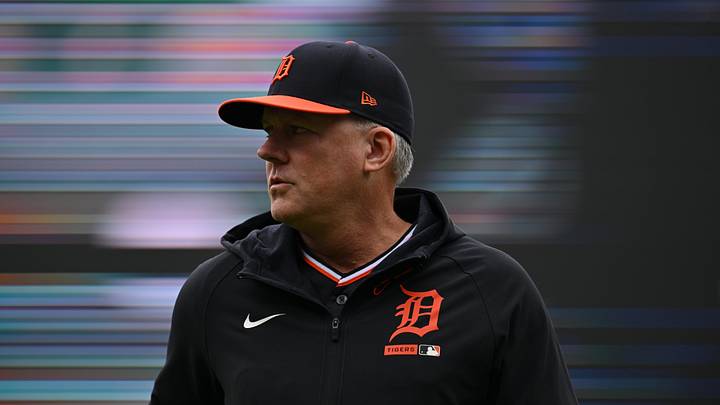
A.J. Hinch Makes Blunt Tigers Admission While Assessing Young Core
In this story:
The Detroit Tigers entered Wednesday with a 66-79 record, sitting fourth in the American League Central and 9.5 games behind the division-leading Chicago White Sox, according to the latest MLB standings. That reality has changed how manager A.J. Hinch must approach the final weeks of the campaign, even if he remains uncomfortable discussing September as an evaluation period.
During an appearance on "Inside the Tigers" with Costa and Jansen with Heather on 97.1 The Ticket, the Tigers manager offered a candid assessment of the standings and several players central to the organization’s future.
"I gotta stop looking," Hinch said. "I don’t like where we’re at. We have a lot of work to do."
Hinch’s first major topic was Detroit’s leading Rookie of the Year candidate. Kevin McGonigle homered in consecutive games against the Minnesota Twins, with his 16th home run accounting for both runs in Tuesday’s 3-2 loss.
When asked whether McGonigle had secured the American League Rookie of the Year Award, Hinch stopped short of declaring the race over but left no doubt about his choice.
"I hope so," Hinch said. "I don’t see a rookie season that’s better than Kevin."
The Tigers rookie remained the clear favorite in MLB.com’s September Rookie of the Year poll. Hinch acknowledged Cleveland Guardians left-hander Parker Messick and other contenders but called McGonigle a "staple" of the organization’s future and praised his ability to remain productive while moving around the infield.
Spencer Torkelson’s Reduced Role Raises Bigger Infield Questions

Detroit’s commitment to evaluating younger players has directly affected Spencer Torkelson, whose playing time has decreased. The radio hosts referenced Torkelson’s recent admission that the situation "totally sucks," though he understood the reasoning behind it, as reported by Detroit News reporter Chris McCosky.
Hinch said the decision reflected how the club was distributing opportunities during the final month. He praised Torkelson for responding professionally and stressed that the former No. 1 overall pick had not been removed from the organization’s plans.
"It doesn’t mean he’s out of it moving forward," Hinch said. "But it is going to change his thoughts on September."
The Tigers manager noted that Torkelson had received a long opportunity to play first base regularly, including when teammates were given days off. Torkelson’s power continued to surface intermittently, including a two-run home run in Detroit’s 12-inning victory over Minnesota on Sept. 2, but the organization also needed to create opportunities for Colt Keith and its growing collection of young infielders.
Detroit’s infield arrangement remained complicated because McGonigle, Keith and Hao-Yu Lee could handle multiple positions. Gleyber Torres had provided stability at second base, while McGonigle could potentially settle at third. That alignment, however, would make it more difficult for Lee to receive regular playing time.
"If Kevin McGonigle is at third and Gleyber Torres is at second, the way that the team was designed to start the year, what do you do with Hao-Yu Lee?" Hinch said. "Where does he get his reps?"

The Tigers also had John Peck and a potentially healthy Javier Báez as shortstop options. Hinch acknowledged that players could benefit from permanent defensive homes, but he believed versatility allowed the club to carry more useful players and build a deeper 26-man roster.
Keith’s usage against left-handed pitchers presented another debate. Hinch conceded that he wished Keith had received more opportunities against lefties. He characterized the platoon decisions as strategic choices based on the strength of Detroit’s right-handed alternatives and the placement of McGonigle and Riley Greene in the batting order.
Jackson Jobe’s Command Remains Central to Tigers’ Pitching Future

The Tigers’ evaluation extended to the rotation, where Jackson Jobe returned from Tommy John surgery and made six starts after his Aug. 7 activation. Jobe produced a 1-2 record, 4.45 ERA, 26 strikeouts, and 12 walks over 28 1/3 innings during that stretch.
Hinch believed Jobe possessed the repertoire and approach needed to challenge Major League hitters. His next step was to consistently command the strike zone and land his secondary pitches, particularly early in games.
"He’s got to be more dynamic, but he’s really got to pound the strike zone," Hinch said.
Detroit’s manager cautioned against viewing Jobe’s upper-90s fastball as a complete formula for success. Velocity had become common throughout the Majors, and a poorly located fastball could still be punished regardless of what appeared on the radar gun. Hinch wanted Jobe to pair that velocity with a dependable slider, curveball and changeup.
The Tigers still saw reasons for optimism elsewhere in the rotation. Hinch said Troy Melton needed to learn how to make better pitches as he worked deeper into starts, while Framber Valdez remained capable of dominating when his command and complete repertoire were working. Valdez provided a recent example by throwing seven scoreless innings in a 6-0 victory over the Guardians.
Those pieces helped explain why Hinch continued to see the foundation of a competitive club. He also refused to pretend the current record reflected anything other than months of inconsistent baseball.
"We have not played well enough to merit a good team’s record," Hinch said. "We’ve got to get back to those characteristics for us to get in the right direction."
Hinch ended the interview with a promise that sounded less like a prediction for the remaining games and more like a challenge for the entire organization.
"We’re going to be better," Hinch said. "We’re going to keep working. We’ve got a lot of work to do."
 Add us as a preferred source on Google
Alvin Garcia is a Puerto Rico-born sportswriter and U.S. Army veteran. He has covered Major League Baseball since 2022, producing breaking news, game coverage, analysis, roster stories and player features for national and team-focused publications. His previous work has appeared at Heavy, The Sporting News, Athlon Sports, Yardbarker, and FanSided. Garcia brings a data-informed, fan-focused approach to his coverage.