
Andrew Sears Exposes Challenge That Could Define Development With Tigers
In this story:
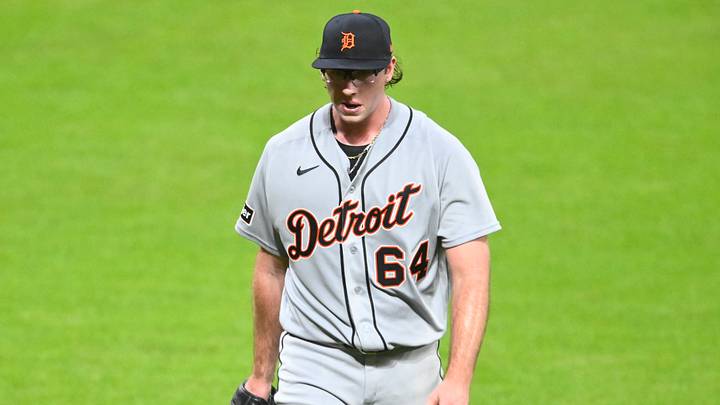
The nightmare began after two outs. Andrew Sears walked Munetaka Murakami, and then Gleyber Torres committed a fielding error that helped Chase Meidroth reach first safely to load the bases. Sears could not get out of the inning getting the third out. He threw a wild pitch that opened the doors of home plate for Tommy Pham. Kyle Teel was hit.
Another fielding error, this time by third baseman Hao Yu-Lee, led to the second run of the inning. Two chances to end the inning and the defense threw them away. Sears tried to recover, but Colson Montgomery crushed his fastball on a 2-2 count to produce a double to right field that cleared the bases.
Sears really was out of the game from the first error that complicated the inning, and he threw four consecutive balls to Tristan Petters, to extend his fateful inning to 37 pitches.
The Detroit Tigers decided that was the end, but the White Sox offensive party continued, as Miguel Vargas hit a double to left field that produced one more run against right-handed reliever Beau Brieske. The inning ended because on that same play, Petters was put out at home plate.
However, the damage was already done. Chicago scored six runs and took an early 6-1 lead. Sears finished allowing six runs, all were unearned, with three walks and only one hit allowed, Montgomery’s bases-clearing double. It is true that the errors complicated the inning, but before the game, Sears had allowed the second-highest OPS (.860) of the entire pitching staff this season after two outs, per Baseball Savant.
Those results leave us an interesting clue about how Sears is facing pressure situations in the first experience of his career in MLB. His ERA is 5.19, but there are several signs that his pitches have the potential to dominate. Opponents are hitting below .250 against each of his pitches, and he came into Friday’s start with a 27.4 whiffs% rate, a rate above the league average of 25.0%.
Beyond Sears’ agonizing first inning

One of Sears’ most important signs is in the quality of contact he allows. His opponents have recorded 27.8% Hard-Hit, just 5.6% Barrel and an average exit velocity of 89.4 mph. Although he is allowing more fly balls than ground balls, hitters are not finding maximum-quality contact frequently. In addition to this, there is an important difference between his pitches.

The changeup, used only 14% of the time, generated 57.9% of whiffs and 55.6% of PutAway, with .165 of xBA. It is still not a weapon in which Sears has total confidence, but the fact that he is getting good results can change his approach.
And I think that is one of the most interesting points of what we have seen from Sears so far. He has pitches capable of generating swings and misses and is limiting hard contact. What he needs is to improve his location to make his potential able to turn those tools into outs consistently.
All statistics were verified using Statcast from Baseball Savant.
 Add us as a preferred source on Google
Yirsandy is a baseball writer specializing in MLB coverage with experience across multiple teams and storylines. He currently writes for Diamond Centric, where he covers the New York Mets, San Diego Padres, Chicago Cubs, Milwaukee Brewers, and Kansas City Royals. My work focuses on game coverage, player analysis, and storytelling that connects performance with context. My Substack has also been an important part of my writing development, where I’ve built much of my baseball coverage and storytelling voice over time. I’m passionate about combining reporting, research, and thoughtful analysis to produce engaging baseball content for readers.
Follow Yirsandy