%20%20--%3E%0A%3Csvg%20version%3D%221.1%22%20id%3D%22Layer_1%22%20xmlns%3D%22http%3A%2F%2Fwww.w3.org%2F2000%2Fsvg%22%20xmlns%3Axlink%3D%22http%3A%2F%2Fwww.w3.org%2F1999%2Fxlink%22%20x%3D%220px%22%20y%3D%220px%22%0A%09%20width%3D%2239px%22%20height%3D%2240px%22%20viewBox%3D%220%200%2039%2040%22%20enable-background%3D%22new%200%200%2039%2040%22%20xml%3Aspace%3D%22preserve%22%3E%0A%3Cpath%20fill%3D%22%23FFFFFF%22%20d%3D%22M38.5%2C7H28.2v26h10.3V7z%22%2F%3E%0A%3Cpath%20fill-rule%3D%22evenodd%22%20clip-rule%3D%22evenodd%22%20fill%3D%22%23FFFFFF%22%20d%3D%22M26.1%2C25.5c0%2C5.8-4.1%2C7.5-12.9%2C7.5C3.9%2C33%2C0%2C31.2%2C0%2C25.2v-1.1h11.6%0A%09v2.4c0%2C0.7%2C0.1%2C1.4%2C1.2%2C1.4c1%2C0%2C1.2-0.4%2C1.2-1.3v-0.9c0-1.6-0.9-1.6-3.5-2.2C2.2%2C21.7%2C0%2C19.7%2C0%2C15.3v-0.9C0%2C9.3%2C5.5%2C7%2C12.9%2C7%0A%09c10.2%2C0%2C12.8%2C2.6%2C12.8%2C7.4v1.8h-11v-2.9c0-0.6-0.4-1.1-1.2-1.1c-0.6%2C0-1.2%2C0.4-1.2%2C1.1v0.9c0%2C1.5%2C0.9%2C2%2C3.3%2C2.5%0A%09c8%2C1.6%2C10.5%2C3.3%2C10.5%2C7.5V25.5z%22%2F%3E%0A%3C%2Fsvg%3E%0A)
NBPA Director David Kelly Q&A: Kawhi Leonard, Second Apron Woes and a Possible Work Stoppage
In this story:
David Kelly swears: He’s not spoiling for a fight.
“Not at all,” Kelly said last month, peering through a Zoom call. Last February, Kelly, a former Warriors executive, was appointed the new executive director of the NBA Players Association. Since assuming the post, Kelly has declared war on the second apron, defended Kawhi Leonard through the Clippers cap circumvention scandal and grumbled about players not getting cut in on NBA Europe. “We actually think that the league is in a very good place,” says Kelly. But? “We're not afraid to take on a fight,” he says. “And we definitely are ready to take on a fight on things that we feel very principled about.”
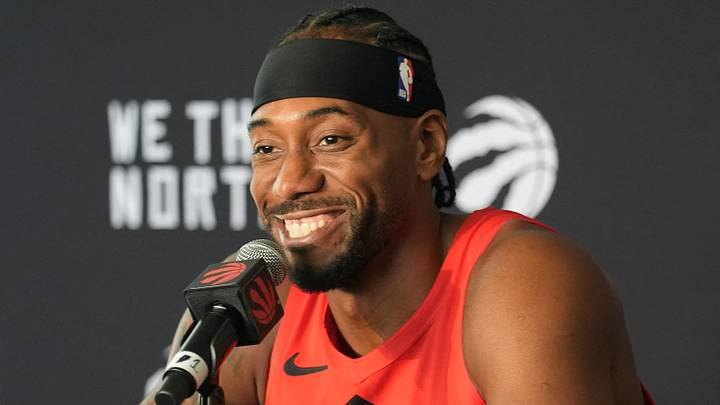
Sports Illustrated: Let’s start with Kawhi Leonard. You signed off on the NBA’s punishment, a $700,000 fine. Why did you O.K. that?
David Kelly: I mean, quite frankly, we looked at the evidence that they had pulled together in the report and what we saw was not sort of a typical behavior by a team, definitely not what I had seen in my years at the Warriors, and so I think it warranted the fine, the “aggressive fine” and stance that the league was taking. I think it was justified and warranted. As it relates to Kawhi, there clearly were some improper benefits that he had received from the Clippers, and so once that came to his attention, he was comfortable with repaying that and moving on.
SI: Back in July, you were quoted as saying that you don't believe there's a "there there" with the investigation. What changed?
DK: At that point in time, I looked at the sponsorship agreements that Kawhi had entered into, and there's been a lot made about how these were no-show agreements, or there weren't requirements. Typically, when drafting a sponsorship agreement, even for a company, you will not draft an agreement such that your client is in breach for failing to do X, Y, or Z, because the company might change its marketing plans, or its desires, or may never ask you to do X, Y, or Z. So, it's always drafted at the request of the sponsor, the team or the player or whoever is your client will do A, B, C. And so, looking at the agreements, I'm like, This is standard.
Then, when you look at the way the agreements came together, and the NBA did its investigation, provided me with the results of it in August, and it was like, oh, O.K. So, these terms put together before were suggested by the team, and then when you have five different sponsors where yes, it's drafted in the same way, but you look at how the sponsors didn't require any sort of performance, well, then you know what was happening. And so that changed from July to August.
SI: Were you comfortable with the severity of the punishment the NBA leveled on the Clippers?
DK: Yes, and actually that is something that we and the NBA had to all agree on. I was comfortable looking at the behavior and the actions that took place that they were able to validate from notes and what have you. I think it warranted a strong stance from the league, and so I was comfortable with the penalty.
SI: It’s hard for people to believe Kawhi didn’t know what was going on. In 2019, the NBA literally warned everyone about these kinds of side deals. Do you really believe he was unaware?
DK: I wouldn't say unaware of what was going on around him, but do I believe that Kawhi was involved in the negotiation or the pre-negotiation of sponsorship deals? No. I don't think that even the most involved player is going to be involved inside of the pre-negotiation or the nitty-gritty negotiation of the sponsorship agreement. Even as a lawyer looking at that sponsorship agreement, I was like, this is a pretty standard sponsorship agreement. And so, you would really have to have known how the negotiation came together to know that this was salary cap circumvention. But looking at the agreement itself, there was no reason to think that there was an issue there.
SI: He got an awful lot of money to do nothing …
DK: Well, the ‘do nothing’ happened later. If I sign up to do 10 different things with Aspiration, and then Aspiration goes out of business, well, two things happen. I didn't have to perform; I also didn't get all my money. And if I do the same thing with Daktronics, and then I'm not asked to perform, it's typically, I don't know how you operate, but typically you're not calling up the person who's able to ask you to do X, Y, or Z and say, "Hey, when do you need me to do X, Y, or Z?" That's typically not how it works just in life.
SI: Is there a lesson to be learned from this? Something you will emphasize to the players moving forward?
DK: I think it's to have greater awareness. And some of it is what Kawhi said, I think, inside of his statement, just making sure that you are taking responsibility for the actions of your advisors because your reputation is going to take a hit even if you did nothing wrong. It's making sure that you have agents that you trust, business managers that you trust, to the extent that we as the union can be a resource, and vetting, and what have you, please reach out. But just understanding that you got to take control of your career no matter who you are, superstar, rookie, whatever.
SI: O.K., moving on. This is your first full season on the job. What is at the top of your agenda?
DK: There are four different things that we're really focused on. Organizational priorities as the PA. The first is to enforce the current CBA and get prepared for the negotiation of the next CBA. That's paramount. That's the reason we exist as the PA is to get a better CBA going forward than the one that we got last time.
The second thing is to make sure that we're providing better services for the players. And that can be second opinions, helping vet agents, business managers, and what have you, informing them of roles, being a resource as it relates to what their market looks like as they're coming up for free agency, just providing those sort of services for the guys.
The third thing is helping to generate more revenue. We have a for-profit entity called Players United that we launched a couple months ago, as a consumer-facing brand, and so making sure that brand is able to do better revenue in the areas of merchandise, content, and experiences.
- NBA Championship Power Rankings: Where Does Your Favorite Team Stack Up?
And then, the fourth thing is more of an internal thing that we're focused on, and that is making sure that we are promoting and hiring the best and brightest, and that we have a culture that allows great ideas to come forward so that we can do the first three things that I mentioned. So, those are our focuses. And then, under each one of those, there are various different things that you have to do in order to deliver services, in order to build a brand, and in order to get ready for the next CBA.
SI: You said a few things there. On the next CBA, what does a “better” CBA look like to you?
DK: We have made no bones about the fact that although we definitely were part of the negotiation in agreeing to the second apron, we're not fans of the second apron, and we think that it's having consequences that definitely go far beyond what we anticipated.
The league may say that these were not unintended consequences. Either way, there are consequences that we think hurt fans, hurt the teams, hurt the players, and therefore hurts the overall game. And so, we have a perspective representing our players, the league has a perspective representing the owners, but overall we need to create a system that creates a better game. And it increases fan interest, and that allows fans to be fans of a player and grow with that player, and that player stay with the team. That helps the team; that helps everybody.
If we have a system in place that forces teams to make trades that are based on business decisions and not basketball decisions, then we think that provision has gone too far. So, whether that is eliminating the second apron or softening the second apron any number of ways, we definitely think that something needs to be done.
SI: Let me offer the NBA’s position. Eight new champions. Unprecedented parity. Aren’t those good things?
DK: I wouldn't counter it. Love the parity, eight new champions is a fact, it's also a fact that the second apron's only been in existence for three of those eight years. And so, you had five years of parity and new champions under the prior system, and so what's wrong with that? And so, I wouldn't even counter that. I think it's yes, but it's not due to the second apron.
SI: How has the game suffered? Beyond player movement increasing, that is.
DK: Well, I think that's how. You already had the parity that you wanted as the league under the prior system, but you had teams that were able to keep their teams together. You were able to have the Warriors running out and seeing how far they could take that dynasty. They didn't have to make a decision based on dollars and cents, they made decisions based on basketball, and you make right decisions and you make wrong decisions. The parity exists because you have so many excellent players inside of the NBA right now and they all are competing.
You don't need an artificial requirement that breaks up teams. We would look at some of the golden years of the NBA, whether it's the Bulls with Jordan, whether it's the Celtics, and we wouldn't look at those teams and say, man, we got to get [Toni] Kukoc out of there." How dare they have Manu Ginóbili, Tony Parker and Tim Duncan on the same team, we got to break that team up. We would not look at it that way, we don't think fans look at it that way, and we don't know why the NBA looks at it that way.
SI: Do you think the Warriors dynasty was good for the NBA?
DK: Yes. The one thing that I would say, and at the time I would never have said this, but in retrospect, the way that we were able to get Kevin Durant was because of a spike in the cap. Should we have had to trade an additional player in order to get KD? Sure. If not for the spike in the cap, that's what we would've had to do. We wouldn't have been able to have the entire core roster that we had and add KD. The only reason that happened was not because of flaws inside of the system, it was because of a spike inside of the cap.
And so, if there was smoothing of the cap, then we wouldn't have been able to create the true juggernaut that had the sauce and KD. I still wouldn't say that was bad for the league because fan interest was at an all-time high, but it was pretty much a superteam.
I'm not arguing that we should or shouldn’t have those sorts of superteams. What I'm saying is that the reason that team existed was because of a spike in the cap, not because of a flaw inside of the CBA.
SI: You would like to see the second apron go. Adam Silver seems to love the second apron. Is there a middle ground in your mind that works for you and what you think would work for the NBA?
DK: I'm sure there will be. I think the point is not us sticking to our position, that it must go, and them sticking to their position, it must stay. It's, can we reasonably agree to certain harms that the current system is inflicting on teams and on fans? If we can agree to that, then how do we create a system that addresses those? We would say that it has to go, they're going to push back, but is there smoothing? Are there certain exceptions that you can have? Are there other things that you can do with respect to the second apron? Can you reduce the penalties? It's also the repeater tax issue. Have we gone too far? To me, that's the biggest question. If we can agree or have some kind of respect between our arguments on that, then we can come to something to pull it back a little bit.
SI: Do you think there should be exceptions for organic growth? Carve-outs for homegrown talent?
DK: 100%. I take it back to the KD example. So, the Warriors should have been able to keep Steph [Curry], Klay [Thompson], Draymond [Green]. They drafted Steph, Klay, Draymond. That's good for every team inside of the league that you can retain your drafted players. That's good for OKC, it's good for small market teams. And so, if you're building the team, and you have created a good scouting department, and you have a culture the players want to stay, you have a great coach, and you've had success, and the fans love you, and you've built this, and built a whole new arena based upon it, why shouldn't you be able to keep that together?
Any sort of system that requires you to break that up we think is bad for the league. Should you also then be able to add a MVP to that mix? Maybe not. And so, if the system, and again, I would say that it happened because of the spike inside of the cap, but a system that allows that probably goes too far inside of the other direction.
SI: Listening to you, it sounds like this could shape up to be a battle. How far are you willing to go to get the kind of agreement you want?
DK: As far as necessary. I mean, I think that this is an important issue to the players. And I actually think it's important to the game, it's important to the fans, it's important to teams. And when I say teams, I mean the GM, the coach, the ticket sellers. Everybody benefits from having a system that allows us to grow the game. It's not just, well, this is bad for the players and so therefore we're going to hold out and do whatever we have to do. No, we think that this is bad for the game, and when we see that sort of an issue, and if the other side doesn't respect it that way, then we'll do what we have to do in order to protect the players and protect the game itself.
SI: Could that mean a work stoppage?
DK: It could. Don’t hope to have one, but have to be prepared.
SI: Are you preparing your players for one?
DK: 100%. We've had conversations and there's some steps that we're taking to make sure that we're prepared.
SI: Few more. Is an 82-game season too long?
DK: I think it's just right. Quite frankly, it doesn't matter what I think, I think our players think that it's just right. We haven't had our membership clamoring to reduce the number of games or increase the number of games. So, we haven't seen that as an issue coming from our membership.
SI: Expansion seems inevitable. Are you in favor of it?
DK: I think if we're expanding to a market that, again, grows the game and grows the footprint, and is a true basketball city like that, then we're for it. However, currently, players do not participate in the expansion fees. And so, when we think about expansion, it's not just, "Yes, expansion's great. Oh, we love that market. It's more jobs." Yes, yes, yes. At the same time, there are expansion fees that are going to be paid to owners that are outside of basketball-related income, and so therefore the players don't share in that, and we think that they should.
SI: Will that be a meaningful part of the CBA talks?
DK: Yes.
SI: Jaylen Brown said recently that he believes players should be allowed to invest in ownership groups. Do you agree?
DK: I think that they should, but there's some nuance to it. The league legitimately has concerns on players having a direct interest in a single team. If you're Player X and you play for the Boston Celtics, and then you have an interest in the Phoenix Suns, and the two teams are playing each other, there could be questions on integrity and what have you. So I think that there's ways to make sure that players have equity, whether it's phantom equity or whatever it may be across the league, across the 30 teams, something like that we think makes sense.
Our mantra is that the players should be able to participate in the revenue that they generate. And if you look at any other business, the most important employee—whether it's a tech company and your engineers are the most important people—they get stock, they have equity.
None of this happens without the players. And so creative minds should be able to figure out a way for them to participate in the upside that they generate. We think that that's good for the players obviously, and ultimately it's good for the game because if you have a vested interest in the entity, it would follow that you're just that much more invested in it. And so, we don't see any sort of downside for the players to have equity across the teams.
SI: Luka Dončić told me that he wanted to own part of a team in NBA Europe …
DK: He should, for a couple of reasons. Number one, we think that players should be able to invest alongside ownership groups in things that they help to drive value. Separately, if you look at the impact that someone like Luka Dončić could have for the growth of NBA Europe itself, we think it's shortsighted for them to say, "No, because you're a player, you can't participate."
You're trying to build this league on the backs of the players, so the first issue we would have is that collectively all the players should be able to benefit from the revenue that's derived from NBA Europe. In addition, a player such as Luka who has the profile that he has, who will be such a great ambassador for NBA Europe itself, we think it's very shortsighted that they would not include him.
SI: Phantom equity. That’s a term I had not heard before this year.
DK: I didn't know what it was until I tried to get it at one of my jobs.
SI: And?
DK: Didn't get it.
PODCAST 🎧: Listen to SI’s NBA podcast, Open Floor, below or on Apple and Spotify. Watch the show on SI’s YouTube channel.
 Add us as a preferred source on Google
Chris Mannix is a senior writer at Sports Illustrated covering the NBA and boxing beats. He joined the SI staff in 2003 following his graduation from Boston College. Mannix is the host of SI’s “Open Floor” podcast and serves as a ringside analyst and reporter for DAZN Boxing. He is also a frequent contributor to NBC Sports Boston as an NBA analyst. A nominee for National Sportswriter of the Year in 2022, Mannix has won writing awards from the Boxing Writers Association of America and the Pro Basketball Writers Association, and is a longtime member of both organizations.
Follow sichrismannix