%20%20--%3E%0A%3Csvg%20version%3D%221.1%22%20id%3D%22Layer_1%22%20xmlns%3D%22http%3A%2F%2Fwww.w3.org%2F2000%2Fsvg%22%20xmlns%3Axlink%3D%22http%3A%2F%2Fwww.w3.org%2F1999%2Fxlink%22%20x%3D%220px%22%20y%3D%220px%22%0A%09%20width%3D%2239px%22%20height%3D%2240px%22%20viewBox%3D%220%200%2039%2040%22%20enable-background%3D%22new%200%200%2039%2040%22%20xml%3Aspace%3D%22preserve%22%3E%0A%3Cpath%20fill%3D%22%23FFFFFF%22%20d%3D%22M38.5%2C7H28.2v26h10.3V7z%22%2F%3E%0A%3Cpath%20fill-rule%3D%22evenodd%22%20clip-rule%3D%22evenodd%22%20fill%3D%22%23FFFFFF%22%20d%3D%22M26.1%2C25.5c0%2C5.8-4.1%2C7.5-12.9%2C7.5C3.9%2C33%2C0%2C31.2%2C0%2C25.2v-1.1h11.6%0A%09v2.4c0%2C0.7%2C0.1%2C1.4%2C1.2%2C1.4c1%2C0%2C1.2-0.4%2C1.2-1.3v-0.9c0-1.6-0.9-1.6-3.5-2.2C2.2%2C21.7%2C0%2C19.7%2C0%2C15.3v-0.9C0%2C9.3%2C5.5%2C7%2C12.9%2C7%0A%09c10.2%2C0%2C12.8%2C2.6%2C12.8%2C7.4v1.8h-11v-2.9c0-0.6-0.4-1.1-1.2-1.1c-0.6%2C0-1.2%2C0.4-1.2%2C1.1v0.9c0%2C1.5%2C0.9%2C2%2C3.3%2C2.5%0A%09c8%2C1.6%2C10.5%2C3.3%2C10.5%2C7.5V25.5z%22%2F%3E%0A%3C%2Fsvg%3E%0A)
NBA Finals Loss Exposed Three Ways Victor Wembanyama Must Improve to Make Another Leap
In this story:
Victor Wembanyama’s first NBA playoff run is officially over—and what a remarkable ride it was.
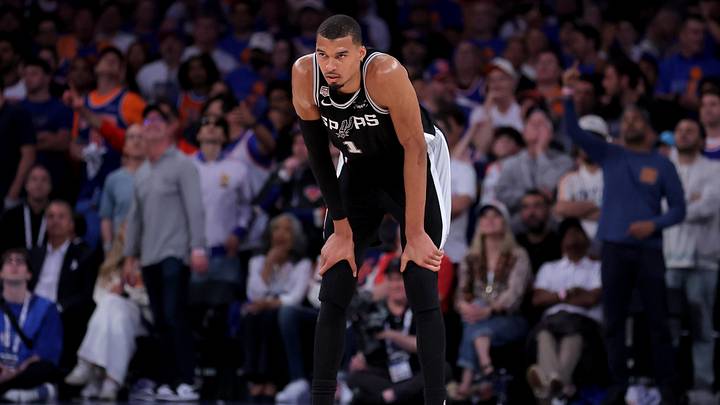
Despite ending in heartbreak, the Spurs’ superstar stepped up in just about every way imaginable for his team as he experienced the ups and downs of postseason basketball for the very first time. With all said and done, Wembanyama averaged 23.8 points, 10.9 rebounds and 3.5 blocks across 22 playoff games; he missed roughly three games due to a concussion and an ejection for elbowing Naz Reid. He shot 48.5% from the field and 34.2% from three. San Antonio outscored opponents by 8.9 points during his 34.1 minutes on the floor per game. And, most importantly, he notched three playoff series wins (including a seven-game heavyweight bout with the defending champion Thunder) before finally falling short in the NBA Finals against the Knicks.
That’s a resounding success for a 22-year-old star making his postseason debut. Playoff success is not easy. It took Michael Jordan three NBA seasons before he got past the first round. LeBron James didn’t make his first Finals run until his fourth year. Wembanyama is undeniably ahead of the curve in leading his team to the final round of the playoffs in his first go-around.
But the lasting impression of the 2026 playoffs, for Wemby and everybody else, will be his failure on the biggest stage. As great as the 7’4” star is right now, he is not yet a finished product as a player and we saw proof time and time again throughout the Spurs’ five-game Finals loss to the Knicks.
As narrow as every San Antonio defeat was, they all exposed the biggest flaws in Wembanyama’s game—flaws he must address in order to take another leap and become the kind of overwhelmingly dominant star who can win a ring.
Here are the three areas the Finals revealed Wemby must improve in to reach the next level of superstardom.
Develop a go-to move on offense

This was not necessarily something we learned from the Finals only, but it was never more obvious than when the Spurs played the Knicks: Wembanyama’s lack of a go-to move offensively is his only Achilles heel right now. He’s so ridiculously long, tall and talented that scoring isn’t an issue over the course of 48 minutes. But in the final seconds when the score is tight? NBA players need a move for that moment. A habitual shot they’ve made a million times. Because those are usually the only shots they can get a clean look off when the opposing defender is completely locked in, and the refs aren’t going to call a foul unless it’s extremely blatant.
Wembanyama doesn’t have that move. He can shoot from anywhere on the court, sure, and his dunk range is further than any of his peers. But he struggles to create his own shot, which makes his life difficult in crunch time. That specific problem gummed up the Spurs’ offense in the clutch of all five games Finals games. They kept putting the ball in De’Aaron Fox’s hands because Wembanyama is currently most effective when the table gets set by a teammate. When he couldn’t spring free because the Knicks were all over him, Fox had to make something happen (and usually failed).
The end of Game 2 might’ve gone differently if San Antonio trusted Wembanyama to get to his spot against Mitchell Robinson, but instead Mitch Johnson drew up a pick-and-pop that left the superstar center with no choice but to take a difficult deep two.
WEMBY'S GAME-WINNER ATTEMPT WON'T GO
— Underdog NBA (@UnderdogNBA) June 6, 2026
KNICKS TAKE A 2-0 LEADpic.twitter.com/vC5emF28NF
Wembanyama is good enough to make any shot. But to execute against a playoff defense in the final seconds of a big game, he needs a go-to move, one that he can make in his sleep—whether that’s a sky hook, a floater or some other way to utilize his absurd combination of length and touch. It’ll ensure his dominance won’t fade in close games and make his life significantly easier in the long run.
Work on finishing strong
The other issue that plagued the Spurs during the NBA Finals? Wembanyama running out of gas in the fourth quarter.
Endurance is a challenge every young star is forced to face in their first playoff runs, and it seemed a particularly fierce one for Wemby. He hadn’t played star-level minutes for an extended stretch at any point in his career, even during this past regular season (his best yet in the NBA); the superstar center averaged fewer than 30 minutes per game in 2025–26. He was outrageously effective anyway, but in the playoffs the margins are so thin teams have no choice but to heavily rely on their stars.
Thus, Wembanyama averaged 34.1 minutes per night during the postseason. In the Finals that number jumped to 39.8 minutes per night. It was unlike anything the San Antonio star had experienced to this point—and that showed. He was absolutely exhausted by the fourth quarter of every game, which should be remembered as a significant factor in how the Spurs blew their leads down the stretch of every game. Wemby didn’t have the energy to react quite as quickly defensively and often resorted to lazy jumpers on offense because he was too wiped to drive to the rim against a physical New York defense.
In the fourth quarter of all Finals games this year, Wembanyama shot 34.5%. In the last two games, when the exhaustion really seemed to set in for the 22-year-old, he went 3-for-14 in the final frame. There’s some shooting luck involved but anyone with eyes could see he was wiped.
Experience is the best teacher for this sort of thing. Wembanyama surely understood he needed to be in tip-top shape entering the playoffs and has undoubtedly gotten tired late in close games countless times. But now he knows for sure what is required to dig deep and step up in the final moments of an NBA Finals game. And he knows for sure the consequences of failing to do so.
Learn to toe the line of physicality, don’t cross it

There were questions heading into the postseason about how Wembanyama’s slim frame would hold up against playoff-level physicality, as well as how the player himself might respond to 40 minutes of getting hammered by opposing players every other night. He definitely answered those questions.
Wembanyama rose to match that physicality and then some. He committed two flagrant fouls and got ejected for one of them. There were numerous examples of questionable off-ball plays that could have been called fouls or even flagrant fouls if the officials had seen it. Nobody can call Wembanyama soft after this playoff run; he embraced the greater latitude granted by the referees to, literally, throw his weight around in the postseason against his opponents.
But Wembanyama crossed the line, obviously. He finished the postseason with three flagrant points. One more and he would have gotten suspended. As the Spurs’ best player he absolutely must prioritize being available in the postseason over the instinctual desire to punch back (figuratively speaking) when he gets clobbered play after play. We’re not going to sit here and say that’s an easy thing to do—but it’s a critical lesson for Wemby to learn.
Imagine if the Spurs won Game 5 and the NBA upgraded the missed Jalen Brunson landing space foul to a flagrant for his fourth point to trigger a suspension? It would have been a catastrophe. Of course it didn’t happen but the fact that Wembanyama allowed the possibility to even exist is unacceptable if the goal is to win a championship. It’s not a problem he has in the regular season, but for next playoffs Wemby has to find the line of physicality and toe it, rather than cross it.
More NBA Finals from Sports Illustrated
Listen to SI’s NBA podcast, Open Floor, below or on Apple and Spotify. Watch the show on SI’s YouTube channel.
 Add us as a preferred source on Google
Liam McKeone is a senior news writer for the NBA team at Sports Illustrated. He has been in the industry covering the NBA and other sports as a content creator starting in 2017. Prior to joining SI, McKeone worked for NBC Sports Boston and The Big Lead. In addition to his work as a writer, he has hosted the Press Pass Podcast covering sports media and The Big Stream covering pop culture. A graduate of Fordham University, he is always up for a good debate and enjoys loudly arguing about sports, rap music, books and video games. McKeone has been a member of the National Sports Media Association since 2020.
Follow liam_mckeone