
Deni Avdija Has Ascended and Is Taking the Blazers With Him
In this story:
The scene inside Moda Center during the final seconds of the Portland Trail Blazers’ NBA Cup matchup against the San Antonio Spurs was one of full euphoria.
Stephon Castle had just missed a desperate 3-point heave, trying to cut the deficit to one. Deni Avdija soared above Julian Champagnie and Keldon Johnson for the rebound, fouled with less than three seconds left on the clock.
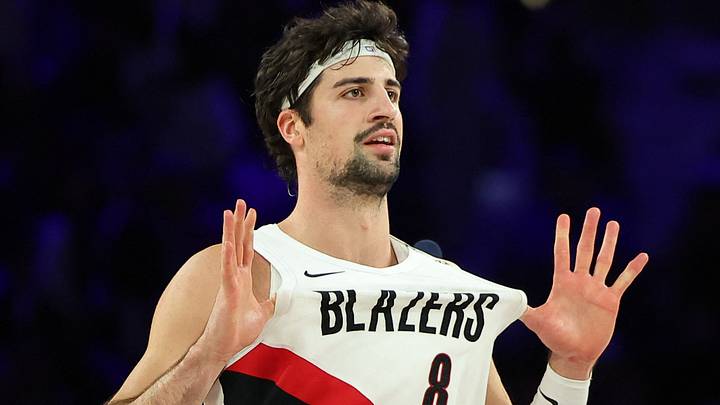
As he approached the free throw line and the applause grew throughout the arena, Avdija lifted his right arm and curled two fingers, beckoning the crowd. An “MVP!” chant accompanied the one-time NBA All-Star on his free throw attempts.
Avdija’s 33-point, 12-rebound and seven-assist performance kept Portland’s NBA Cup hopes alive. Two days later he had 26 points to lift the Blazers over the Golden State Warriors, securing Portland the Western Conference's No. 2-seed in the eight-team knockout bracket.
Sitting with a 13-6 overall record at the time I’m writing this, Portland, like last year, has so far exceeded expectations, only this time it hasn’t come as a mid-to-late-season push, clawing to finish above .500.
No, this is certainly different. A team many doubted has begun to morph into something almost nobody would've earnestly predicted during the summer — a contender.
And I mean a real contender. Not the big-market kind that talking heads sorely attempt to convince you can make a run if everything breaks their way. But the type that has the cream of the league just a little apprehensive about facing in a seven-game series.
If Portland’s kismet isn’t to be a contender, it is surely to be, at the very least, a disruptor — and it’s all because of Avdija.
Efficiency jump

At only 25 years old and coming off the best season in his career, Avdija is undergoing a tectonic career shift. He’s ascending into the illustrious All-NBA stratosphere, a layer containing bonafide and burgeoning superstars (something a certain someone predicted possible before the season).
Per the Trail Blazers PR, Avdija is one of six players in the NBA with 400+ points, 100+ rebounds and 100+ assists so far this season, and is the only of the six to reach those numbers while shooting above 50 percent from the field and 40 percent from the arc.
On the season, he’s averaging 24.9 points, 6.6 rebounds and 6.2 assists in 32.9 minutes per game. Those numbers are very similar to last year’s campaign, when he achieved a stat line that only he, Luka Doncic, and Nikola Jokic reached — or, in the latter two’s case, surpassed.
There is one major difference, however: his efficiency, particularly from three. Per Cleaning The Glass, which excludes garbage time and end of quarter possessions, Avdija is shooting 41 percent on all 3-point attempts and 40 percent on non-corner threes (an incredible leap from his dreadful 31.8 percent clip from last year). Those rates place him in the 83rd and 80th percentile, respectively, in relation to his position.
It helps that even more of his 3-point makes are assisted on this year. Of course, it also doesn't hurt that he's now sharing the floor with Damian Lillard.
Before, an opposing team could essentially focus most of its efforts on Avdija. He, obviously, had the ball a lot last year (this year his usage rate is still rather high, in the 96th percentile of forwards) but now teams have to account for one of the best shooters of all time.
This creates more space, and thus more opportunities. With Lillard 11th in on-ball perimeter gravity and third in off-ball perimeter gravity, the attention he commands from defenses alleviates pressure on the arc.
Sometimes, it’s as simple as handing the ball off and waiting for the defense to sag off just a bit too much.
Other times the ball finds him through unselfish swings that are yielded through a Lillard pick-and-roll. If the Blazers opt to run double-staggered pindowns for Lillard, an action they (understandably!) love, it’s a simple matter of relocation.
When the two decide to play a two-man game, however, defenses are in absolute peril. They frequently engage in simple dribble-handoffs, but I personally really enjoy it when they opt to dabble in the pick-and-roll game.
Lillard is often blitzed when receiving on-ball screens. With Avdija as the screener, the options are limitless — he has the athleticism to slip or roll toward the basket, the shooting touch to fade, and the physicality and stature to flip or re-screen as many times as he'd like.
As the defense is concentrated on the volcanic twosome, everybody else on the Blazers gets a chance to eat.
Transition opportunist

They call him Turbo for a reason. Anyone who watches a few minutes of a Portland game quickly ascertains that Avdija is perhaps at his best in transition.
He’s a speeding, irrepressible bullet and especially dangerous when he starts the break off his own defensive rebound. Everything then is mincemeat.
But it’s not just his prowess in fast-break opportunities that overwhelms teams; he thrives in catch-and-go’s and is in a constant downhill mentality.
This, of course, means he is quite adept at drawing fouls, ranked in the 98th percentile relative to his position in free throws generated per field goal attempt. A lot of people don’t like that.
Flopper, foul-baiter, free-throw merchant, unethical hooper — it’s all been used to describe Avdija. He’s not alone. Plenty of fans and keyboard warriors spend their time whining about guys like Shai Gilgeous-Alexander, Jalen Brunson, Doncic, or Victor Wembanyama online.
People are allowed to dislike the officiating of today’s product, but they also have to accept reality: the ability to manipulate your body in a manner that forces the official to blow their whistle is a skill. If it wasn’t, or if it were easy, everybody would do it.
It can be a hated skill, but it’s a skill nonetheless. Don’t just take my word for it, though. I asked San Antonio Spurs head coach Mitch Johnson about what makes Avdija so proficient at drawing fouls, particularly in transition, and his overall perspective on guys around the league who are criticized for their style of play.
“One, he’s big, strong, fast and good with the basketball, so (that’s) a good combination to start with,” Johnson said. “Very aggressive. I think a lot of times the guys that draw the most fouls are also the most physical. … And so, you know, part of that is the intelligence behind a lot of those guys understanding where to take advantage of certain situations or circumstances where maybe the defender's out of position and they're trying to show the ref where there's potentially excessive contact, and it's (an) extremely hard play to judge with those types of guys a lot. I unfortunately have to acknowledge that, even though I typically complain myself. … But yeah, I mean, it's a skill in itself. … I don’t blame them for it.”
Avdija’s per game averages in fast break points, paint points, and free throw points are about what you’d expect them to be. His foul drawing reaches preposterous levels, though, a signature strength of his repertoire.
Per Cleaning The Glass, Avdija is first among forwards in shooting fouled percentage (percentage of a player’s shot attempts he was fouled on) and is in the 93rd percentile in floor fouled percentage (the amount of non-shooting fouls a player draws per team play).
“He’s just downhill, downhill, downhill,” Golden State Warriors head coach Steve Kerr said pregame on Nov. 27. “He goes right, and even when you know he’s going right, he gets right. Even when he knows that you know he’s going right, he still gets right. He’s got a knack for drawing fouls — he’s learned the tricks of the trade, so you have to be really vigilant as a team to cut off his transition driving lanes and to show your hands. If you don’t show your hands, he’s going to be living at the foul line.”
Prolific playmaker and rising tide

Besides getting theirs, a vital indicator of a true superstar is the capability to enhance your teammates’ talents, to avoid being an empty-calorie stat stuffer and instead bring your guys into the light with you.
Avdija is Portland’s rising tide. Per Cleaning The Glass, the Blazers have a +10.2 efficiency differential when Avdija is on the court, which is 8.5 points per 100 possessions more than when he is on the bench. That +10.2 mark equates to a 63-win team, which is 18 wins better than how the Blazers play without Avdija.
Portland scores 121.3 points per 100 possessions with Avdija on the floor, which places him in the 87th percentile of all players; that means 87 percent of players’ teams score less than 121.3 points per 100 possessions when they are on the floor.
Most of his teammates experience a massive jump in their performance when he’s on the floor — eight of them have a higher effective field goal percentage with Avdija on the floor than without him. Though his assists per game are down this year, he's as phenomenal facilitating as he's ever been. Per DataBallr, Avdija is in the 93rd percentile in potential assists and the 89th percentile in rim assists.
On an individual level, however, it’s Toumani Camara and Donovan Clingan who benefit the most alongside Avdija.
Although he’s simmered from his ridiculous shooting clip to start the year, Camara — who is also building a strong argument for a return to the All-Defensive teams — remains scorching, shooting 37.3 percent from three on 6.6 attempts per game, averaging 12.0 points, 4.0 rebounds and 1.5 assists.
When he’s playing with Avdija, Camara’s true shooting percentage jumps a remarkable 11.9 percent, from 50.9 to 62.7, per DataBallr. His 3-point percentage goes from 33.3 to 39.1, and his plus-minus rises +11.2.
The looks just come easier. If defenders choose to overload at the nail to contain an Avdija drive, it’s a mundane swing. Avdija’s constant threat to attack the rim (he leads the league in drives per game at 21.7) forces teams to stunt hard, providing Camara the breathing room to reposition and knock down the three.
Fantastic at filling the lanes, Camara's one of Avdija's favorite targets in transition. It's a guaranteed open shot at least once per game.
And then there’s my beloved pick-and-roll. I really wish Portland ran it more with Avdija (he averages 5.8 possessions per game where he’s the ball handler in the action, which puts him outside the top 20, per NBA Advanced Stats, but his 58.8 effective field goal percentage on those possessions is better than all those in front of him save Doncic) and think it’s one of the few missed opportunities in the Blazers’ offense.
It just works with everyone, including Camara. Whenever the defensive stalwart is having a dry spell, a little action between him and Avdija is a reliable way to get him a clean look. He doesn't even need to set the final screen! Utilize Camara to get the favorable switch, and then let Avdija cook with Robert Williams III or Clingan.
Speaking of Clingan, his percentage leaps are absolutely ludicrous playing with Avdija. Per DataBallr, his true shooting percentage spikes an utterly absurd 19.1 percent, climbing to 68.1 from 48.9. Clingan’s 3-point shooting surges to 41.7 percent as well, a +11.7 increase from his 30 percent mark without Avdija.
He’s another beneficiary of Avdija’s relentless pursuit of the rim, and he’s a dependable dance partner in the pick-and-roll.
Oddly enough, the one person who sees a noticeable dip in their shooting numbers when playing with Avdija is Lillard. I've been critical of Lillard at times; he's pouring in 20.9 points per game but his 3-point shooting (34.1 percent) has been streaky, and his field goal percentage is straight up bad (39.1 percent).
Is this a product of playing alongside Avdija? I don't think so. I know — it seems contradictory to credit Avdija for the growth in some of his teammates games but absolve him of blame for Lillard's decreased efficiency. But a simple eye test I think proves that Lillard clearly benefits from Avdija's presence, despite what the advanced metrics say.
Every now and then, you have to push the advanced stats aside and judge basketball from a plain perspective. I, obviously, have a strong affinity for advanced stats, but even I realize that sometimes they can be deceiving.
We'll see if the trend continues downward with Lillard individually. Portland is better with both Avdija and Lillard on the court, so it's more of a micro issue than a macro one. But can you imagine if Lillard's efficiency numbers catch up? If they start to match the potential we see on the court?
The league better pray it never materializes.
 Add us as a preferred source on Google

Elias Esquivel is a graduate from the University of Oregon with a Bachelor's in Journalism and minor in Sports Business. He freelanced for multiple national and international publications during his time at Oregon, covering events ranging from state, college and world championships. Post graduation he transitioned to covering local preps in the Willamette Valley. He's been published in World Athletics, The Oregonian and The Portland Tribune. His favorite book is Orson Scott Card's Speaker for the Dead and his favorite video game is God of War Ragnarök. He has two cats.
Follow _esquivel01