%20%20--%3E%0A%3Csvg%20version%3D%221.1%22%20id%3D%22Layer_1%22%20xmlns%3D%22http%3A%2F%2Fwww.w3.org%2F2000%2Fsvg%22%20xmlns%3Axlink%3D%22http%3A%2F%2Fwww.w3.org%2F1999%2Fxlink%22%20x%3D%220px%22%20y%3D%220px%22%0A%09%20width%3D%2239px%22%20height%3D%2240px%22%20viewBox%3D%220%200%2039%2040%22%20enable-background%3D%22new%200%200%2039%2040%22%20xml%3Aspace%3D%22preserve%22%3E%0A%3Cpath%20fill%3D%22%23FFFFFF%22%20d%3D%22M38.5%2C7H28.2v26h10.3V7z%22%2F%3E%0A%3Cpath%20fill-rule%3D%22evenodd%22%20clip-rule%3D%22evenodd%22%20fill%3D%22%23FFFFFF%22%20d%3D%22M26.1%2C25.5c0%2C5.8-4.1%2C7.5-12.9%2C7.5C3.9%2C33%2C0%2C31.2%2C0%2C25.2v-1.1h11.6%0A%09v2.4c0%2C0.7%2C0.1%2C1.4%2C1.2%2C1.4c1%2C0%2C1.2-0.4%2C1.2-1.3v-0.9c0-1.6-0.9-1.6-3.5-2.2C2.2%2C21.7%2C0%2C19.7%2C0%2C15.3v-0.9C0%2C9.3%2C5.5%2C7%2C12.9%2C7%0A%09c10.2%2C0%2C12.8%2C2.6%2C12.8%2C7.4v1.8h-11v-2.9c0-0.6-0.4-1.1-1.2-1.1c-0.6%2C0-1.2%2C0.4-1.2%2C1.1v0.9c0%2C1.5%2C0.9%2C2%2C3.3%2C2.5%0A%09c8%2C1.6%2C10.5%2C3.3%2C10.5%2C7.5V25.5z%22%2F%3E%0A%3C%2Fsvg%3E%0A)
Wizards Sign Trae Young to Huge New Deal: Grading Washington’s Decision to Offer Star Guard Near-Max Contract
In this story:
Trae Young’s time as a free agent will be as short as it can possibly be.
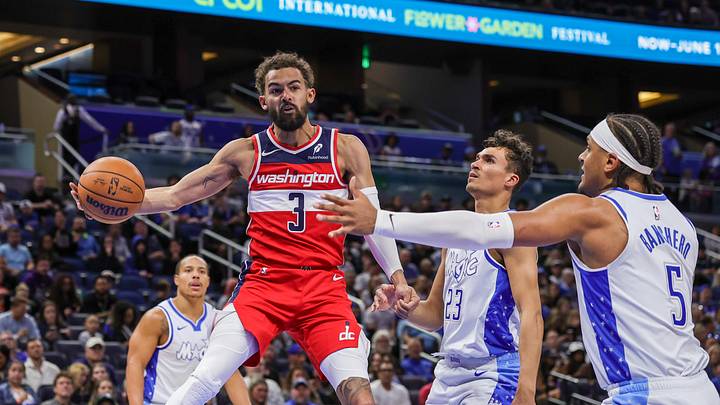
Days after reports emerged that Young intended to decline the final year of his contract with the Wizards and enter unrestricted free agency, ESPN’s Shams Charania was first to relay that the star point guard “intends to sign” a new deal to stay with Washington once free agency begins. The contract will be worth up to $212.9 million over four years, with a player option for that fourth year.
It’s a terribly early free agency report. It’s also pretty surprising! When Young decided to decline his $49 million option for the 2026–27 season, the widely-held assumption was that he did so in order to secure a longer-term deal with the Wizards at a lower annual salary. Instead, he wound up getting a raise and long-term financial security—this new deal will pay him an average annual salary of roughly $53 million. It’s slightly less than the maximum Washington could have offered but about the maximum amount of money Young could have received from another team in free agency.
Not a bad bit of business from the 27-year-old guard, who was acquired by Washington ahead of this past season’s trade deadline. To fully grasp the implications of the deal, let’s grade the signing and break down why the Wizards gave Young a near-max contract after he scored 17.9 points and dished out 8.0 assists in 25 games last season.
Why the Wizards are re-signing Trae Young

The Wizards clearly believe Young has a lot to offer after they emerged as the only real suitor for his talents on the trade market last year. And that makes some sense on the surface. Young is a clear minus defensively and his offensive numbers have generally declined over the last three seasons. But he remains one of the league’s top passers with elite vision and boasts a ton of experience running an NBA offense.
Washington’s current roster lacks players with those qualities. Anthony Davis is a fellow vet, but has spent his career getting the table set for him offensively. The young players that the Wizards hope will comprise their future core (Alex Sarr, Tre Johnson, Bilal Coulibaly and Kyshawn George) are all finishers rather than playmakers. Furthermore, although Washington will be adding another blue-chip talent with the No. 1 pick in Tuesday’s draft, none of the three likeliest options (AJ Dybantsa, Darryn Peterson, Cam Boozer) are true point guards.
Having a veteran hand guiding all that youthful talent by setting them up in the halfcourt offense seems obviously beneficial. The Wizards will be patient in allowing them to develop but are clearly moving out of their tanking era. As long as Young doesn’t hog the ball to a detrimental degree, re-signing him will only help usher along that development. If it results in some wins and the organization’s first playoff appearance since 2021, all the better.
As to why the team felt the need to pay him a near-max contract? Josh Robbins of The Athletic had some reporting on that front.
“That Young will receive such large annual salaries no doubt will come as a shock to many observers, especially after Young’s reputation took a beating toward the end of his Hawks tenure,” Robbins wrote Monday. “But in recent weeks, Wizards decision-makers became convinced that, with the NBA’s new anti-tanking measures compelling more teams to compete, Young was going to command maximum-salary contract offers from other franchises through either a straight free-agent signing or a sign-and-trade proposal. ... Wizards officials are not concerned that Young’s new contract will age poorly and prevent them from making future moves to improve their roster.”
In short: the Wizards felt Young would be beneficial in helping a young roster take the next step; didn’t believe that paying him a ton of money would hinder team-building in any way; and were nervous he might leave in free agency.
How the Trae Young signing can go wrong
The dollar amount on this contract suggests Washington is paying an All-NBA point guard. But Young was only available on the trade market in the first place because he is no longer an All-NBA point guard.
Young’s scoring and efficiency numbers have steadily declined in each of the last three seasons. He missed all but 15 games last year due to injury and, as a small guard playing starter minutes in the NBA, will always be more susceptible to the daily wear-and-tear than most of his colleagues. Young certainly tries harder on defense than he did to start his career, but, at his best, tops out as a below-average defender whose mere presence offers opponents an easy target. All of those downsides mean Young has to be really good offensively to make up for it. Once upon a time, he was. But that’s no longer the case. He’s still a great passer, but posts pedestrian numbers otherwise, and his year-over-year drop in three-point shooting is growing to be more of a concern.
Young is not a championship-caliber player, and Washington knows that, even if the price tag suggests otherwise. The issue instead is that it’s a real question whether Young is a plus-starter on even an average NBA team. He’ll serve a purpose with the Wizards as the guy who makes sure the young bucks know how to play in an NBA offense, but it’s an awfully high price to pay for that specific archetype—and Young’s game doesn’t seem likely to age well.
Final grade: C

It’s very hard to not see this as a massive overpay.
Is it a franchise-altering mistake? No. Would the Wizards have done it if there was even a possibility they thought it might hinder the development of their young talent? Also no. Did they have to pay Young more than he’s worth after spending the last several years dwelling in the basement of the East? Probably. Washington had money to spend with the bulk of the roster on rookie deals; there are worse ways to route that cash than toward a player with an All-NBA résumé. Especially a player who seems happy to be there and willing to embrace the responsibility of setting up his young teammates for success over piling up his own stats.
But from an objective value standpoint, it’s a bad deal. Young will start next season in the same annual salary bracket as Luka Dončić, Evan Mobley, Cade Cunningham, Jamal Murray and Donovan Mitchell. He isn’t in the same stratosphere as those players—the fact that Washington isn’t paying him to play on their level doesn’t matter. And given how far off free agency is (relatively speaking), it’s difficult to shake the impression that the Wizards were bidding against themselves and gave Young a huge deal out of fear they’d come up empty in a week’s time. They might feel like it was worth it, but nobody made them pay Young Dončić money instead of, say, LaMelo Ball money ($40 million AAV) or Zach LaVine money ($43 million AAV).
All that would be a concern for any player signed for more than their statistical production suggests they're worth. With Young, it’s amplified because he has visibly lost some quickness over the last two years (despite being in the middle of his physical prime), while his simultaneously declining three-point accuracy knocks him down several pegs as an offensive threat (with room yet still to fall). How a player of his build can impact the game at this level is a very delicate balance, and it’s already tilting negatively. The odds of this deal aging poorly seem pretty high.
The Wizards found their guy and are willing to pay a markup to keep him around. We’ve seen worse process from a front office in D.C. But at this stage, it feels like a miscalculation of Young’s true value in the modern NBA, and it’s impossible to see him living up to that dollar amount.
More NBA From Sports Illustrated
Listen to SI’s NBA podcast, Open Floor, below or on Apple and Spotify. Watch the show on SI’s YouTube channel.
 Add us as a preferred source on Google
Liam McKeone is a senior news writer for the NBA team at Sports Illustrated. He has been in the industry covering the NBA and other sports as a content creator starting in 2017. Prior to joining SI, McKeone worked for NBC Sports Boston and The Big Lead. In addition to his work as a writer, he has hosted the Press Pass Podcast covering sports media and The Big Stream covering pop culture. A graduate of Fordham University, he is always up for a good debate and enjoys loudly arguing about sports, rap music, books and video games. McKeone has been a member of the National Sports Media Association since 2020.
Follow liam_mckeone