
Drawbacks Do Exist for Bears With Safer Caleb Williams Targeting
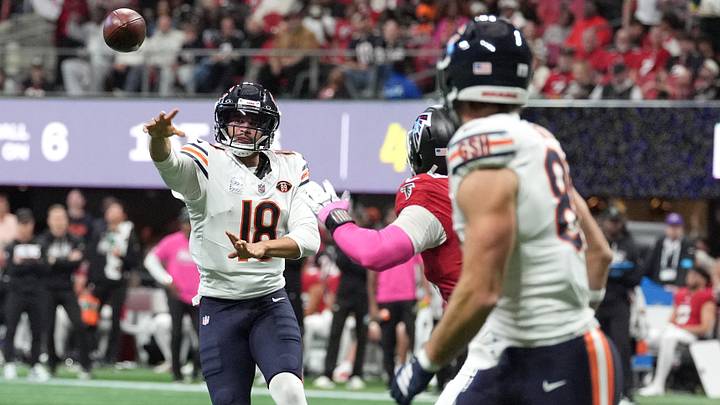
In this story:
The Bears lead the NFL in time of possession and rushing, and no one can really dislike this.
Still, it's a situation causing at least one disturbing trend.
Bears coaches talk extensively about finding their identity. Look at their stats so far and they seem to be trending toward a more plodding, hold-the-ball team that lacks explosiveness.
In their defense, not having Caleb Williams as quarterback for three of the six starts and a small portion of another game has held them back. However, even in the games he played they had only one game when they showed the real explosiveness anticipated for Year 2 of the Ben Johnson era.
It's not that they're running the ball so much better. They have running it well, except for last week and the game with Green Bay. But some of that can be traced back to the lack of Kyle Monangai as the enforcer type ball carrier who punishes defenses.
Bears are the best team in the NFL when Caleb Williams plays the entire game:
— Die-Hard Chicago (@DieHard_Chicago) October 19, 2026
1st in points (45 PPG)
1st in total yards (460/Game)
1st in rushing
1st on 3rd down (61%)
1st in takeaways (3/game)
2nd in sacks
And the Bears are #1 in the NFL in time of possession. pic.twitter.com/f3EXcxMy9Q
Similar running, passing different
Last year after six games, the Bears had what they refer to as 17 big plays, or passes of 25 yards or longer. This year, they have seven. In the running game, a big play is 10 yards or longer and they're comparable to last year even without Monangai. They have 24 and last year had 26 at this point.
Explosive plays are a little different than "big plays." Explosive plays are passes of 20 or longer. Getting to the top in this category can be critical and the Bears are nowhere near that point. The Bears are only 14th in explosive play rate at 5.8% according to Sharp Football Analysis.
A few weeks ago, offensive coordinator Press Taylor summed it up fairly well.
"If you're getting explosives, you're probably not eating as much clock," he said. "Where if you're just getting 4 yards here, 6 yards there, 7 yards here, 2 yards here, you're probably going to end up eating a little bit more clock.”
The Bears don't just beat you. They take the ball and don't give it back.
— Caleb Matas Pete (@CalebBears1) October 21, 2026
Time of possession per game, 2026:
🐻 Bears: 36:01
Vikings: 33:38
Giants: 33:11
#1 in the NFL by more than two minutes a game. The Patriots are 11th at 31:17.
Every extra minute Caleb has the ball is a… pic.twitter.com/nSobj30Eov
Buffalo, Baltimore, San Francisco, Kansas City and Green Bay are all teams near the top in explosive play rate and they are to be feared offensively as a result. On Thursday night, the Patriots come in with Drake Maye averaging 8.0 yards per pass attempt. That is a number like a team needs to be a serious Super Bowl threat.
The Bears, meanwhile, average 7.1 per attempt. Williams is at 7.8 so this does make a difference with him at quarterback.
Beyond not having Williams available for half the starts and using weaker-armed backups, there are two possibilities for this drop in explosiveness.
Caleb downfield passing tape.
— Danny🧌 (@CylinderAnalyst) October 19, 2026
For those of you comparing Caleb to Bo Nix or calling him a checkdown merchant, this is the difference. pic.twitter.com/m82L6e83jW
One is they have drilled the deep targeting out of their quarterback. All Williams has heard since camp started is not to be afraid of the other options on a play or of the checkdown pass.
Williams' average intended air yards so far is 5.8. It's a fraction ahead of Bo Nix for lowest in the NFL. His average air yards per completion is 4.4. That's longer than only Cam Ward, Aaron Rodgers, Baker Mayfield and Nix, among starters. And Mayfield has been injured.
Obviously they are looking shorter and throwing shorter.
Top 5 Fastest QB Runs of 2025
— Polymarket Football (@PolymarketBlitz) May 12, 2026
1) Caleb Williams: 21.01 mph
2) Caleb Williams: 20.45
3) Bo Nix: 20.33
4) Caleb Williams: 20.31
5) Caleb Williams: 20.29 pic.twitter.com/GdPq2Al4nB
This isn't necessarily bad if they are piling up the yards after catch. But their top YAC wide receiver is Luther Burden at 20th in the league with 5.2 per catch per NFL Next Gen Stats. Pro Football Reference does have them sixth in YAC as a team at 773 yards but their volume for plays is so high that they will naturally rank higher. They're getting more chances at it.
Limiting themselves
The other reason for fewer big plays might be how they are limiting themselves by plan.
When the season started, they had this big emphasis on running more 13-personnel packages. That's three tight ends. The Rams did it effectively last year and it became the rage.
The Bears have increased this with rookie Sam Roush as the third tight end with Cole Kmet and Colston Loveland They line up this way with 18% of their plays. Last year it was 8.3%, according to Sharp.
Lowest avg depth of target this season
— PFF (@PFF) October 21, 2026
(min 100 dropbacks)
Caleb Williams 5.9
Bo Nix 6.3
Jalon Daniels 6.5
Kyler Murray 7.0
Patrick Mahomes 7.0
Cam Ward 7.2 pic.twitter.com/TRnlGZfhcv
Using three tight ends can be good for running the ball or getting needed short completions. It's usually not going to increase any team's explosiveness. If you want bigger plays, use faster pass catchers. Wide receivers and running backs are faster. Tight ends are faster, lighter version of linemen.
The Bears are using more than twice as much 13-personnel and it's not necessarily going to up their yards per pass attempt or explosiveness. It can help with ball control.
It's a tradeoff. They're looking shorter keeping the ball longer and churning out first downs but they've had problems in the red zone scoring and aren't getting the big plays they had last year.
At some point, they'll run into a defense again doing the same thing Minnesota did. They blitzed at every opportunity and dared the Bears to beat them deeper.
Caleb Williams is ELITE and goes to his first read less than any QB in the NFL - #Bears https://t.co/cUwHtI6gcx
— Swift Sports Network (@SwiftyNetwork) October 21, 2026
The problem with pulling back and going ball control too much is when that challenge comes, the offense is ill-equipped to handle the pressure.
It seems almost hypocritical to say after so much criticism went Caleb Williams' way for being too focused on the big passing plays and not enough on the shorter gains, but at some point the Bears will need to challenge downfield or eventually get too bogged down.
Time of possession is fine, and the Eagles used it in 2024 to go on and win the Super Bowl. Normally the top TOP team is somewhere in the playoffs, but not necessarily the winner.
Too much of anything isn't a good thing. It's better balance the Bears need to achieve. A team capable of this can handle anything any opponent throws at them,
Caleb has played 3 games this year
— Ghost Mugs Halas 🐻⬇️ (@Nickdabearfan) October 20, 2026
Week 1 they put up 59 points, pushed the ball down the field consistently
Week 2 he gets injured in a rainstorm game against Brian Flores
Week 6 coming off a hammy, Atlanta game plans to take away the deep shots because that’s what Caleb… https://t.co/v8J06e2Pv6
 Add us as a preferred source on Google

Gene Chamberlain has covered the Chicago Bears full time as a beat writer since 1994 and prior to this on a part-time basis for 10 years. He covered the Bears as a beat writer for Suburban Chicago Newspapers, the Daily Southtown, Copley News Service and has been a contributor for the Daily Herald, the Associated Press, Bear Report, CBS Sports.com and The Sporting News. He also has worked a prep sports writer for Tribune Newspapers and Sun-Times newspapers.