
How The Bengals Cooled Down a Hot Pittsburgh Defense in Week 10
In this story:
The offseason discussion on the Bengals' run game wasn't a waste of time.
Well, it was, but it was an understandable conversation! Teams that are too spread out and can't present a credible threat on the ground are getting beaten over the head by the flexibility that allows defenses. The Bengals have, from time to time, had issues with it, and it stood in the way of maximizing their output and efficiency.
There was another part of that.
The pass protection was egregiously bad. Yes, it was more exposed to difficult rush conditions, a big part of that flexibility I just mentioned, but they were bad. That is emphatically no longer the case.
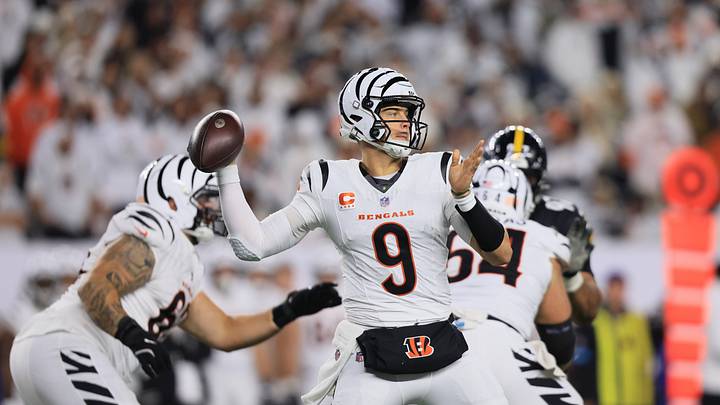
Now, Burrow, Chase, and Higgins, who have always been good enough to do this, are able to attack any defense and any coverage. They're fine with light boxes, shifting/disguised coverages, and teams putting a lid over the top. Almost no other team has a QB that can live this way, but now that he has enough time to do so, the Bengals can throw options out there and allow Burrow to point out the coverage, get through his read, and find an answer.
Nowhere is safe from a QB who can truly survey and get the ball accurately to every inch of grass. Teams know this. Now that their four-man rushes aren't working, they are beginning to get desperate and make bigger and bigger mistakes. On Sunday night, the Bengals torched Pittsburgh's pressure packages, specifically targeting the structures of their pressure coverages.
So what did exactly did they attack? And how?
Fire Zones

Fire Zones are five-man pressures where you don't want to push all your chips in and play man. Also known as "zone pressures" or "zone blitzes". Fire zone is a specific set of coverages. It's constructed as a balance between aggression and coverage. You're only sending five instead of six like a true blitz, and you're playing softer zone coverage but matching guys that enter your zone.
Between aggression and coverage, man and zone coverage, it's almost the ultimate balance of everything.
— MTFilmClips (@MTFilm) July 31, 2024
Your typical fire zone configuration is an even 3-deep, 3-under coverage like the above.
Michigan is running a traditional Fire Zone path with a Trap 2 behind it.
— Cody Alexander (@The_Coach_A) May 4, 2024
On the bottom, the CB plays a Squat technique to support the Deep 1/2 player coming from low to high.
Plays out similar to Quarters & how the Chiefs play their 'Tango' coverage. #ArtofX pic.twitter.com/fJQTI458NN
You can also play what's called a "two-trap fire zone" where the corners can help out underneath. Standard 3d3u fire zone is very exposed in the flat with the SCF (seam-curl-flat) defenders working inside out and the CBs playing a loose third. This is meant to give some support into the flat.
These are the main way zone pressure coverages are played. When teams play the Bengals, this is how they tend to do it when they send extra pressure because they don't want to give up an automatic 50 yards down the sideline to Chase. Understandable, but it also happens to be a terrible idea. There is no safe way to send extra bodies at the Bengals passing offense.
When blitzed in the last three games, #Bengals QB Joe Burrow is:
— Jay Morrison (@ByJayMorrison) November 16, 2026
30 of 33 for 391 yards -- 11.8 yards per attempt!! -- with 5 TDs, 1 INT and a passer rating of 143.0.
Next week's opponent, Washington, has the fourth highest blitz rate in the league.
Elite processing QBs are unblitzeable because they are comfortable speeding up their operation and finding the weakness. Even more, Burrow's pre-snap command and unlimited protection-adjusting autonomy allows them to customize based on look and optimize their pickup.
The Bengals are so effective against fire-zones for a few reasons. Against the standard 3u-3d structure, DCs tend to give the CBs big cushions, as again fire zone is designed to prevent the all or nothing nature of standard man pressures. With two of the best go-ball threats in the league, that is even more pronounced against the Bengals' offense
Primary issue with running fire zones against the Bengals is that you have to give them huge cushions on the outside to stay out of go ball territory and they're very aware of it pic.twitter.com/AsDau20fTe
— Max Toscano (@maxtoscano1) November 18, 2026
The Bengals absolutely love to take these freebies whenever they're given them, and they get them a lot.
2-Trap fire zones are not much better https://t.co/oVK9ePVjCl pic.twitter.com/EMIjOJwvcS
— Max Toscano (@maxtoscano1) November 18, 2026
Because 2-trap fire zones are so focused deep and outside, they leave a lot of space in the middle. This happens to be the area the Bengals are most above the rest of the league as a passing attack.
"Hot" Blitzes

Al Golden has found a pressure that works in this 3 deep 2 underneath hot coverage pic.twitter.com/fauU7Fjq4u
— mike (@bengals_sans) October 13, 2025
The idea of HOT blitzes, which are blitzes with the unique "HOT" pressure coverage is simple. They're basically fire zone with one less guy, 3 deep, 2 under instead of 3 deep, 3 under. This is because when you send a true blitz of six guys instead of a standard pressure with five, you obviously lose that one guy in coverage. The Steelers played it a little differently than normal, with the deep middle S playing more of a "lurk" technique instead of a deep post, but the structure is the same.
This coverage exists for the same reason fire zones do though. The idea is to prevent those easy 1v1 bombs into huge deep voids. The outside CBs and deep S will play it similarly to fire zone, but the seam defenders inside will park themselves on the seams and read the eyes of the QB. They almost freeze, don't overcommit anywhere, and react as best they can. It's the best they can do given the space they have to cover.
The issue is that it's extremely vulnerable in the intermediate middle. Because a lot of college QBs struggle to process here, as it's an unclear and shifting picture with all the bodies that populate the MOF, and effectively maximize this area, HOT has become very popular in the college game.
What about "HOT" pressures? https://t.co/oVK9ePVjCl pic.twitter.com/kZecfLBHV3
— Max Toscano (@maxtoscano1) November 18, 2026
Joe Burrow is not a college QB. Essentially, hot coverages need the blitz to get someone to the QB and disrupt the play. If protection is good, it is not designed to hold up at all. The Bengals pass protection has been fantastic this year, especially relative to its exposure.
Post-wheel is a concept that is death to "HOT" coverages like this with the SEAM (eyes technique) defenders having so much space to account for.
— Max Toscano (@maxtoscano1) November 18, 2026
It's very hard to protect for long enough against 6 rushers for it to work so it's not normally exploited pic.twitter.com/sdUCXGb1Su
Because the CB can be run off taking the outside WR deep, the seam defender is sometimes asked to carry anything vertically from the slot.
The Bengals exploited this here by putting Chase at two on a post-wheel concept. This takes a minute to develop so it's not a common answer vs this coverage, but if you can protect it and give your QB the time, it's lethal. This is where Burrow becomes a force multiplier too. In addition to the protection command and pre-snap sense we discussed above, his ability to negotiate space and get up in the pocket consistently meets the OL halfway and, in this case, unlocked a filthy coverage beater with some high barriers to entry.
Conclusion
The Bengals are rolling out the Greatest show on Turf 2.0.
That said, Joe Burrow isn't any different than he was last year or especially in 2024. The only difference between this offense and year's past is that, as Bengals fans have been arguing on social media for years, the pass protection wasn't there. The one answer teams had in the past was to play MacDonald-ball.
They could rush four and still create havoc while shifting on the back end to make Burrow dig through his reads and find an answer without the time. He has the time now, and he's going to find it. Sending extra guys is only going to make the beatings worse.
For more on the Bengals, subscribe to our YouTube Channel, and check us out on your favorite audio platforms, including Apple Podcasts, Spotify, iHeartRadio, and Amazon.
 Add us as a preferred source on Google

Max Toscano breaks down football strategy. Prior to joining Bengals On SI, he interned with the coaching staff at the University of Connecticut, assisting the defensive staff in opponent scouting as well as assisting the Head Coach and GM with analytics on gameday. Max's areas of specific expertise include Quarterbacks and Tight Ends, including also hosting a publication dedicated to the tight end position. He also writes for "And The Valley Shook" on SB Nation.