%20%20--%3E%0A%3Csvg%20version%3D%221.1%22%20id%3D%22Layer_1%22%20xmlns%3D%22http%3A%2F%2Fwww.w3.org%2F2000%2Fsvg%22%20xmlns%3Axlink%3D%22http%3A%2F%2Fwww.w3.org%2F1999%2Fxlink%22%20x%3D%220px%22%20y%3D%220px%22%0A%09%20width%3D%2239px%22%20height%3D%2240px%22%20viewBox%3D%220%200%2039%2040%22%20enable-background%3D%22new%200%200%2039%2040%22%20xml%3Aspace%3D%22preserve%22%3E%0A%3Cpath%20fill%3D%22%23FFFFFF%22%20d%3D%22M38.5%2C7H28.2v26h10.3V7z%22%2F%3E%0A%3Cpath%20fill-rule%3D%22evenodd%22%20clip-rule%3D%22evenodd%22%20fill%3D%22%23FFFFFF%22%20d%3D%22M26.1%2C25.5c0%2C5.8-4.1%2C7.5-12.9%2C7.5C3.9%2C33%2C0%2C31.2%2C0%2C25.2v-1.1h11.6%0A%09v2.4c0%2C0.7%2C0.1%2C1.4%2C1.2%2C1.4c1%2C0%2C1.2-0.4%2C1.2-1.3v-0.9c0-1.6-0.9-1.6-3.5-2.2C2.2%2C21.7%2C0%2C19.7%2C0%2C15.3v-0.9C0%2C9.3%2C5.5%2C7%2C12.9%2C7%0A%09c10.2%2C0%2C12.8%2C2.6%2C12.8%2C7.4v1.8h-11v-2.9c0-0.6-0.4-1.1-1.2-1.1c-0.6%2C0-1.2%2C0.4-1.2%2C1.1v0.9c0%2C1.5%2C0.9%2C2%2C3.3%2C2.5%0A%09c8%2C1.6%2C10.5%2C3.3%2C10.5%2C7.5V25.5z%22%2F%3E%0A%3C%2Fsvg%3E%0A)
Why Are There So Few Empty Seats at the 2026 World Cup?
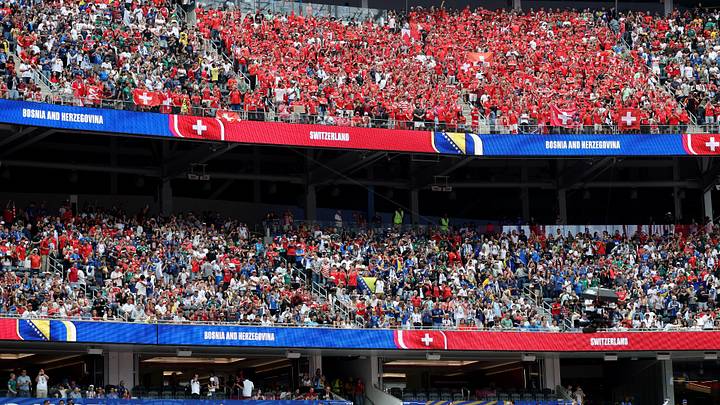
INGLEWOOD, Calif. — The combined populations of Bosnia & Herzegovina and Switzerland is around 12.6 million—less than a third of L.A. County’s residency. Neither boasts a considerable diaspora population in Los Angeles, which is at least a 14-hour flight from either European country.
These are not World Cup powerhouses of years gone by—the pair have combined for precisely zero knockout wins across their collective competition histories.
In a world where single players get considerably bigger billing than their nations—the font for Christian Pulisic’s name is at least 10 times the size of “United States” on Fox Sport’s promos—they both lack a glitzy star. Arguably the most compelling individual attraction is a 40-year-old who spent last season playing in Germany’s second tier.
Yet, despite all that, this seemingly unglamorous group-stage clash saw 70,026 squeeze into SoFi Stadium’s 70,492-capacity spaceship of a venue, dancing and chanting their way through another remarkably well-attended affair.

Official attendances across the group stage thus far report that stadiums have been at a collective 99.4% capacity. The most sparsely attended fixture thus far—Saudi Arabia’s 1–1 draw with Uruguay in Miami—produced just 1,714 empty seats.
While some will question the legitimacy of those figures provided by FIFA—which count the number of tickets scanned at the gates rather than literal bums on seats—the vast swathes of barren stands which were prevalent at the Club World Cup held across the U.S. last summer have not been repeated this year.
At a time of widespread economic strife and tickets of unprecedented expense, how have so many seats been filled?
Bow Down to the Market

FIFA president Gianni Infantino has remained defiantly unapologetic in the face of widespread backlash to World Cup ticket prices. As he repeatedly pointed out, you have to play the rules of the game you’ve entered. The World Cup is just another entertainment event in North America which will command hefty prices.
The figures swirling around tickets for the recent NBA Finals series between the New York Knicks and San Antonio Spurs make the sums spent on World Cup games look like a pittance. The cheapest seat for Game 3 at Madison Square Garden was in excess of $7,000—and that was for a spot among the nosebleeds. Sums quickly spiraled towards six digits the closer you got to the court. Paying through the nose has been normalized.
But that’s not to say that every ticket at this World Cup requires the sort of purchase made with wobbly three-in-the-morning logic which is subsequently hidden from your spouse.
Dynamic pricing cuts both ways: If demand is high, then the majority is punished, but if sales start to dry up, then the supply has to be slashed. Tickets spiked after the draw in December when fans were told precisely when and where they would be able to follow the nations (or players, as is increasingly the case) they were interested in. But fees have gone through various gulleys since.

Each game has enjoyed its own unique trend. Half of the group stage fixtures that have been played so far saw a decrease in price across the three days immediately prior to kickoff, per Ticket Data. Argentina’s clash with Algeria, for instance, dropped by 24% as fans started to have doubts as to how impressive the Lionel Messi show would be. Those that turned up weren’t disappointed.
While a seat for Messi’s majesty would have set you back around $1,000, those heading to the SoFi for Bosnia & Herzegovina’s clash with Switzerland on Thursday were charged around $350. For plenty of people, that is a cost worth swallowing.
Who Is Going to All These Games?

Ivan, 32, shoots me a quizzical look. The proud Bosnian has traveled to North America with a swollen contingent of BH Fanatics, the largest fan group in the country, to cheer on his nation at its second-ever World Cup appearance, and the first in a dozen years. Weaving through the crowded Inglewood streets on a muggy, unusually cloudy L.A. day, he has found a metal trashcan to successfully crack the lid off the top of his beer bottle and offers me the rewards of his ingenuity. I politely decline and he can’t understand why. It’s 9:15 a.m.
The amount of blue and white fabric flooding towards SoFi Stadium is staggering, until the troops of red Swiss contingent filter in, marching with admiral synchronicity. In the stadium, it’s Ivan and his compatriots who dominate, cheering vociferously and whistling even louder when Switzerland dare to take a corner kick. At one point in both halves, there are so many people leaping up and down in unison that the press box gently (but noticeably) vibrates.
One of the consequences of an expanded World Cup is the number of nations who have had to wait so long for an appearance at the tournament. There are four debutants this summer; DR Congo, Haiti and Iraq are back after nearly 50 years; while none of Austria, Norway, Scotland or South Africa have been here this century. After generational absences, it’s perhaps no surprise that so many are desperate to take this opportunity. Who knows when it will be back again?
For the nations that do regularly qualify, the diehard fans have been spliced together with locals who can afford the expense (and the perennial cluster of Colombian fans, who appear to be a prerequisite of every fixture this summer).
The U.S., Canada and Mexico are three of the world’s richest countries and the number of box-fresh shirts that have been prevalent across the tournament suggests that the World Cup has inspired some new wealthy fans. Just consider how many Canadians failed to spot the team’s star Alphonso Davies walking among them on the way to the stadium, even the ones with his name and number on the back of their new tops.
What Does This Mean for the Future?

While the players, managers and (most especially) competition organizers are thrilled by the prolific turnout, it poses probing questions for tournaments going forward. FIFA have all the evidence they need to justify a repeat of this approach.
UEFA have proactively responded to fears of high prices at the 2028 European Championship, freezing most of the tickets for games that will be hosted across Great Britain and the Republic of Ireland. FIFA, however, has shown no inclination of ever spurning the chance to extract all the revenue available—and, of course, divert it straight back into soccer.
The 2030 World Cup will be (mostly) held across Spain, Portugal and Morocco. The fervor for the sport is considerably more integrated in the fabric of those nations compared to this year’s co-hosts, but it remains to be seen if there is the same disposal income available to fill out some of the less heralded fixtures should the pricing remain as high.
Mauricio Pochettino and the U.S. men’s national team discovered first-hand the power of a partisan crowd in their opening game of the tournament. “We need the people. We need the fans,” the Argentine coach recognized, a truism which applies to his specific team and the atmosphere of the tournament at large. “Football without fans? It’s impossible.”
READ THE LATEST WORLD CUP NEWS, ANALYSIS AND INSIGHT FROM SI FC
 Add us as a preferred source on Google
Grey Whitebloom is an Associate Editor for SI FC. He has more than half a decade of experience in sports media across all its various guises, from the fast-paced demands of news articles and match reports to in-depth research required for features. Whitebloom graduated with a First Class Honours from University College London and found himself named on the Dean’s List—which, despite his initial fears, was a form of praise rather than a punishment. He specialises in the Premier League and Champions League, while also boasting an extensive track record of La Liga coverage.