%20%20--%3E%0A%3Csvg%20version%3D%221.1%22%20id%3D%22Layer_1%22%20xmlns%3D%22http%3A%2F%2Fwww.w3.org%2F2000%2Fsvg%22%20xmlns%3Axlink%3D%22http%3A%2F%2Fwww.w3.org%2F1999%2Fxlink%22%20x%3D%220px%22%20y%3D%220px%22%0A%09%20width%3D%2239px%22%20height%3D%2240px%22%20viewBox%3D%220%200%2039%2040%22%20enable-background%3D%22new%200%200%2039%2040%22%20xml%3Aspace%3D%22preserve%22%3E%0A%3Cpath%20fill%3D%22%23FFFFFF%22%20d%3D%22M38.5%2C7H28.2v26h10.3V7z%22%2F%3E%0A%3Cpath%20fill-rule%3D%22evenodd%22%20clip-rule%3D%22evenodd%22%20fill%3D%22%23FFFFFF%22%20d%3D%22M26.1%2C25.5c0%2C5.8-4.1%2C7.5-12.9%2C7.5C3.9%2C33%2C0%2C31.2%2C0%2C25.2v-1.1h11.6%0A%09v2.4c0%2C0.7%2C0.1%2C1.4%2C1.2%2C1.4c1%2C0%2C1.2-0.4%2C1.2-1.3v-0.9c0-1.6-0.9-1.6-3.5-2.2C2.2%2C21.7%2C0%2C19.7%2C0%2C15.3v-0.9C0%2C9.3%2C5.5%2C7%2C12.9%2C7%0A%09c10.2%2C0%2C12.8%2C2.6%2C12.8%2C7.4v1.8h-11v-2.9c0-0.6-0.4-1.1-1.2-1.1c-0.6%2C0-1.2%2C0.4-1.2%2C1.1v0.9c0%2C1.5%2C0.9%2C2%2C3.3%2C2.5%0A%09c8%2C1.6%2C10.5%2C3.3%2C10.5%2C7.5V25.5z%22%2F%3E%0A%3C%2Fsvg%3E%0A)
As World Cup Host, USMNT Embraces Chance to Take Soccer to the Next Level
The 1994 World Cup opening ceremony did not get off to an auspicious start for soccer purists. Diana Ross, singing “I’m Coming Out” at what was meant to be the world game’s coming-out party in the United States, stepped to the penalty spot to have a go at converting the first goal of the tournament.
The shot missed the mark by some distance, but the goal still theatrically split in half down the middle. The show went on, but it ended up being wildly upstaged by the tournament itself, with the spectacle of soccer hitting the target and helping to launch the game to greater renown.
When the World Cup begins on June 11, the United States has a chance to show the world how much it has learned since Ross’s effort. The biggest showcase in the sport is finally back on U.S. soil in a totally different landscape than when Bill Clinton was in his first term. There is no coming-out party needed. The sport has arrived in the U.S. At least, that’s the idea.
Like 1994, there will be cringey moments from entertainers; we’re getting the first World Cup final halftime show, curated by Coldplay and headlined by Shakira, Madonna and BTS. But the ball rolling in the U.S. men’s national team’s opener against Paraguay is a moment many have dreamed of for decades.

It also will be a moment charged with expectation. Club owners, stakeholders and fans have long hoped this summer’s tournament would firmly move soccer out of the niche it has occupied for more than six decades in this country and take its place as a “major” sport. Or perhaps it could at least help convince the thousands of people who turn up for exhibition matches played by teams visiting from England or Mexico or who flock to bars in the early morning to watch teams from Germany or Spain that it’s worth tuning in to the local league as well—or at least subscribing to the streaming service it’s offered on.
“We have an opportunity to inspire generations of people,” says USMNT defender Tim Ream. “From young to old, from diehards to casual fans to people who aren’t even interested in the game until the World Cup rolls around.”
The easiest path to that actually becoming a reality is a deep run for the U.S., one that sweeps up those periodic fans and turns them into the type of soccer supporters who will pay attention more than every four years.
“You want to have success in front of your own fans because you know what it means,” says Cobi Jones, a World Cup veteran who played at the 1994 tournament and appeared in more matches for the USMNT than any other player. “You know that if you do have a successful World Cup, it allows for exponential growth of the game within your country.”

The U.S. heads into the tournament as the No. 16 team in the FIFA rankings, so seeing the team standing alone as the confetti falls July 19 at MetLife Stadium feels all but impossible. But a run to the knockout stage that truly captures the nation’s attention is within reach—especially with games played at an hour when it’s socially acceptable to grab a beer at a bar, as opposed to, say, the 10 a.m. kickoff for the Yanks’ last knockout game, in 2022 against the Netherlands.
The goal is “to go as far as we can because obviously anybody and any team entering the World Cup is going there to win it and has plans to win it. That’s why we’re there,” midfielder Weston McKennie said in March. “That’s why we do what we do, because we compete. I think that’s the best way to describe success: for us to be proud of our performance.”
Will the team’s pride match the public’s expectations? Can the USMNT do enough in this tournament to give a whole sport a boost? It will need everything to break right. It will need a number of superb performances from individuals and as a team. And it will need a guiding hand that leads the team to the correct decisions.
Following the Leader
Wooing Mauricio Pochettino to the U.S. national team program in September 2024 felt like a coup. Predecessor Gregg Berhalter had played and coached abroad but hardly has the international cachet of the Argentine manager, nor had he produced anything close to the same on-field achievements.
Pochettino, 54, has worked at some of the most important clubs in the world—including Tottenham Hotspur, which he took to the 2019 Champions League final, and Paris Saint-Germain, which won the Ligue 1 title in 2021–22.
On top of that, while Pochettino had no experience managing a national team, he had gone to the tournament as a player. The combination of a successful playing career, experience coaching prestigious clubs and actually being available to work through the summer of 2026 made him a home run hire—even if he wasn’t at all familiar with the idea of a home run.
At least, that’s how it seemed at the time.
It hasn’t all been sunshine in the Pochettino era. The U.S. lost both regional trophies on offer in 2025, falling to Panama in the semifinals of the Concacaf Nations League and losing to Mexico in the Gold Cup final. The rest of the year saw positive performances in friendlies, with a switch to a formation anchored by Crystal Palace standout Chris Richards that allows the wide defenders to aggressively join the attack.
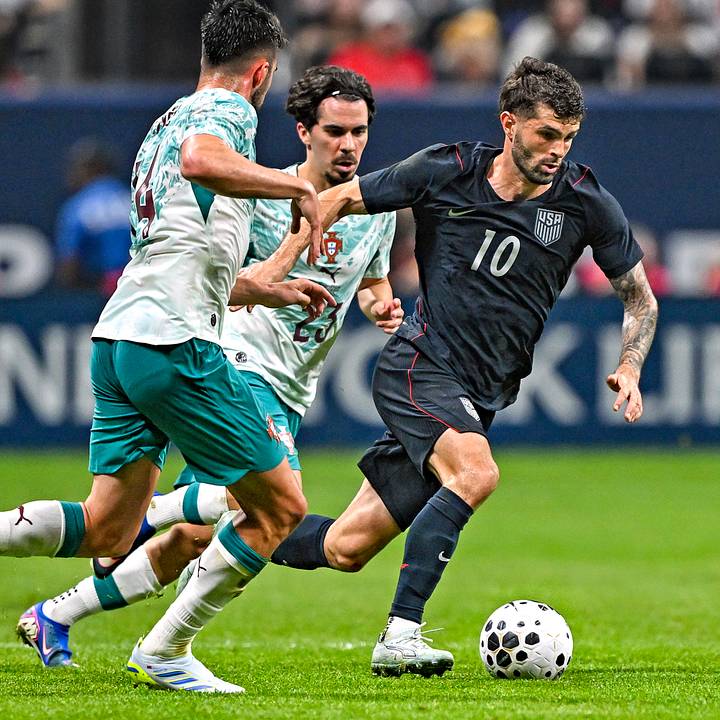
In March, however, Pochettino’s side lost 5–2 to Belgium and 2–0 to Portugal, though the manager insisted the learning experiences against two top 10 teams will serve the Stars and Stripes at the tournament.

“Even if it’s painful, it’s the only way to improve, the only way to learn, the only way to see how these top players and teams compete,” Pochettino said after the Portugal loss.
Widely expected to return to a job in the European elite after the World Cup, the 54-year-old has generally been able to stay free from the types of tiffs that can plague international teams. He and star Christian Pulisic had a difference of opinion about how much the attacker should play during the summer of 2025, with the coach snapping, “Players need to listen and to stick with our plan.” That saga, though, is now well in the past.
Getting along off the field is one thing. Getting everyone pulling in the same direction on it is another.
Rather than continue to utilize the same formation in those March games that had worked in the fall, Pochettino experimented further. He played Pulisic as a center forward rather than his usual role as a playmaker. He went to a flat back four instead of a three-man back line and stuck Tim Weah, who typically plays in attack, at right back against one of the world’s best wingers, Belgium’s Jérémy Doku.
The moves didn’t work out, but the competition also was much steeper. While plenty of fans perceived a regression, members of the team itself insist the enthusiasm remains high. “I feel like we are a lot closer than people think,” Pulisic said. “We put a lot of pressure on them in the first half of both the games.
“We were able to create chances, which if I finish chances, which I know I’m going to, then things are going to be a bit different.”

Putting the ball in the back of the net more often is the simplest fix in soccer, but the lessons learned from matches against the European squads may go deeper. The nature of the international game, Ream says, is that the friendlies are one thing, but the World Cup is another. “We understand where things went wrong, and we understand how and when and what we need to do to fix those things,” Ream says. “At the end of the day, the World Cup is the World Cup. Everything is completely different, and games that you played previously aren’t actually going to matter. You can’t think of all the bad things or the negative things or the momentum-sapping things that have happened because they don’t matter at that point.”
Pochettino will have to work quickly, though, to make sure the team is in the right place mentally ahead of the tournament and to determine how to get the most out of his group. While the USMNT won’t run into a squad as deep as its March opponents in the group stage, the knockout round will produce those types of matchups.
“I think now is the time to learn, to get better,” the manager said after the Portugal defeat. “I think the preparation for a World Cup has to be at the highest level, understanding we can get better. We have quality players, but we’ve got to improve, above all when we’re playing against top-level players.”
Pochettino has been in big moments before, and probably received more scrutiny in London and Paris than he’ll get this summer across the U.S., but this is by far the biggest moment he’s been in on the international stage.
The Best Chance at Success
Pochettino’s arrival isn’t the only reason for hope at this tournament. The USMNT should be hitting its stride. After the frustration at the failure to qualify for the 2018 World Cup in Russia, many young American players started to come through the ranks in MLS academies and make the jump to top clubs in Europe.
The U.S. has had players at important clubs before, but never in this quantity. Richards starts regularly in the Premier League, as does Fulham fullback Antonee Robinson. Pulisic and McKennie are regulars for historic AC Milan and Juventus, respectively. Forward Malik Tillman plays Champions League football for Bayer Leverkusen. The list goes on. Gone are the days when simply having the quality to play in Europe is enough to clinch a place on the team.

The roster largely came together in 2022, and while it always looked too young to make a major statement, the U.S. advanced from its group with a win and two draws. That included a disciplined defensive showing against England and a victory over Iran thanks to a Pulisic goal. In the first round of the knockout stage, however, the USMNT couldn’t cope with the speed of the Netherlands out wide and displayed a listless attack.
This year the field has expanded, meaning the groups are diluted to some extent. While the U.S. won’t want to take anything for granted, its round-robin opponents Paraguay, Australia and Türkiye all have weaknesses it can exploit. Additionally, having topped Australia 2–1 in an October friendly and beaten Paraguay by the same score a month later only will help with confidence.
But simply getting out of the group isn’t the standard for the U.S., especially with the big event taking place at home soil. “We want to show the world why we want to be one of the soccer powerhouses people talk about,” Richards says. “It takes good performances. When it comes World Cup time, we’ll be ready.”
With the Pressure on
Playing at home typically has helped teams at the World Cup. Pochettino cited South Korea’s run to the 2002 semifinal as inspiration for his team.
But as 2026 World Cup cohost Mexico knows too well, sometimes that push from the crowd can become a burden. That relationship, long soured by high expectations and Mexico’s frequent trips to the U.S. for friendlies, hit a low in November when El Tri fans in Torreon booed the team off the field after a scoreless draw. “Maybe that’s why they always take us to the United States,” forward Raúl Jiménez said afterward.
That’s not the dynamic in the U.S., but the spotlight this summer will be brighter than it has been on any men’s team in the nation’s history. “It’s a different kind of pressure when you’re playing for your nation and playing for a World Cup and everything is riding on a few weeks,” Jones says.
Social media increases that pressure, as does the fact that there never have been so many former players with microphones getting paid to opine on the current generation. Some of the best ever to wear the USMNT jersey—including Clint Dempsey, Landon Donovan, Tim Howard and Alexi Lalas—will work in analyst roles during the World Cup.

The players have shrugged off any criticism, noting the high expectations they have for themselves. “You guys want me to feel the pressure. That’s for sure,” Pulisic said in March, before the friendlies. “There’s pressure. It’s a World Cup. It’s not because of my position in the team or anything. I’m used to this. I feel privileged to be in this position. There’s pressure. I feel it. Yes. It’s there, but it’s nothing I can’t handle. I’m going to attack it head-on, and we are as a team.”
If the USMNT can shake off the pressure and advance through the field, it may succeed in its goal of further raising the profile of soccer in the country, especially ahead of the 2028 Los Angeles Olympics. But no matter how good or bad the performance, the World Cup—the sport’s absolute pinnacle—will remain a singular event. Players can take the biggest stage only once every four years, with legacies cemented and moments magnified because of the significance of every kick, tackle or save. The tournament won’t return to North America during their careers.
This is something so many have waited years and years to enjoy, and each of the 90-minute matches will be remembered forever.
The moment is here. It’s up to the U.S. to meet it.
More World Cup from Sports Illustrated
 Add us as a preferred source on Google
Jon Arnold is a journalist who specializes in coverage of soccer in the Concacaf region. He has covered the biggest matches for the U.S. and Mexico national teams in North America but also has reported from places like Paramaribo, Suriname, Santiago, Chile, and Kazan, Russia. His work also appears on ESPN FC, The Athletic, MLSsoccer.com and his own Getting CONCACAFed newsletter. A graduate of Texas Tech, he enjoys supporting the Red Raiders when not watching a soccer match.
Follow ArnoldcommaJon