%20%20--%3E%0A%3Csvg%20version%3D%221.1%22%20id%3D%22Layer_1%22%20xmlns%3D%22http%3A%2F%2Fwww.w3.org%2F2000%2Fsvg%22%20xmlns%3Axlink%3D%22http%3A%2F%2Fwww.w3.org%2F1999%2Fxlink%22%20x%3D%220px%22%20y%3D%220px%22%0A%09%20width%3D%2239px%22%20height%3D%2240px%22%20viewBox%3D%220%200%2039%2040%22%20enable-background%3D%22new%200%200%2039%2040%22%20xml%3Aspace%3D%22preserve%22%3E%0A%3Cpath%20fill%3D%22%23FFFFFF%22%20d%3D%22M38.5%2C7H28.2v26h10.3V7z%22%2F%3E%0A%3Cpath%20fill-rule%3D%22evenodd%22%20clip-rule%3D%22evenodd%22%20fill%3D%22%23FFFFFF%22%20d%3D%22M26.1%2C25.5c0%2C5.8-4.1%2C7.5-12.9%2C7.5C3.9%2C33%2C0%2C31.2%2C0%2C25.2v-1.1h11.6%0A%09v2.4c0%2C0.7%2C0.1%2C1.4%2C1.2%2C1.4c1%2C0%2C1.2-0.4%2C1.2-1.3v-0.9c0-1.6-0.9-1.6-3.5-2.2C2.2%2C21.7%2C0%2C19.7%2C0%2C15.3v-0.9C0%2C9.3%2C5.5%2C7%2C12.9%2C7%0A%09c10.2%2C0%2C12.8%2C2.6%2C12.8%2C7.4v1.8h-11v-2.9c0-0.6-0.4-1.1-1.2-1.1c-0.6%2C0-1.2%2C0.4-1.2%2C1.1v0.9c0%2C1.5%2C0.9%2C2%2C3.3%2C2.5%0A%09c8%2C1.6%2C10.5%2C3.3%2C10.5%2C7.5V25.5z%22%2F%3E%0A%3C%2Fsvg%3E%0A)
Tennis Mailbag: Is Carlos Alcaraz’s Injury Part of a Bigger Problem Plaguing the Sport?
Hey everyone,
• Here’s this week’s Served podcast. We talk Rafael Jodar, beleaguered college tennis and more:
• In non-tennis news: The Little 500 is among the coolest college sporting events in America.
Onward …
Jon,
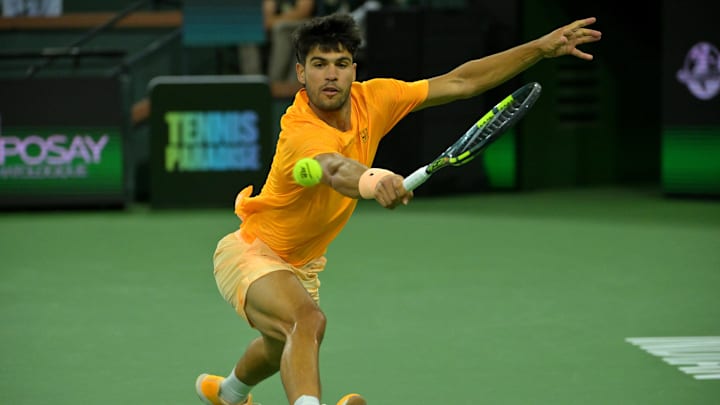
How worried should we be about Carlitos’s injury? When I hear “wrist,” I can’t help but think of Juan Martín del Potro and how he was never the same. Also Dominic Thiem. If you have access to his medicals, please share. If not, do you have any idea how serious it is?
Thanks,
P.
• This question, of course, pertains to the news that Carlos Alcaraz will miss Roland Garros—and the opportunity to defend his title—because of his wrist injury. The severity? That’s the big question. One hopes that this is largely precautionary, and that Alcaraz recovers quickly—in time for grass season—and that this is simply an unfortunate incident in a long and successful career (none of which elapses totally free of injury).
But yes, reflexively, we think of other tennis players who have had wrist injuries and wince. We discussed this on Tennis Channel the other night: Juan Martín del Potro and Dominic Thiem endured wrist injuries, and Andrea Petkovic mentioned Belinda Bencic, who was sidelined by a wrist injury earlier in her career. Then again, Nadal had a wrist injury in the summer of 2016. By August, he won a gold medal at the Rio Olympics.
Our periodic question: Are we okay with the level of injuries? Acknowledging that sports are, by nature, physical and physical activity invites injury, should we accept that at any given time, a certain number of players will be hurt? I would argue no. We can lean on data. But we can also lean on anecdotes. Just go down the rankings. Alcaraz, Jack Draper, Holger Rune, Qinwen Zheng (now returning), Paula Badosa and more have been contending with injuries as of late.
Too many players are getting injured for too many reasons. Why? This we know: it’s not monocausal. It’s a combination of schedule demands, balls, racquets, strings, a sport that hasn’t changed its rules and procedures, and an on-court product that requires relentless physicality and has changed manifestly from even a decade ago.
What has tennis done? Mostly a version—admittedly on a smaller scale—of thoughts and prayers. Tournaments send posts ostensibly saying, Get well soon! See you next year! We need a credible study about what is causing so many players to sustain injuries and miss time, and what can be done to mitigate this. (And 12-day Masters events ain’t the answer.)
There’s a good reason why top men players are looking at the French Open with hope, given the unfortunate injury to Carlos Alcaraz. The last time a player other than Alcaraz or Jannik Sinner won a tournament in which both of them participated was Madrid in 2024. Do you happen to know if that level of dominance by two players has been matched in the modern era by any other duo, male or female? Thanks!
Rob Richie
• Good one. Let’s look back to 2005. Roger Federer and Rafael Nadal won every TMS and major through October. But then Tomáš Berdych won Paris Indoors, and David Nalbandian won the Masters Cup. In 2011, Novak Djokovic (and the Big Three) dominated, but Andy Murray won Cincinnati. Long story short: I think you’re right. Neither Claude nor I find examples of comparable two-player dominance.
Jon, jumping into the Venus wild card question after her most recent loss on clay in Madrid. Could there be a compromise as far as specific tournaments. Say, as a Wimbledon and U.S. Open champ automatic wild cards into grass and U.S. hard court events, including the spring season. Denial or qualifying wild card to clay and other events?
Bob, Green Bay
• Not bad. A former champion can always get a wild card, but there are parameters on, say, Madrid, giving a wild card to a player over the age of 40 who hasn’t won a clay court match in years. I guess that could work, but who would have the jurisdiction to enforce this? The tours—partially governed by tournaments—are unlikely to approve a measure that would restrict their autonomy to run events as they see fit. And the majors are going to do as they please as well. We’re injecting millions in prize money, and you’re trying to tell us who can and can’t be eligible for our wild cards?
I’ll say it again: A) Wild cards have already been corrupted and commodified; it’s hard to work up much outrage for Venus’s wild-card tour. B) I would love to give her truth serum and—no judgments—get a sense of what is truly driving her to continue playing. It seems totally on-brand and off-brand at the same time. C) While we’re here, it’s been a little (too) quiet on the Serena Williams comeback front, no?

Dear Jon:
Given all the well-deserved accolades for Carlos Alcaraz after he achieved the career Grand Slam at the Australian Open in January, why is nobody talking about the possibility of Jannik Sinner completing the career Grand Slam at the French this year? Had Jannik cashed in on one of the three match points he held against Carlos at last year’s French Open, he would have completed the career slam at Wimbledon 2025. How amazing would it be for tennis to have both achieve this feat in the same year!
Ed M.
Pasadena, CA
• Good point. We still have a few weeks for the hype meter to get cranked up. But, yes, we could very easily have back-to-back career Grand Slam winners, with Alcaraz completing the box set in Australia. Embedded in your question: Sinner is really good on clay. His long, sturdy legs are well-suited for the dirt. He benefits from the extra split second to set up his shot. Note that his training base is not a hard-court facility but the Monte-Carlo Country Club. Last year, I visited him, and Sinner’s coach, Darren Cahill, suggested to me that, for all Sinner’s success on hard courts, clay might even be his best surface.
(Not to get too far ahead of ourselves, but if, somehow, Stan Wawrinka were to win his final Wimbledon, we could have back-to-back-to-back career Grand Slam winners. He’s the only remaining three-major winner on the men’s side.)
We had a few residual questions about the Markéta Vondroušová doping controversy. A few points of clarity from last week’s column and the discussion on Served.
• Four years is the maximum penalty, but unlikely to be imposed and enforced.
From the ITIA:
“I think there’s some conflation between the missed test / strikes situation and a refusal too. If a tester turns up where the player says they will be, in the allocated hour and the player is not there or uncontactable, then that is potentially a strike. This can happen for a lot of reasons in sport—particularly tennis—when plans change, they get knocked out of a tournament, or just something in their personal life happens and that’s why there are three strikes before a charge. If a tester turns up outside of the hour and the player is not at home, is unable to return or uncontactable then it is not considered a missed test or strike. They have no obligation to be there outside of that hour.
However, if the tester turns up outside of the hour, the player opens the door or answers the intercom and is notified, they have to provide. It’s a fundamental part of any testing programme in any sport. You cannot refuse.”
Jenny of Georgia, take us out!
Does USTA have a “not invented here” challenge?
This is coming to you delayed since the pod the interview with Craig Tiley was a bit ago. So, the thoughts are not “hot.” That said, maybe you’ll find what I have to say interesting; especially since the USTA is always trying to grow tennis.
I’ve lived in a Northwestern suburb of Atlanta, Georgia for almost the last 30 years. The Atlanta Lawn Tennis Association (ALTA) has turned this metropolitan area into a tennis Mecca. Founded in 1934 (!!) they somehow found a formula to grow tennis. You should fact check, but the number tossed around for ALTA membership is 80,000. USTA membership doesn’t have anywhere near that penetration.
I would LOVE to see if the USTA has done a study on them. They have a highly functional formula for league play that starts divisions at the beginner level and goes all the way up to former D1 players, teaching professionals and former ATP players (so much fun to watch and the tickets are free). Add to that, within each division for match play, you play five matches where the lines are arranged best to least (lines 1–5). Everyone can find their level.
I’ve captained our local subdivision team for many seasons. The format allows us to bring on new players at Line 5 and give them the opportunity to develop and grow in a supportive environment. Players find their footing and confidence and grow to be functional members of the team.
I would love to understand how building subdivisions in the Atlanta metro area with tennis courts became a thing. This one factor turned “Swim/Tennis” is a selling point for subdivisions and an open invitation to start ALTA teams on the courts. Not to miss out on the action, many public tennis centers have adult teams and host Junior ALTA teams as well.
For many teams, matches are a social event. Spouses and children come, hang out and make it an afternoon.
Tennis coaches thrive in Atlanta finding fertile ground for drill sessions and opportunities to develop young players.
All in all, ALTA has driven tennis growth from many perspectives: participation, infrastructure, and ancillary industry resources (e.g. coaches and tennis shops).
I’m in the process of moving to Chicago. I doubt I’ll find the tennis community I've enjoyed in Atlanta there. ALTA is truly unique. It could be fun to do a 60 Minutes segment on them.
I'm glad you join Andy on his podcast. I enjoy the pod and always learn something.
Best regards,
Jenny
Shots
• The USTA announced that distinguished tennis officials Shirley Damiano, Darren Potkey and Carl Richko were honored for their dedicated and exemplary service to the game of tennis at the USTA’s Umpire Awards, which were held virtually on April 23.
More Tennis from Sports Illustrated
 Add us as a preferred source on Google
Jon Wertheim is a senior writer for Sports Illustrated and has been part of the full-time SI writing staff since 1997, largely focusing on the tennis beat, sports business and social issues, and enterprise journalism. In addition to his work at SI, he is a correspondent for “60 Minutes” and a commentator for The Tennis Channel. He has authored 11 books and has been honored with two Emmys, numerous writing and investigative journalism awards, and the Eugene Scott Award from the International Tennis Hall of Fame. Wertheim is a longtime member of the New York Bar Association (retired), the International Tennis Writers Association and the Writers Guild of America. He has a bachelor’s in history from Yale University and received a law degree from the University of Pennsylvania. He resides in New York City and Paris with his wife, who is a divorce mediator and adjunct law professor. They have two children.
Follow jon_wertheim