
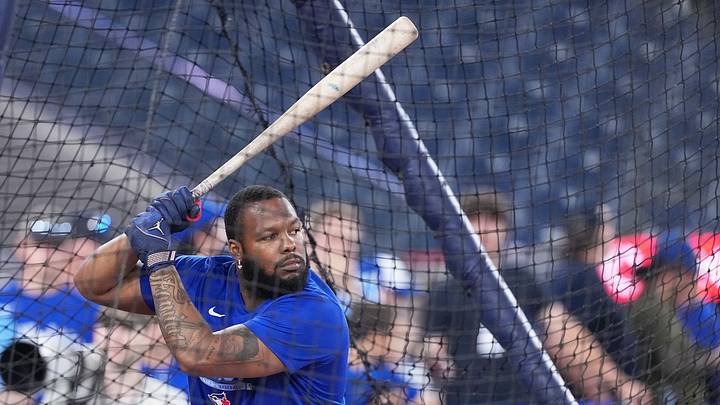
Vladimir Guerrero Jr.’s Difficult 2026 is Testing Blue Jays’ Staggering Bet
In this story:
It was a staggering amount of money even by modern sports-contract standards. But that was the commitment the Toronto Blue Jays made to Vladimir Guerrero Jr. over 14 years — $500 million.
The deal represents an enormous show of faith, one built on Guerrero remaining productive throughout his 30s and into his age-40 season. That makes his injury-riddled first season under the agreement worth examining.
Guerrero has dealt with an elbow contusion, recurring back tightness and hamstring discomfort during 2026, an unusual development for a player whose durability had previously been one of his constants.
Guerrero had played at least 156 games in every full season from 2021 through 2025. When back tightness kept him out of consecutive games in June, Toronto was still hoping to avoid what would have been the first injured-list stint of his Major League career.
The Longer Risk Behind Guerrero’s $500 Million Deal

Guerrero's sudden injury-plagued season illustrates some of the risk an organization assumes when committing to a player for 14 years. Research on MLB aging curves suggests offensive decline can begin earlier than conventional wisdom might imply.
One recent study by Dr. Quang Nguyen and Dr. Gregory J. Matthews of more than 2,000 hitters estimated that the average OPS peaked around age 26 after accounting for players whose declining performance led to them leaving the Major Leagues entirely.
That should not be taken as confirmation that Guerrero’s best days are already behind him. Aging curves describe trends across thousands of careers, not the future of one individual player. Guerrero has also spent much of his career performing well above the average hitter (132 career OPS+), making his specific skill set more important than any league-wide curve when projecting how he might age.
Speed is already one of the weaker elements of Guerrero's profile. His 26.3 feet-per-second sprint speed ranks near the bottom quarter of MLB this season, although his defense has shown notable improvement. The 27-year-old currently sits in the 84th percentile in outs above average per Statcast, a significant jump from seasons in which he ranked near the bottom of the league.
That improvement gives Guerrero another avenue to preserve value in the short term, but first base leaves little room for his bat to be ordinary. As his athleticism eventually declines, designated hitter could become a more prominent part of his future, as it has for many aging sluggers looking to preserve their most important tool: the bat.
Why Guerrero’s Bat Has to Age Well

Guerrero's offensive profile at its best is a treat for the eyes. Average exit velocity, bat speed, barrel rate, hard-hit rate, when Guerrero is clicking, the metrics tied to how forcefully he impacts the baseball tend to place him among the game's elite. His combination of raw power, bat-to-ball skill, and discipline is exceedingly rare, making it easy to understand why Toronto handed him a blank check before this season began. The challenge is determining which of those traits are most likely to age well.
His ability to make contact is perhaps Guerrero's best offensive tool. Even during his current down season, he owns an 86% zone-contact rate and 20% whiff rate, both better than the MLB averages of 82.7% and 25%, per Statcast.
His swing decisions have been less consistent. Guerrero's chase rate has ballooned to 31% this season after falling to 21.5% in 2025.
“I have to start hitting,” Guerrero told MLB.com earlier this month. “I have to start hitting. ... I need to get hot so that we can keep going and try to make the playoffs.”
The quote does not establish that Guerrero is pressing or explain the jump in his chase rate, but it does show that he is acutely aware of the expectation to produce. More importantly for Toronto's long-term investment, his underlying bat-to-ball ability has remained intact even while his overall production and swing decisions have slipped. However, making contact is only one part of hitting. The trajectory of that contact will become increasingly important as Guerrero ages.
That is where one of the more concerning parts of his offensive profile appears. Guerrero has had a tendency to drive too much of his hardest contact into the ground. MLB.com noted earlier this season that 56% of Guerrero’s hard-hit balls had been hit on the ground, up from 43% in 2025, while his barrel rate has fallen from 12.2% last season to 6.7% this year. As Guerrero’s body eventually begins losing its fight with Father Time, consistently getting his hardest contact off the ground could become much more important.
Overall, Guerrero’s first season under his new contract has provided a reminder of just how much Toronto is asking from him over the next 13 years. One difficult season does not make the $500 million commitment a mistake, particularly given his track record. The more revealing question will be how well the traits that have made Guerrero such an extraordinary hitter will evolve as he ages. Year 1 was simply the prelude to a very, very long story.
 Add us as a preferred source on Google
Wesley Dixon is a sports writer focused on thoughtful analysis, roster-building angles, player development and feature-style storytelling. He has covered the Philadelphia 76ers and the NBA, with work centered on breaking down team direction, player fit and the larger stories behind the game. Wesley is a lifelong MLB fan, following multiple teams throughout the league. He is excited to bring that same detail-oriented approach to On SI.