
Five Moments That Defined Justin Verlander’s Legendary Career
In this story:
The tears were uncontrollable in Justin Verlander’s eyes. He was looking around, watching how the fans began to stand up to give him an ovation in his farewell at Comerica Park. The end had arrived, that moment so difficult that every baseball player clings to accepting.
His daughter Genevieve ran toward him and ended up in his arms, while Verlander’s tears mixed with the conflicting emotions of a fan base that had enjoyed his entire career and that was now witnessing something that would not happen again. His teammates slowly climbed up to the mound to show him their affection, and they stayed around when Detroit Tigers manager A.J. Hinch came up to ask him for the ball one last time.
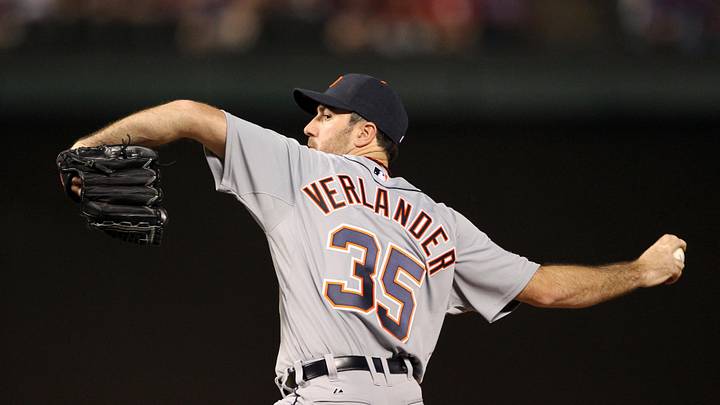
Justin Verlander closed his career the way he started it: competing.
— Yirsandy Rodríguez (@Yirsandy) September 26, 2026
In his final start, against the Pirates, in front of the fans who welcomed him from his debut at Comerica Park, he pitched 5⅓ innings, allowed five hits and two runs, and struck out six opponents. He did it… pic.twitter.com/WuHKXo81DT
Verlander had closed the 557th start of his career as he began: competing. He pitched 5⅓ innings against the Pittsburgh Pirates, allowed five hits, two earned runs that included a solo home run by Brandon Lowe, and struck out six opponents. He did it after six months without pitching in MLB, kept away from the mound by inflammation in his left hip and a subsequent hamstring strain.
Home plate umpire Laz Diaz also joined the tribute, in what was the last time we saw one of this generation’s future Hall of Famers pitch. Verlander walked hand in hand with his daughter Genevieve while all the fans sent him off with an ovation of a few minutes that will feel eternal in our memory.
That is why it was impossible to watch Verlander crying and think only about his farewell. There were too many conflicting emotions, glorious moments and achievements that came to mind for many of us at the same time. There was the 43-year-old pitcher who had just pitched for the last time, the same young man who more than two decades ago had to watch one player get selected before his name was called in the Draft.
There was the pitcher who became the Rookie of the Year with the Detroit Tigers in 2006, and then threw a no-hitter and began to write history by winning the 2011 MVP. The veteran who found a second life in Houston and threw another no-hitter at 36 and who, finally, managed to become a World Series champion to complete the dream of the long-awaited ring he spent years pursuing.
Look, I don’t think there can be a perfect way to summarize Justin Verlander’s career, with all its versions and stories of overcoming adversity. But I think each of us who watched him pitch and appreciated his career has some moments that will remain engraved in our memories forever. So I chose five of them, and I think that, in some way, each one helps understand how he overcame this long road until shedding tears alongside his daughter in the place where he became a legend.
2007: The Moment Detroit Discovered What It Had

Justin Verlander finished with a 17-9 record and a 3.63 ERA in his 2006 season, earning American League Rookie of the Year honors and finishing seventh in the Cy Young voting. He had already shown glimpses of what he could be before his historic night on June 12, 2007, when he threw a no-hitter at Comerica Park to beat the Milwaukee Brewers 4-0. The 24-year-old right-hander began to transform the perception that existed around him.
He struck out 12 batters and, although he issued four walks, no batter reached scoring position. Half of the strikeouts came against the first two batters in the Brewers’ lineup, two against Craig Counsell and four against Tony Graffanino. The image that remained from that night was Verlander reaching the ninth inning with 101 pitches, showing a powerful arm and the voracious aggressiveness of a challenger that defined him as an ace on the mound.
Beyond his 12 strikeouts, his teammates also contributed at the plate and on defense. Brandon Inge drove in half of the runs, starting with a solo home run in the third inning, and Magglio Ordonez also helped preserve the no-hitter with a defensive play.
2011: The Year Verlander Reached the Top

Four years later, there was not much left to discover. Verlander was at the top of his profession and the 2011 season remains the best way to explain how far his dominance and consistency could go when everything aligned.
He won 24 games, finished with a 2.40 ERA and struck out 250 batters. He led the American League in bWAR with 8.7, wins, ERA, WHIP, starts, innings, ERA+ and strikeouts, completing the pitching Triple Crown. It was one of the best seasons of all time, so it was reasonable that he ended up winning the Cy Young unanimously and also became the American League MVP.
Do you still remember how that season began? On May 24, 2011, Verlander finished an agonizing sixth inning in which the Tampa Bay Rays scored a three-run rally against him at Comerica Park to add six earned runs to his record. That night he lost and finished the 11th start of his career with a 4-3 record and a 3.42 ERA. So, being honest, I don’t think many thought that start was worthy of a Cy Young race, the Triple Crown or the MVP award.
Verlander decided that it was. His smoking fastball and devastating breaking balls marked the path and in his next 23 starts he posted a 20-2 record and an impressive 1.94 ERA.
2017: The Two Seconds That Changed His Career

After that season, Verlander retained much of his best version of dominance the following year, leading the league again in bWAR (8.1), innings (239 1/3), ERA+ (161), complete games (6) and finished second in the Cy Young voting. In two consecutive seasons, 2011 and 2012, he accumulated 16.7 bWAR, 45.6% of his bWAR in the first decade he pitched in MLB.
However, after reaching the summit, his career began to move in a different direction. Injuries appeared and the decline in performance made us wonder, for the first time, if Verlander could return to the dominance that defined him as one of the best pitchers of his generation.
And then August 31, 2017, arrived.
The trade deadline was about to close. Two seconds remained when Detroit and Houston completed the move that sent Verlander to the Astros, which, over time, meant a new beginning in his career. In Houston, during that second half of the season, he found again the version that seemed lost. In September he won five games and finished with a 1.06 ERA. And when October arrived, the story took another turn: Verlander was the MVP of the American League Championship Series and ended up helping the Astros win the World Series.
After long years of waiting, the first ring arrived and it was with Houston. Verlander had found a second life when it seemed that his career was beginning to enter the unavoidable decline in which veteran pitchers sometimes cannot accept that their best years were behind them.
Verlander recovered.
2019: When There Was Still a Light at the End of the Road

Two years later, Verlander was 36 years old, an age at which the conversation revolves around a single question: how long can he keep dominating?
Decline can appear at any moment, but you really never know. Verlander responded with another season that seemed to challenge any doubt about the ability of his arm. In 2019 he threw his third no-hitter—the sixth pitcher in a very small group of pitchers who had recorded at least three—this time against the Blue Jays, for the second time in his career at the same Rogers Centre. He struck out 14 batters, issued one walk and needed 120 pitches to complete the game.
But Verlander’s achievements that season did not end there. Later he reached 3,000 career strikeouts, becoming the 18th pitcher to reach that number in the Majors.
2022: The Victory He Owed to His Own History

By 2022, Verlander already had almost everything a pitcher of his generation could long for. He had won Cy Young, MVP, the Triple Crown, multiple league leads in a single season and a World Series. He surpassed 200 wins (226 at the end of the 2021 season), had thrown three no-hitters and surpassed 3,000 strikeouts.
However, he had a small debt to himself, since he had lost his first eight decisions in the World Series. He had a 0-6 record with a 5.68 ERA. And, being honest, he had been a disappointment even when he managed a solid start in which he could not come away victorious. But he is Verlander, and when he took the mound wearing any uniform, we only expected him to win.
On November 3, 2022, in Game 5 against the Phillies, Verlander pitched five innings and allowed one run. Houston won 3-2 at Citizens Bank Park, with a pair of RBIs from Jeremy Pena and a run-scoring groundout by Yordan Alvarez in the top of the eighth to make the difference. When Astros closer Ryan Pressly retired Nick Castellanos on a grounder to shortstop, Verlander finally got to celebrate what was his only victory in a World Series game.

Many of these moments went through my mind when Verlander’s tears ran down his cheeks. And perhaps that is the image that ends up telling his legendary career best, ending in the same place where it all began. In front of the great fan base that welcomed him in Detroit, his coaches, his teammates, his family and the infinite embrace of his daughter Genevieve after making his final pitch.
 Add us as a preferred source on Google
Yirsandy is a baseball writer specializing in MLB coverage with experience across multiple teams and storylines. He currently writes for Diamond Centric, where he covers the New York Mets, San Diego Padres, Chicago Cubs, Milwaukee Brewers, and Kansas City Royals. My work focuses on game coverage, player analysis, and storytelling that connects performance with context. My Substack has also been an important part of my writing development, where I’ve built much of my baseball coverage and storytelling voice over time. I’m passionate about combining reporting, research, and thoughtful analysis to produce engaging baseball content for readers.
Follow Yirsandy