
4 Takeaways from Pelicans' Overtime Loss vs. Suns
In this story:
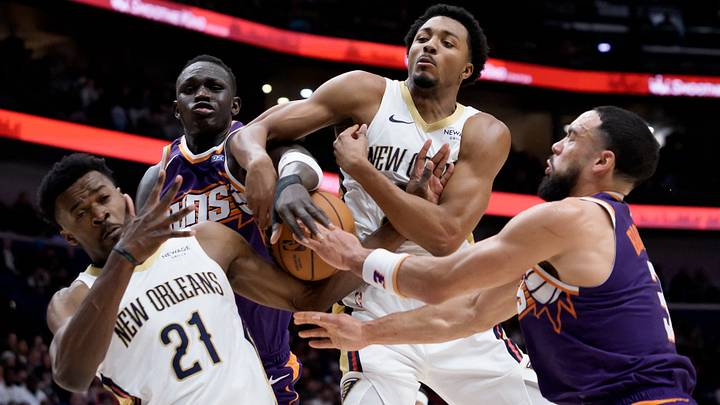
The New Orleans Pelicans had plenty of opportunities to beat the Phoenix Suns. Jordan Poole delivered one of his best performances of the season; the reserves gave New Orleans a significant production advantage, and the Pelicans carried a four-point lead into the fourth quarter.
What happened next was no surprise to those who have watched the Pelicans with any regularity.
Phoenix outscored New Orleans 30-26 in the fourth quarter before taking a 123-119 victory in overtime. Devin Booker didn't need one of his typical spectacular Smoothie King Center performances to get the Suns across the finish line. Instead, Phoenix took advantage of New Orleans' mistakes and received timely contributions from its supporting cast.
Some encouraging individual performances came from the bench, but the final result exposed familiar shortcomings. Here are four takeaways from another disappointing night for the Pelicans.
1. Jordan Poole's Shooting Gave the Pelicans a Chance
Poole was nearly unstoppable through three quarters, finishing with 28 points on 9-of-12 shooting, including 6-of-8 from beyond the arc. His shot-making helped New Orleans establish control and gave the Pelicans the offensive production they needed.
Saddiq Bey added 21 points, while Derik Queen posted 11 points and nine rebounds. Karl Matkovic chipped in five points in 13 minutes, and Bryce McGowens added two.
The reserves combined for 67 points, compared with 39 from Phoenix's bench. That's a substantial advantage, especially considering New Orleans' starters combined for just 52 points.
Poole's production disappeared after the third quarter. He didn't score again, and the Pelicans couldn't find another consistent source of offense when the game tightened.
His performance was outstanding, but the team needed more than one exceptional shooting night to get a win.
2. Derik Queen Was Both a Solution and Part of the Problem
Queen offered a glimpse of why his offensive versatility could become such an important part of New Orleans' future. Mosley increasingly trusted the rookie with the ball in the fourth quarter, using him as a facilitator rather than simply a finishing option.
Queen found Bey for a three-point play, created opportunities with his own drives, and nearly picked up his fifth double-double of the season. His passing and presence give New Orleans another way to generate offense when its perimeter attack stalls.
But his performance came with some costly mistakes. Queen committed five turnovers and made just one of five free throws. He missed consecutive opportunities at the line during the fourth quarter, when New Orleans needed to protect the lead. Those empty possessions mattered in a game that eventually went to overtime.
The encouraging part is that Queen is already showing the ability to influence an offense in different ways. The concern is that his decision-making and free-throw shooting still need work.
Both sides of his performance are important. The Pelicans have a promising offensive talent, but they also need him to become more dependable in situations where every possession counts.
3. Jeremiah Fears is Becoming a More Complete Playmaker
Fears finished with seven points, seven rebounds, 11 assists, and four steals in 40 minutes. He also committed just two turnovers.
The 11 assists marked his third double-digit assists performance of the season and his fifth game with at least seven assists and five rebounds. That's meaningful progress for a young point guard still learning how to manage an NBA offense.
He struggled to find his shot, making three of 17 attempts, but continued to create opportunities for teammates. Fears also delivered the tying basket late in regulation and made several important defensive plays.
There is still a significant developmental hurdle on the other end. Phoenix repeatedly attacked him in isolation, particularly through Collin Gillespie, who finished with 18 points on 7-of-11 shooting. Fears eventually fouled out with 43.1 seconds remaining in overtime.
The offensive development is encouraging, even if the shooting remains inconsistent. His defensive limitations are something New Orleans will have to address, but his ability to run the offense and create shots for others is growing by leaps and bounds.
4. Zion's Scoring Didn't Offset His Turnovers
Williamson finished with 25 points on 10-of-18 shooting and made all five of his free throws. He was efficient around the basket, but his overall performance was less complete.
Zion committed six turnovers, grabbed four rebounds, and didn't record an assist in 40 minutes.
The six turnovers tied his highest single-game total since the 2024-25 season. That's a significant number for the player carrying so much of New Orleans' offensive responsibility.
Williamson's scoring ability has to produce more than just points for him. When teams force him into difficult decisions, the Pelicans need him to recognize opportunities for teammates and take better care of the basketball.
New Orleans finished with 19 turnovers, compared with 17 for Phoenix. The Suns converted those mistakes into 21 points.
Zion's scoring kept the Pelicans competitive, but six turnovers and zero assists are difficult to overlook in a game decided by four points.
Another Missed Opportunity
New Orleans actually won several important statistical battles. The Pelicans outrebounded Phoenix 49-42, including a 17-9 advantage on the offensive glass. Their reserves outscored the Suns' bench by 28 points, and they had a lead entering the fourth quarter.
The Pelicans also dominated the paint, 62-44, and scored 24 fast-break points, compared to Phoenix's 17. New Orleans was 18 of 26 at the stripe, outscored by the Suns by two points.
The free-throw difference became particularly damaging late. The Pelicans converted just nine of 16 attempts in the fourth quarter and overtime, leaving seven points at the line. They also went 0-for-6 from three over those two periods.
Booker finished with 22 points, but Phoenix didn't need him to take over. Jalen Green scored 25, Gillespie added 18, and the Suns received enough production throughout their lineup to get the win.
The Pelicans had individual performances worth appreciating and enough opportunities to leave with a victory. What they couldn't do was consistently turn those advantages into points when the game was on the line.
That's frustrating. And all too familiar.
 Add us as a preferred source on Google
