%20%20--%3E%0A%3Csvg%20version%3D%221.1%22%20id%3D%22Layer_1%22%20xmlns%3D%22http%3A%2F%2Fwww.w3.org%2F2000%2Fsvg%22%20xmlns%3Axlink%3D%22http%3A%2F%2Fwww.w3.org%2F1999%2Fxlink%22%20x%3D%220px%22%20y%3D%220px%22%0A%09%20width%3D%2239px%22%20height%3D%2240px%22%20viewBox%3D%220%200%2039%2040%22%20enable-background%3D%22new%200%200%2039%2040%22%20xml%3Aspace%3D%22preserve%22%3E%0A%3Cpath%20fill%3D%22%23FFFFFF%22%20d%3D%22M38.5%2C7H28.2v26h10.3V7z%22%2F%3E%0A%3Cpath%20fill-rule%3D%22evenodd%22%20clip-rule%3D%22evenodd%22%20fill%3D%22%23FFFFFF%22%20d%3D%22M26.1%2C25.5c0%2C5.8-4.1%2C7.5-12.9%2C7.5C3.9%2C33%2C0%2C31.2%2C0%2C25.2v-1.1h11.6%0A%09v2.4c0%2C0.7%2C0.1%2C1.4%2C1.2%2C1.4c1%2C0%2C1.2-0.4%2C1.2-1.3v-0.9c0-1.6-0.9-1.6-3.5-2.2C2.2%2C21.7%2C0%2C19.7%2C0%2C15.3v-0.9C0%2C9.3%2C5.5%2C7%2C12.9%2C7%0A%09c10.2%2C0%2C12.8%2C2.6%2C12.8%2C7.4v1.8h-11v-2.9c0-0.6-0.4-1.1-1.2-1.1c-0.6%2C0-1.2%2C0.4-1.2%2C1.1v0.9c0%2C1.5%2C0.9%2C2%2C3.3%2C2.5%0A%09c8%2C1.6%2C10.5%2C3.3%2C10.5%2C7.5V25.5z%22%2F%3E%0A%3C%2Fsvg%3E%0A)
Regrading the Knicks’ Blockbuster Trade for Karl-Anthony Towns, Two Years Later
In this story:
Two years ago, the NBA landscape shifted just ahead of the season.
Karl-Anthony Towns’s nine-year run in Minnesota came to a close as the Timberwolves dealt the franchise’s longtime star and former No. 1 pick to the Knicks. If he stayed in Minnesota, his massive contract would’ve force the team to operate over the second apron for multiple years, which cripples the team’s roster-building options.
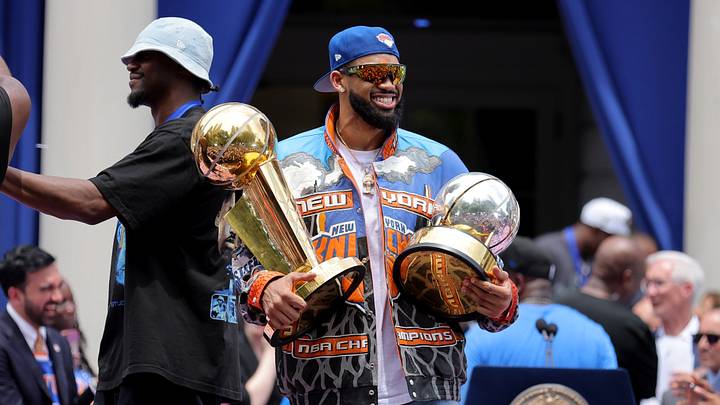
The Wolves’ financial strain benefitted the Knicks as Towns has made two All-Star appearances in as many seasons in New York. Most significantly, he adjusted his game seamlessly over their dominant run through the playoffs last season, which netted the franchise its first championship in 53 years.
Let’s take a look back at the monumental trade which was the final puzzle piece of the Knicks’ long awaited journey the NBA’s mountaintop:
Revisiting the trade terms of the deal that landed Karl-Anthony Towns in New York
- Knicks receive: Karl-Anthony Towns (via Timberwolves), draft rights to James Nnaji (via Hornets)
- Timberwolves receive: Julius Randle (via Knicks), Donte DiVincenzo (via Knicks), Keita Bates-Diop (via Knicks), Future first-round pick (from Knicks via Pistons)
- Hornets receive: Charlie Brown (via Knicks), DaQuan Jeffries (via Knicks), Duane Washington Jr. (via Knicks), three second-round picks (two from Knicks, one from Timberwolves), cash considerations
Keen eyes will recall another team was involved in the KAT trade. Charlotte jumped into the deal to make the money work. The Hornets took on a few smaller contracts from the Knicks, acquiring three fringe players. DaQuan Jeffries was the only one that would play for the Hornets, but they received a few second-round picks and some cash for their role as a salary dumping ground.
Since the Hornets had to send out something, they sent the draft rights of James Nnaji, the 31st pick in the 2023 draft, to New York. Yes, the same James Nnaji who played college basketball at Baylor last year and transferred to George Mason over the summer.
At the time of the trade, the Knicks were at a crossroads. They had been eliminated in the second round in two straight years and just acquired OG Anunoby at the trade deadline in the season before. Jalen Brunson was fresh off his best season yet, but it was clear the franchise needed more to get over the hump. Julius Randle was the No. 2 to Brunson, but he missed the entirety of the playoffs after he was shut down toward the end of the regular season due to shoulder surgery.
Donte DiVincenzo stepped up in the postseason as a key member of the “Nova Knicks” with Brunson and Josh Hart, but he would be a key piece sent to Minnesota as an affordable contract and impactful contributor. Randle was the biggest piece that went back to the Wolves as the Knicks had to send out his contract, plus it helped Minnesota’s future outlook as his deal was up three seasons before Towns’s.
The Wolves were in a similar spot when they made the trade as they just made a trip to the Western Conference finals. However, an increasingly expensive roster that would balloon over the second apron with little wiggle room to duck back under forced the team to make a franchise-altering decision. Minnesota already committed to Anthony Edwards and Jaden McDaniels with big extensions that were each about to kick in. Then there was Rudy Gobert, who the Wolves traded for two seasons prior. His maximum contract would finish in 2024–25, which put him in the market for a new deal. That plus the new world of salary cap aprons forced Minnesota to make a tough choice. Keep the current roster intact and face severe penalties for operating above the second apron for multiple seasons or part with one of the bigs.
Edwards was on a consistent rise to superstardom. This was his team. Compared to Gobert, Towns would net more on the trade market and his contract extended well past Gobert’s, which gave the Wolves optionality as they looked to put a championship team around Edwards. It was the new reality of the new CBA, but that didn’t make the decision to part with a franchise icon any less difficult.
"The whole idea of trading people I think is pretty gross and weird, and it's hard to get players of this caliber, so to ensure to do that, we had to give up one of the best players to ever put on a Timberwolves jersey,” Wolves president of basketball operations Tim Connelly said after the trade in 2024. “As good of a player as [Towns] is, he’s a better guy, so New York got a heck of a player and a better person. He’ll be missed; we’re super excited, but again, just want to let New York know they got a special guy.”
Towns arrived in New York just months after the Knicks sent a massive haul of first-round picks to the Nets for Mikal Bridges, which reunited another Villanova Wildcat with some of his college teammates. However, the trade with the Wolves was the move that completed the Knicks’ eventual championship group of Towns, Brunson, Anunoby, Bridges and Hart. It took a season as they were eliminated in the Eastern Conference finals in the first year with the unit together, which led to Tom Thibodeau’s departure in favor of Mike Brown. From there, the rest was history.
- 2027 NBA Championship Predictions: Which Team Will Hoist the Larry O’Brien Trophy?
So, who won the deal?

This one’s pretty easy. When a trade leads to one team winning a title two seasons later, that team came out on top. Towns has given the Knicks at least 20 points per game over the last two seasons as the team’s second leading scorer to Brunson. Over the dominant playoff run, he adjusted his role to create more for his teammates. He was limited as a scorer in the Eastern Conference finals and during the Finals against the Spurs, but he still knocked down big shots and was a huge part of New York’s title team. Plus, “The Big Bodega” is certainly a fan favorite in New York, just as he was—and continues to be—in Minnesota.
Towns is currently eligible for an extension, which is the first difficult decision the Knicks face to keep their title team together for the long haul. Last week, ESPN’s Shams Charania reported that contract talks between the two had stalled. Towns is under contract for two more years with a $61 million player option in the final year of his deal (2027–28). Knicks owner James Dolan desperately wants to avoid the second apron, which his team is currently $3.3 million below. Towns can sign up to a four-year, $227 million deal, which would put him around $70 million annually. He’s been huge for New York, but that’s way too much for a second option. He could take a discount to remain with the Knicks when his deal is up and there’s plenty of time to reach an agreement on an extension, but how long New York can keep this team intact while ducking the second apron is something to monitor.
Minnesota isn’t necessarily a loser in the trade. The Wolves set up the roster for the future and avoided the second apron for multiple seasons, although they had to operate as a second apron team the season after Towns was traded. With him still around, though, they would’ve faced additional ramifications for being a repeater. Of course, Minnesota has yet to get over the hump. The franchise made the Western Conference finals once again with Towns gone but with the dominance and rise of the Thunder and Spurs, getting to the Finals and winning a title is only becoming more difficult.
The Wolves reshuffled their roster again this summer when they dumped Randle’s contract to the Nets to then acquire LaMelo Ball. The Wolves knew they needed to do something this offseason to compete with the class of the Western Conference, and pairing Edwards with Ball is just that. Notably, if the Wolves were over the second apron, the trade for Ball would’ve been impossible.
Grading the KAT trade two years later
At Sports Illustrated, we put on our teacher’s glasses and assign a letter grade for every notable trade. We figured we’d do that now that most of the dust has settled from the big deal.
- Knicks: A+. Any trade that leads to a championship passes with flying colors. Yes, New York made other big deals to put its title team together, but the move for KAT was debatably the most significant.
- Wolves: B. Minnesota had to make a move as its roster got more expensive and it stared multiple seasons of the second apron in the eye. Still in the second tier in the West, the Wolves did fine in this deal, they just haven’t gotten where they need to be yet.
- Hornets: B+. Thanks for being here, Charlotte. We couldn’t have done it without you and you got some draft capital for the trouble.
PODCAST 🎧: Listen to SI’s NBA podcast, Open Floor, below or on Apple and Spotify. Watch the show on SI’s YouTube channel.
 Add us as a preferred source on Google
Blake Silverman is a writer at Sports Illustrated, primarily covering the NBA and WNBA. Before joining SI in November 2024 as a breaking/trending news writer, he covered the WNBA, NBA, G League and college basketball for numerous sites, including Winsidr, SB Nation and A10Talk. He’s an alum of both Michigan State and St. Bonaventure University, receiving a master’s degree from the Bonnies’ sports journalism program. Outside of work, he’s a husband, father, yogi and fairly mediocre tennis player who’s open to any tips on how to play defense in EA Sports College Football.
Follow blakesilverman