%20%20--%3E%0A%3Csvg%20version%3D%221.1%22%20id%3D%22Layer_1%22%20xmlns%3D%22http%3A%2F%2Fwww.w3.org%2F2000%2Fsvg%22%20xmlns%3Axlink%3D%22http%3A%2F%2Fwww.w3.org%2F1999%2Fxlink%22%20x%3D%220px%22%20y%3D%220px%22%0A%09%20width%3D%2239px%22%20height%3D%2240px%22%20viewBox%3D%220%200%2039%2040%22%20enable-background%3D%22new%200%200%2039%2040%22%20xml%3Aspace%3D%22preserve%22%3E%0A%3Cpath%20fill%3D%22%23FFFFFF%22%20d%3D%22M38.5%2C7H28.2v26h10.3V7z%22%2F%3E%0A%3Cpath%20fill-rule%3D%22evenodd%22%20clip-rule%3D%22evenodd%22%20fill%3D%22%23FFFFFF%22%20d%3D%22M26.1%2C25.5c0%2C5.8-4.1%2C7.5-12.9%2C7.5C3.9%2C33%2C0%2C31.2%2C0%2C25.2v-1.1h11.6%0A%09v2.4c0%2C0.7%2C0.1%2C1.4%2C1.2%2C1.4c1%2C0%2C1.2-0.4%2C1.2-1.3v-0.9c0-1.6-0.9-1.6-3.5-2.2C2.2%2C21.7%2C0%2C19.7%2C0%2C15.3v-0.9C0%2C9.3%2C5.5%2C7%2C12.9%2C7%0A%09c10.2%2C0%2C12.8%2C2.6%2C12.8%2C7.4v1.8h-11v-2.9c0-0.6-0.4-1.1-1.2-1.1c-0.6%2C0-1.2%2C0.4-1.2%2C1.1v0.9c0%2C1.5%2C0.9%2C2%2C3.3%2C2.5%0A%09c8%2C1.6%2C10.5%2C3.3%2C10.5%2C7.5V25.5z%22%2F%3E%0A%3C%2Fsvg%3E%0A)
Albert Breer’s Takeaways: Steelers Are All In to Give Themselves One More Shot
Jump to a topic
- Pittsburgh Steelers
- Nick Chubb
- Jacksonville Jaguars
- Washington Commanders
- Los Angeles Chargers
- Dae’Quan Wright
- Preseason games
- Quick-hitters
I’ve now seen 23 teams live and have a couple more coming this week. And there’s plenty of takeaways to get to, so let’s dive in.
Pittsburgh Steelers
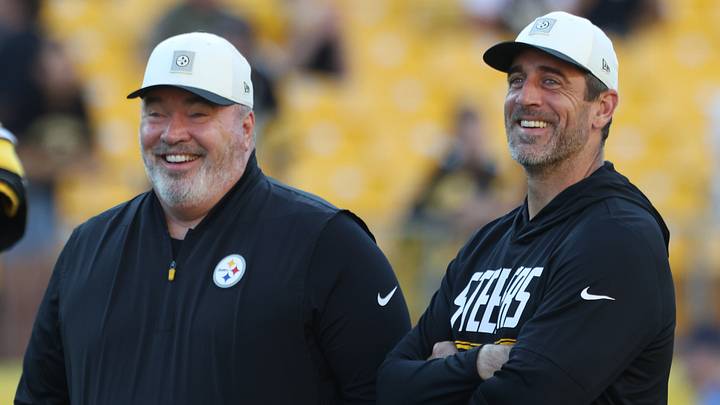
There’s a logical way to look at the Steelers’ construction for 2026. I got my hand up as a guy who thought, for sure, the Aaron Rodgers experiment was a one-year thing—and that Mike Tomlin’s departure created a good opportunity to hit the reset button and do what they’ve always done: find a really good young defensive coach to take over (I would’ve pegged Rams DC Chris Shula for the job in January).
Instead, Rodgers is back, and Mike McCarthy, an offensive-bred 62-year-old who became the oldest head coach in the franchise’s 94-year history on his first day, is joining him.
It makes sense for this year, honestly. And after spending a day there as they broke camp in Latrobe, Pa., I got a pretty full picture on that—and how it goes for so many different corners of an aging roster that’s together for one last shot. Here’s a few of those ways …
• Obviously, McCarthy’s background with Rodgers will allow for the Steelers to build an offense for him that will leverage every bit of his experience and knowhow. And as a play-caller, that background, of course, should allow for coach and quarterback to have a good rhythm within the game (yes, they also have had their rocky moments, but those help, too).
• If the starting skill players around Rodgers wind up being, say, DK Metcalf, Michael Pittman Jr., Pat Freiermuth, Darnell Washington Jr. and Rico Dowdle, then that’s a total of 32 seasons of NFL experience between five guys. Sub third receiver Roman Wilson in for Washington and it’s still 31 years, with four of the five having at least six years in. That’s a ton of tenure, and should allow for Pittsburgh to be versatile and complex, and get the most from Rodgers.
• On defense, new coordinator Patrick Graham brings a scheme with a lot of exotic looks and flexibility, and it takes vets to run it. He has those types on every level—with T.J. Watt and Cam Heyward up front, Patrick Queen and a wise-beyond-his-years Payton Wilson on the second level, and Jalen Ramsey, DeShon Elliott and Jamel Dean on the back end.
🏕️🏕️ 5⃣ from @Steelers 🏕️🏕️
— Albert Breer (@AlbertBreer) August 18, 2026
🏈 @AaronRodgers12 helping next generation.
🏈 Deep well of skill talent in place.
🏈 Right side of OL a swing factor.
🏈 Veteran crew on D fits Pat Graham.
🏈 Team's age makes depth a 🔑.https://t.co/dWE08ilbmZ
Now, of course, with older players, there’s increased injury risk, implications on how you can run practice, and general wear and tear happens as the year goes on. So you’re walking a narrower path to contention. But, again, there’s decent logic to all this.
As for 2027 and beyond, obviously the Steelers will worry about that when they get there.
Nick Chubb
There are few things the star-crossed Browns have gotten right over the 27 years since they re-entered the NFL, but here’s one of them: the 2018 selection of running back Nick Chubb with the 35th overall pick. Chubb, now 30 years old, retired from the NFL over the weekend after eight seasons. Few players have deserved an appreciation for what they accomplished like Chubb does.
Simply put, I can’t think of many guys who said less and accomplished more than Chubb.
He first came on my radar as a college player, a freshman who blew everyone’s doors off after Georgia lost Todd Gurley to a torn ACL in 2014. Chubb had his own gruesome knee injury to fight back from a year later, but by the time all was said and done, he had played his way back into the first-round discussion ahead of the 2018 draft.
Going into that draft’s second day, Cleveland had Chubb circled at 35. GM John Dorsey made the call to take Nevada offensive lineman Austin Corbett at 33, trusting the Giants, who took Saquon Barkley second overall, wouldn’t take a back at 34. Dorsey saw Chubb as pretty close to a sure thing.
“I don’t remember if this actually happened, but that was one of those ones where you turn the card in right away,” remembered then-Browns assistant GM Eliot Wolf. “Just as far as vision inside, between the tackles, feet, natural feel, squareness, all those things, Nick was as good as I’ve seen.”
That all manifested. Chubb fell 4 yards short of 1,000 as a rookie, then reeled off four straight 1,000-yard seasons, topping 1,250 in three of them, and getting to 1,494 and 1,525 in 2019 and ‘22, respectively, while making the Pro Bowl after each of those four seasons. Add in his receiving yardage and and he broke 1,750 yards from scrimmage in 2019 and ’22. He averaged more than 90 rushing yards per game from 2019 through ‘22, which underlined his consistency.
There was the famous game against the Raiders in Week 4 of Chubb’s rookie year that showed his skills right away. He played just three offensive snaps in the game and had three carries for 105 yards and two touchdowns, keeping Cleveland in a 45-42 overtime loss to Oakland. Less than three weeks later, starter Carlos Hyde was traded and it became Chubb’s show.
But more than just those spectacular moments, with Chubb, there was the unmistakable leadership element that set him apart. Head coach Kevin Stefanski was hired before Chubb’s third season and, as he built his program, quickly grew a rare affinity for Chubb.
“He was everybody’s favorite player—and that’s his teammates’ favorite, his coaches’ favorite,” Stefanski, now in Atlanta, says. “I know I’m not supposed to have favorites, but he was my favorite. I always get that question from young kids: Who’s your favorite player? And I know you’re not supposed to say, kind of like you’re not supposed to say who your favorite kid is, but I would always reply, Nick Chubb. He was a joy to coach.”
So much so that the coach has kept a specific picture on his phone that exemplifies Chubb. In September 2023, Chubb suffered another unsightly injury to the same knee he hurt in 2015, and this one was thought to be career-threatening. A year later, in September 2024, Stefanski was looking out his office window at 7 a.m., the sun barely up yet, and there was Chubb, in a helmet, football under his arm, running sprints, straining to get back.
“He wasn’t doing it for anyone to see, I know that to be a fact,” Stefanski said. “But, man, it’s this quiet, disciplined mentality that I think just permeated through the entire locker room, which is so, so, so rare in this day and age.”
WELCOME BACK, NICK CHUBB. YOU WERE MISSED.
— Sports Illustrated (@SInow) October 20, 2024
(via @NFL)pic.twitter.com/3UQptIDn5G
So, yes, Stefanski has his favorite plays from his favorite player. There were a pair of runs in a game earlier in Chubb’s career where the coach said into the headset, “Those are the best back-to-back runs I’ve ever seen from a running back.” There was the 70-yarder on a gap run in Cincinnati in 2021 that was schemed, blocked and run in a way that Stefanski would describe as “football nirvana” (and it was accompanied by a legendary, “he’s running to the river” by late Browns play-by-play man Jim Donovan). In so many ways, Stefanski echoed Wolf in saying Chubb was at the top in power, agility, foot quickness and contact balance.
But, like it is for most who’ve been around Chubb, for Stefanski, it’s who he was—as much as what he was—that was most memorable. He embodied what all coaches want in a player.
“One hundred percent,” Stefanski said. “He’s one of the greatest I’ve been around.”
That’s quite a legacy to leave.
Jacksonville Jaguars
The Jaguars have their act together going into their second year of the current regime. I was there last week, and that’s one thing that stands out: For a franchise that has had so much infighting over the years and so many mismatched bosses, everything seems to be straightened out now, allowing the football people to actually build some momentum.
A lot of this goes back a long way. Owner Shad Khan’s first coaching hire in 2012 was Mike Mularkey, who was matched with long-time GM Gene Smith. The next year, both were fired, and Khan paired Falcons exec David Caldwell with Seahawks DC Gus Bradley as GM and coach. Then Bradley was fired and replaced with Doug Marrone in 2016. Tom Coughlin was put over the top of both. Caldwell was then replaced with Trent Baalke in November 2020. Urban Meyer was then paired with Baalke before he was fired and replaced with Doug Pederson.
That’s a lot of half-measures, a lot of people without experience working together in arranged marriages and folks on different timelines, and all of it under the backdrop of an owner, Khan, who isn’t in the office day to day and thus wasn’t around to officiate so many of the squabbles that would undermine the organization.
Thus, I’d say the hiring of Tony Bosell as executive vice president of football operations in February 2025 came with a healthy dose of self-awareness on the owner’s part. And getting to see Boselli work in person showed me that.
🏕️🏕️ 5⃣ from @Jaguars 🏕️🏕️
— Albert Breer (@AlbertBreer) August 18, 2026
🏈 @TrevorLawrence loaded for bear with WRs.
🏈 A new-look run game.
🏈 OL still has questions to answer.
🏈 Defensive front 📈📈📈.
🏈 The @TravisHunterJr plan.https://t.co/g10y1bcJ2O
One of the biggest strengths of ex-players that become GMs or head coaches, as I see it, is that they usually don’t need the job for any sort of self-validation. Mike Vrabel, DeMeco Ryans and Dan Campbell—to pick three—accomplished a ton as players and have legacies that are secure. They’re not coaching to prove something. They’re coaching because they choose to. So they’re free of some of the pressure a career coach might have in showing how good he is, and are less desperate to hang on to a job because it might be their only shot.
I just sense Boselli being the same way with general manager James Gladstone and head coach Liam Coen, who, after time spent together with the Rams, have the shared time on task together that all the ex-Jaguars decision-makers lacked. Boselli’s job is, essentially, to set the table for Coen and Gladstone and make their jobs easier, taking on any responsibility that may get in the way of coaching the team or building the roster and making sure the alignment is right.
Personally, I think that showed in the swift, decisive player acquisition and scheme installation you saw in Jacksonville last year, and in how they were able to hit on midlevel guys such as Jakobi Meyers, Robert Hainsey, Dennis Gardeck and Jourdan Lewis, while fitting the pretty talented group (in particular guys like Trevor Lawrence, Parker Washington, Anton Harrison and Travon Walker) they inherited into the new way of doing business.
Does it mean the Jags are going to start winning Super Bowls? No, it doesn’t.
But that team-building buzzword—alignment—is present and apparent in Jacksonville now after it had been absent for a long time. That gives the Jaguars a heck of a chance.
Washington Commanders
It has been a different summer in Washington. Dan Quinn took a very real look at all that went wrong in 2025, when the Commanders fell seven games off their 2024 pace, sinking all the way down to 5-12. And yes, injuries, primarily to star quarterback Jayden Daniels, were part of it.
But just as much, he saw a team that lost the edginess it played with in his first year.
So camp has been hard on the players. Longer practices. More conditioning. Higher intensity. And most interesting to me is how Quinn is pushing game situation after game situation after game situation on his players and new coordinators.
“Two new systems, a lot of battling back and forth,” said Quinn, who’d post results in the building. “And so I know the players enjoy those periods as well, not just two-minute back and forth, but, Hey, man, these are all third and fourth downs. This is the next space, these are all fourth downs. So we just made it like you and me were playing like a best of five—Hey, it’s 4th-and-3, 4th-and-7, 4th-and-1 and play it out, winner/loser, have at it. And so I think they all got a little sharper and stronger because it was a little bit on the edge.
“And so that was a big piece of it in the competitions. And then not having as many scripted periods helped some because that also can raise the stress. … Also did it in one-on-ones, like you were going against me, you were a receiver, I was a DB, go Breer against Quinn and put that on the board. It was as many of those as I could. I just tried to ramp everything up.”
There’s a benefit there to new OC David Blough and DC Daronte Jones, who have no play-calling experience in the NFL between them, and only one year of doing it in college (that was Jones at LSU in 2021). By loading practices up with 11-on-11 “call it” periods—where there’s no script and the coordinators are simply making calls against each other based on situations Quinn is presenting—Blough and Jones are getting very valuable reps.
And beyond just that, there’s mental and psychological weight being put on the players. The new coordinators are bringing in systems that are more complex and versatile than what Quinn had the last two years, with Blough’s system inspired by Bears coach Ben Johnson and Jones’s based off the Brian Flores scheme he worked in with the Vikings. As part of that, the guys on the field have more command over checks and adjustments, and the structure of practice is pushing them and testing whether they know what they’re doing in their positions.
“It’s not scripted,” Daniels told me. “It’s not only me, it’s on the rest of the skill position group to study what we need to study because it’s not scripted, where you might get the script, and, O.K., you know you’re running these four plays in a row. Now he can call anything, and we all gotta be prepared for it. That’s been the most fun part about it, just seeing where his mind’s going, and he’s trying to play that chess game with Daronte in what he’s gonna call—giving me answers here, giving me a kill here or an alert here.
“It’s been fun to do that. It’s a cat-and-mouse game with our defense, for sure.”
It’s different. It was cool to see. And I could tell, talking to the guys there, that they can’t wait for everyone else to get a look at what it’s helping the Commanders build.
🏕️🏕️ 5⃣ from @Commanders 🏕️🏕️
— Albert Breer (@AlbertBreer) August 20, 2026
🏈 Dan Quinn trying to revive his team’s edge.
🏈 Blough taking a different approach with @JayD__5.
🏈 WR room feeling Stefon Diggs’ presence.
🏈 OL questions are lingering.
🏈 Daronte Jones’ D prizes versatility.https://t.co/yxndeLm5n4
Los Angeles Chargers
The Chargers losing center Tyler Biadasz is a really tough blow. There was no addition that GM Joe Hortiz and coach Jim Harbaugh made this offseason they were more excited about. They thought the ex-Cowboy and ex-Commander had a ton left in him, and his experience through six NFL seasons and 84 starts at center was going to make him an ideal pivotman for Mike McDaniel’s scheme, one that puts a lot on the position mentally.
Chargers place C Tyler Biadasz (knee) on season-ending IR. pic.twitter.com/Civ71sBPRj
— NFL (@NFL) August 23, 2026
It sucks that he suffered a season-ending knee injury for the Chargers. No getting around that.
But if there’s one silver lining, it’s the presence of rookie Jake Slaughter, the team’s second-rounder who started 33 games at Florida at center and came in with a reputation for being one of the draft’s most football-smart lineman. He’s also athletic and tough for the position, so the question is going to be how quickly he adjusts to a heightened level of play.
He was also in contention for the one open spot on the Chargers’ O-line, at left guard, so taking him out of that mix thins the field in that race. Ex-Eagle and Lion Kayode Awosika, former Saints first-rounder Trevor Penning and 2025 sixth-rounder Taylor Branson are left vying to start there, with another former first-rounder, Cole Strange, entrenched at right guard.
There’s another reason this is all pretty important: The foundation of the Chargers has been built through the offensive line. That’s what made their 11 wins last year without left tackle Rashawn Slater and (mostly) right tackle Joe Alt so remarkable. Bottom line: If that line group is humming, I don’t think there’s a ceiling on where the Chargers can go in 2026. That’s what makes guys like Slaughter, Awosika, Penning and Branson so vital.
Dae’Quan Wright
I’m speechless at the news that TE Dae’Quan Wright will be waived by the Browns and join LSU and play for Lane Kiffin if he clears waivers. ESPN’s Adam Schefter had that Sunday. And while we all heard this train coming down the tracks, I’m not sure I was fully prepared for when the wreck actually became real.
Could this mean that next week at this time, at the cutdown, players are mulling whether to join practice squads in Jacksonville or New Orleans … or the Indiana Hoosiers? It looks like it.
And that’s only indicative of how willing the powers that be at the college level have been to let this happen. The primary culprit, as I see it, is retired NCAA president Mark Emmert. I’d say for a good quarter-century (if not more) before it happened, we all knew that eventually the jig was going to be up for the big-time schools and players were going to get paid. The NCAA, in turn, had all that time to prepare for the inevitable and get a deal done with the players.
Instead, under Emmert’s direction, they simply let the old crooked system run its course until July 2021, when the courts told the schools it couldn’t be done that way anymore. Emmert announced he was stepping down in April 2022, running from the problem he was complicit in creating, allowing for others to clean the mess his negligence created.
There was a way out, and now I’m not sure there is, because it’s in the hands of the courts and the lawyers that work within them. And that has had a cascading effect that goes well beyond the college football and basketball players that have a legit shot at the NFL and NBA.
The NFL also, in my mind, should’ve done way more to try and help—I know former NFL exec Brian Rolapp was attempting to do so through his relationship with the networks—because big-time college football is so integral and so beneficial to how they operate. But that’s another case, and another argument, where people’s self-interest has gotten in the way of better big-picture thinking (example: the NFL big-footing the College Football Playoff).
Anyway, the sport needs real leadership on this one because this is a mess that’s only going to get bigger.
Preseason games
As we’ve seen this preseason, games are continuing to move further and further toward being glorified tryouts, with most of the guys who’ve nailed down roles sitting. So if you’re competing to start or make the team, you’ll play. But if you’re a big part of your team’s plan? Your biggest decision might be what hat you wear for the cameras.
With Atlanta and Cleveland still working through quarterback competitions, there are 30 starting quarterbacks in the league. Here’s how their teams used them this weekend …
• 19 of the 30 sat out their games entirely.
• Of the 11 who played, seven played a single series.
• Bryce Young, Bo Nix and Baker Mayfield played two series apiece, then came out. Cam Ward played three series, going into the second quarter.
Last week, remember, was what’s generally considered the “dress rehearsal” week, where teams switch from a training-camp schedule to one more like the regular-season schedule, and have normally treated the game more seriously. When I started covering the league, a lot of coaches liked to play their starters a series into the third quarter so they’d get the experience of coming in and out of the locker room together. That practice is long gone.
What’s in its place is teams leaning more into the controlled, repetition-rich environments that joint practices provide, allowing for coaches to generate whatever situations and circumstances they need to test their players in, while mitigating the injury risk. Honestly, I don’t mind that at all, and while it sucks for the audience, joint practices are a great take for fans, and the league could do more with those, for sure.
I just wish the NFL would stop selling these games as anything approximating what we’ll see less than three weeks from now.
Quick-hitters
It’s time for the quick-hitting takeaways …
• I don’t think it’d be a terrible idea for the Browns to call the Giants about Jameis Winston. He has played in Cleveland, so he understands the dynamics there, and he was with Todd Monken for three years (2016 to ’18) in Tampa.
• Speaking of the Browns, defensive end Alex Wright’s season-ending Achilles rupture is a very big loss for the team. He was having a really nice camp, and was expected to make an impact opposite Jared Verse.
• Since I haven’t touched on the divergent 49ers and Rams plans for Australia, I think it’s relatively easy to break down. The Niners are going for a week to try and acclimate to the time change, while the Rams’ approach is to ride it out so they don’t have to acclimate back ahead of Week 2. We’ll see what impact either has. Obviously, there’s no precedent here.
• Great to see Niners tight end George Kittle is making his way back. And it’s pretty unbelievable, given that he tore his Achilles just eight months ago in the wild card round of the playoffs.
• Our hearts go out to Ed Oliver and his family. Just an unspeakable tragedy.
• Big week in Atlanta with Michael Penix Jr. returning to 11-on-11 work. It’d be great if Penix showed he could be a viable answer for Week 1. Tua Tagovailoa has had every opportunity to take the job, and that hasn’t happened.
• Ashton Jeanty’s injury certainly could impact when the Raiders turn to quarterback Fernando Mendoza. A big part of the decision on when to play the rookie, I’ve been told, will be tied to the rest of the offense’s ability to support him. Losing running back Jeanty is a big blow in that regard.
• Harrison Butker’s 69-yard field goal was wild—it did look like it might’ve been good from 75. It also makes you wonder if we’re getting close to a point where the NFL looks at tightening the goal posts or something to make field goals more challenging. I’d be against that because I hate punishing people for being good at something.
• That Christian Gonzalez and the Patriots haven’t done a deal yet, nine days after Devon Witherspoon got one done in Seattle, makes you wonder who’s holding their line. It’s also worth noting that it has been a long time since New England paid a homegrown player at a premium position at the very top of the market, which is what it’s going to take to get this one done.
• The Aaron Donald watch continues …
 Add us as a preferred source on Google
Albert Breer is a senior writer covering the NFL for Sports Illustrated, delivering the biggest stories and breaking news from across the league. He has been on the NFL beat since 2005 and joined SI in 2016. Breer began his career covering the New England Patriots for the MetroWest Daily News and the Boston Herald from 2005 to ’07, then covered the Dallas Cowboys for the Dallas Morning News from 2007 to ’08. He worked for The Sporting News from 2008 to ’09 before returning to Massachusetts as The Boston Globe’s national NFL writer in 2009. From 2010 to 2016, Breer served as a national reporter for NFL Network. In addition to his work at Sports Illustrated, Breer regularly appears on NBC Sports Boston, 98.5 The Sports Hub in Boston, FS1 with Colin Cowherd, The Rich Eisen Show and The Dan Patrick Show. A 2002 graduate of Ohio State, Breer lives near Boston with his wife, a cardiac ICU nurse at Boston Children’s Hospital, and their three children.
Follow AlbertBreer