%20%20--%3E%0A%3Csvg%20version%3D%221.1%22%20id%3D%22Layer_1%22%20xmlns%3D%22http%3A%2F%2Fwww.w3.org%2F2000%2Fsvg%22%20xmlns%3Axlink%3D%22http%3A%2F%2Fwww.w3.org%2F1999%2Fxlink%22%20x%3D%220px%22%20y%3D%220px%22%0A%09%20width%3D%2239px%22%20height%3D%2240px%22%20viewBox%3D%220%200%2039%2040%22%20enable-background%3D%22new%200%200%2039%2040%22%20xml%3Aspace%3D%22preserve%22%3E%0A%3Cpath%20fill%3D%22%23FFFFFF%22%20d%3D%22M38.5%2C7H28.2v26h10.3V7z%22%2F%3E%0A%3Cpath%20fill-rule%3D%22evenodd%22%20clip-rule%3D%22evenodd%22%20fill%3D%22%23FFFFFF%22%20d%3D%22M26.1%2C25.5c0%2C5.8-4.1%2C7.5-12.9%2C7.5C3.9%2C33%2C0%2C31.2%2C0%2C25.2v-1.1h11.6%0A%09v2.4c0%2C0.7%2C0.1%2C1.4%2C1.2%2C1.4c1%2C0%2C1.2-0.4%2C1.2-1.3v-0.9c0-1.6-0.9-1.6-3.5-2.2C2.2%2C21.7%2C0%2C19.7%2C0%2C15.3v-0.9C0%2C9.3%2C5.5%2C7%2C12.9%2C7%0A%09c10.2%2C0%2C12.8%2C2.6%2C12.8%2C7.4v1.8h-11v-2.9c0-0.6-0.4-1.1-1.2-1.1c-0.6%2C0-1.2%2C0.4-1.2%2C1.1v0.9c0%2C1.5%2C0.9%2C2%2C3.3%2C2.5%0A%09c8%2C1.6%2C10.5%2C3.3%2C10.5%2C7.5V25.5z%22%2F%3E%0A%3C%2Fsvg%3E%0A)
NFL Panic Meter: Ranking Every 0–2 Team Based on Desperation
In this story:
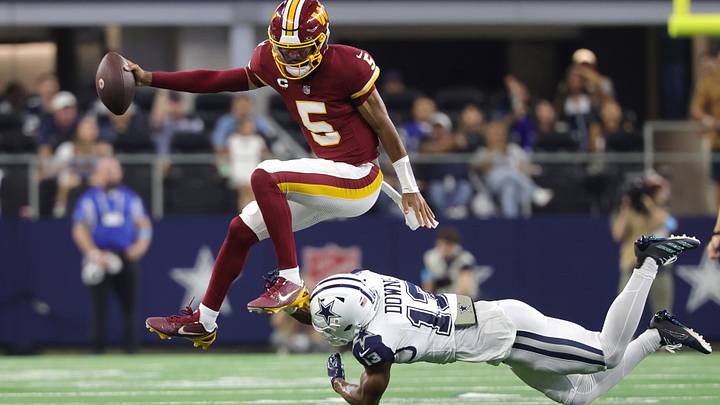
The most consequential play in recent Commanders history looked like an interpretation of football; a bunch of improv kids at Second City lining up to pratfall their way through a physical comedic exercise. Jayden Daniels lines up under center with three seconds to go in the half (we’ll come back to that later), with the Commanders trailing by a touchdown. As he takes the snap, he trips over the foot of his right guard, plants his nonthrowing hand into the ground, and then tries to hurl a one-armed pass to the running back as time expires.
Tom Brady, whose internal programming was momentarily operating in sentient human mode, said what we were all thinking the moment the slow-motion replays began to show Daniels’s elbow looking like a Tyeb Mehta painting: “Ah, shit.” I’m certain that Commanders head coach Dan Quinn was thinking the same for two reasons.
The first is obvious: Without Daniels for another season, the 0–2 Commanders are cooked. The Commanders are 3–7 when missing the former No. 2 pick and went 2–6 down the stretch after Daniels dislocated that same elbow a season ago (and then played during a lost season, re-aggravating it a second time).
Which brings us to the other thing: Quinn opted to go for it with three seconds remaining in a game that was still wide open on Sunday. When Daniels dislocated his elbow a season ago, it was in the middle of a 31-point blowout, in which some people (not me, for the record) blamed Quinn for irresponsibly handling Daniels’s health by having him out there at all. I am guessing that attempting a touchdown when a field goal would have been perfectly understandable (given the flow of the game at that point) will not deter fans from making the lazy comparison between Daniels’s post-rookie issues and the injury issues sustained by Robert Griffin III due to overuse. Quinn has a battle of optics ahead of him.
This is one of the reasons why the Commanders rank highly on my 0–2 team panic meter. We’ll be breaking down every team that has started the season winless, rating the degree of panic (out of 10) each club should be experiencing right now, starting with Washington. Since the AFL-NFL merger in 1970, only 11% of 0–2 teams have gone on to make the postseason.
I want this list to feel less a prisoner of the moment and more an exploration of panic on the grander scale at this point in time.
The score is the composite of different categories that—I feel—contribute to a groundswell of panic.
- What happened over the first two games in context
- Security of the head coach and health of the organization
- Play of young cost-controlled talent and under-contract tentpole stars
- Fan satiation over a longer period of time and relative to this year’s specific expectations
- Volume of controversial decisions, bad press conferences, and appearances that convey apathy, evident frustration or surrender
We will list the league’s eight winless teams in order of the most understandable panic to the least understandable panic.
1. Commanders
Level of panic (out of 10): 8.9
I am a certified catastrophizer and always have been. But this is now an elbow dislocation, re-aggravation and second dislocation in less than a year (sadly, at a point in the Cowboys game when Daniels really seemed to be rediscovering his magic). Behind Daniels is a team that won’t have any time to come into its own under a new set of coordinators before it gets to the point where Washington will have to decide whether it’s worthwhile to play him again this year. Washington’s schedule from here is brutal. The Commanders play the Seahawks next week—a team that, by the way, prevented the Cardinals from having a single pass of more than 10 yards, which was the first time that happened to the franchise since the strike in 1987—followed by the underrated Colts in London, the Giants, a road game against the 49ers, the Eagles, the Rams, the Giants again, and the Bengals. This is not to say that the Commanders can’t win any of these games, but I don’t think it’s out of the realm of possibility that Washington is picking in the top five of the 2027 NFL draft with Daniels having played fewer than a complete season’s worth of games combined between 2024 and 2025. If that’s the case, that complicates the team’s plans as it relates to whom the Commanders should draft and creates the foundation for possibly acrimonious contract discussions where, I’m sure, Daniels’s camp will want to base his future projections off his rookie of the year season (Daniels enters the final season before his team option in 2027).
That is why the Commanders’ panic level has suddenly reached doomsday level. We’re not just talking about an unexpectedly bad season; we’re talking about issues of long-term viability with a tentpole franchise player and a situation where you could be in position to take that player’s immediate replacement six months from now.
The Commanders made the fewest selections in the 2025 draft after Daniels led the team on a surprise trip to the NFC championship game, mostly because that capital was tied up in immediately improving the team to maintain that level of success. None of the six first-round picks the franchise had before GM Adam Peters’s arrival are on the team, providing any meaningful assistance, either. Washington has the sixth-oldest roster in the NFL, and you could argue that the team has one of the worst stockpiles of cost-controlled, under-25 talent in the NFL.
While this is a big pill to swallow after Week 2, and I’m sure I’ll be told to relax, I have to assume the team would like to walk back its aggressiveness in the post-NFC championship era to mitigate the sting of the fallout.
2. Buccaneers
Level of panic: 8.6
If we had to possess one takeaway that doesn’t feel flimsy after two weeks as it relates to the NFC South, it would be this: The Saints are tougher and more resilient than Tampa, and the tide of this division is clearly turning. Losing to the Browns in what was not only an emotional game but a draining contest that included a two-plus-hour rain delay laid bare some of the team’s most pressing issues: a lack of killer instinct on offense and the absence of a pass rush on defense. To Deshaun Watson’s credit, he transformed from one of the longest snap-to-throw times in Week 1 to one of the shortest in Week 2. Gone were the befuddling, elongated dropbacks out of the shotgun, and what remained was a quarterback who likely played his second-best game as a Brown (which is saying a lot, given that he’s been there for almost half a decade, but whatever). We can say that this couldn’t have come at a worse time for the Buccaneers, but the truth is that Tampa had enough talent to beat this Browns team soundly and, again, had two hours to script a game-winning drive having already been in Cleveland territory. Mayfield isn’t the same player confidence-wise without Mike Evans, with his EPA per play bearing that out over a two-game stretch. The Buccaneers are 29th in dropback EPA, and Mayfield continues to keep the team on a razor’s edge with every dropback (since 2024, Mayfield has seven more fumbles than the next-closest quarterback and more interceptions than anyone save for Geno Smith).
Complicating the panic is what we’ll call the Brian Daboll principle. I wrote about it here. What can be gained by grinding out a season under a head coach who increasingly appears to be on borrowed time? Tampa Bay had a chance to pivot after an end-of-season collapse last year but opted for the offensive coordinator change and a flier on Ruben Bain Jr. in the first round to help buoy Todd Bowles’s pass rush. So far, none of the levers seem to have regenerated a team whose window seems to be passing by. Tampa Bay now has the Vikings, Packers and Cowboys in successive weeks. While Minnesota could certainly suffer a comedown loss after an emotional win over the division-rival Bears, Mayfield is already playing at a sub-optimal level as one of the most pressured quarterbacks in the NFL. So far this season, Mayfield has the third-worst quarterback rating among the eight most pressured quarterbacks in the NFL, though Matthew Stafford before Monday Night Football is one and Malik Willis is the other. Mayfield is posting a worse EPA per under-pressure dropback right now than Watson, Aaron Rodgers, Carson Wentz or Cam Ward.

3. Chargers
Panic Level: 8.1
The move to acquire Mike McDaniel as offensive coordinator was, admittedly, catnip for folks like me. The conversation around McDaniel’s play-designing acumen reached sacred levels over the course of his time with the 49ers and, eventually, as the head coach of the Dolphins. But as Timo Riske of Pro Football Focus pointed out, the playbook feels too similar. Several two-man route concepts look like they would be effective for Jaylen Waddle and Tyreek Hill, but not, perhaps, for Ladd McConkey and Brenen Thompson. When plays break down, the Chargers look scattered. Quarterback Justin Herbert looks like a guy who is tired and is chucking balls out of frustration (he also slammed his helmet into the bench on Sunday). And then, there are the self-inflicted wounds, like the six fumbles the Chargers had Sunday, extraordinarily lucky to recover five of them.
Herbert was lucky not to lose a fumble deep in his own territory on Sunday. That, to me, guy sitting at his dining room table, looked like a kind of summation of anger that the Chargers have blown a gift schedule to start the season, combined with the plays where Herbert will hit David Njoku only to have the ball bobbled and picked.
But the panic level is high because Los Angeles now enters the meat of its schedule: Bills, Seahawks, Chargers, Chiefs, Rams and Chargers. This team should have had legitimate playoff aspirations. Still, it’s dealing with the very real possibility that it will be 0–4 and out of the playoff conversation entirely by the time Halloween rolls around.
These next two weeks will be not only an indictment of McDaniel, who needs to find a way to retrofit this offense and, perhaps, adjust some of the backfield theatrics for an offense that clearly can’t time it up, but also of Harbaugh, who will need to demonstrate how well he can connect with this roster and handle expectations that aren’t being met.
4. Texans
Level of panic (out of 10): 6.5
The Texans’ problem is obvious: Houston has no running game and is often put in obvious passing situations, where an offensive line that cannot support the running game also struggles to protect the quarterback. Despite having only four true three-and-outs this season over two games and coming into Sunday’s game against the Bengals with a respectable drive length and drive-time average, the impact on what was supposed to be the strength of the team—its powerhouse defense—has to be significant. The offensive performance also has to be weighing on DeMeco Ryans, who made a particularly conservative decision to take a field goal against Cincinnati on Sunday despite it being fourth-and-1.
There’s some nuance to this. Houston had four active tight ends against the Bengals on Sunday but lived in 11 personnel and threw the ball an astounding 55 times. To me, that shows a clear disconnect between the plan on paper and what is being executed in real time. Ryans wants to run the ball more efficiently, but in the first half of Sunday’s game against the Bengals, Houston posted a 0% success rate on rushes. It feels impossible—especially when QB C.J. Stroud has roughly 17 under-center snaps per game—to craft any realistic play-action out of these raw materials. It leaves the offense on the shoulders of Stroud, which, in fairness to Stroud, he seems to be handling quite well, given the circumstances.
In fairness to the running game, David Montgomery faces some of the highest percentages of eight-man boxes in the NFL, likely because the Texans are so beat up at the wide receiver position. It is an absolute rock-and-a-hard-place scenario.
That, to me, is why this “panic” feels different than the “panic” Houston had a season ago when it started the season 0–3, won three of its next five games and then 10 consecutive games to follow. The Texans spent the offseason attempting to fix the problems that led to offensive inefficiency by acquiring and drafting offensive line help, and then trading for Montgomery. But now, minus a miraculous trade deadline, there doesn’t seem to be an obvious fix on the horizon. That portion of the test is over.
Football is strange, and there certainly exists a world where Nick Caley, the Texans’ offensive coordinator, figures it out. Maybe the Texans try to live in heavier personnel to take pressure off their tackles and find a spark in the run game. Maybe the defense once again dons a cape and takes over game after game. But, again, one would have hoped those rough edges were smoothed already, especially with the entire roster lining up with a window of legitimate Super Bowl contention.

5. Colts
Level of panic: 4.5
The Colts assuaged a lot of my biggest fears on Sunday night in a 33–30 overtime loss to the Chiefs. Through two weeks, this is the second-best rushing offense in the NFL, which can provide the foundation to solve almost all ailments. Certainly, the defense allowing more than 1,000 total yards of offense over the first two weeks is a concern. Still, it may be more due to coordinator Lou Anarumo having to face, in back-to-back weeks, a completely revamped Ravens offense under a new coordinator and a completely reshaped Chiefs offense under a new coordinator. The Colts will get Lamar Jackson, Patrick Mahomes, Zay Flowers, Travis Kelce and Kenneth Walker III at the healthiest and most impactful they’ll possibly be all season before the grind of the year chips away. While a divisional matchup against Houston looms, the Colts then face the Daniels-less Commanders, the unwatchable Steelers and the Titans in subsequent weeks. In addition, the AFC South is 1–7, with the Jaguars the only team to log a victory (over the Browns) so far this year.
Shane Steichen is getting filleted right now for refusing to attempt a fourth-and-8 at the Chiefs’ 15-yard line despite trotting out the offense to see if the playcall would have worked against Steve Spagnuolo’s defense and not getting the look he wanted. But if this and a defense that hasn’t quite gelled yet are your primary issues after two weeks, the Colts have champagne problems compared to some of the other teams on this list.
Now, if we want to put the team under the same microscope as the Commanders, a continuation of this losing streak will increase the team’s panic score exponentially (the Colts’ division doesn’t produce the same kind of urgency right now). Indianapolis does not have its first-round pick from the Sauce Gardner trade, Gardner was again battling lingering rib pain and soreness last night, and the Colts have won one game since swinging the trade for the former defensive rookie of the year. Ahead of Indianapolis lies a rebuild that is not as complex as the one facing the Commanders in terms of scope, but significant in that the Colts have committed a ton of money to Daniel Jones and Alec Pierce, forcing whichever general manager inherits this team next to deal with the ramifications and, possibly, the dead money.
6. Atlanta Falcons
Level of panic: 4.3
My eyes opened a bit wider this morning when I saw Mike Silver’s column suggesting that the Falcons may start internally questioning the toughness of Michael Penix Jr. if he doesn’t get on the field soon. Penix is medically cleared to play but is not yet comfortable returning, which is understandable, given that the next serious injury Penix sustains may end his career. This doesn’t jibe with the Falcons’ timeline, since the organization wants to make a firm evaluation of Penix before approaching the coming offseason. This kind of internal strife wouldn’t be much of a needle-mover had it not been placed at the backdrop of two abysmal performances to start the season by the offense, which has yet to reach the red zone. Defensively, Atlanta had a top five defensive performance in Week 1, albeit against the Steelers. In Week 2, Atlanta’s defense suffered a bit optically, as the Panthers’ scoring onslaught included a Devin Lloyd interception returned for a touchdown, which, like the red zone statistic, is really a Cooper Rush statistic.
My concern here specifically is the timing of a lost season for the Falcons. Yes, it’s still in the very nascent stages of Bijan Robinson’s three-year extension. However, this is the age-34 season of tackle Jake Matthews and the age-29 season of Chris Lindstrom. It’s the sixth Drake London season with no meaningful place in an offense that is merely trying to survive (except for short-yardage jet sweeps, apparently), while likely placing a disproportionate amount of pressure on Robinson to make up for the lack of a quarterback. Like the Browns, the goal in Atlanta is to survive it constructively without letting a toxicity seep in. Somehow, though, Atlanta is the team whose players are jawing with fans and whose team looks altogether more disengaged through two weeks. That is a Kevin Stefanski problem.
You can argue that the Falcons are in a similar no-lose situation as the Titans, whose “franchise” young quarterback was not chosen by the current administration, thus allowing for a painless separation. But now, Atlanta’s entire optimism hinges on a coaching staff at least stringing together snippets of inspiring play from Penix when he is active in order to motivate the veteran playmakers to return in 2027, when the quarterback of choice is on the roster. The same Penix who is apparently, in their eyes, not tough enough to get on the field.
7. Titans
Panic level: 4
The last two teams in this exercise present a difficult issue: How much would you panic if you’re a new head coach inheriting an awful team, and you assume you’ll have at least one more season to get it right? Cam Ward’s performance against a very good Eagles defense was inspiring on Sunday, with Ward posting a positive EPA per play and completion percentage over expectation mark. When the Titans had a complementary run game, this offense was downright efficient. Ward still has a lot to learn, and I thought this note from Cameron Wolfe of NFL Network was interesting about a pronounced tendency of Ward’s that allowed the Eagles’ pass rush to net a critical sack.
In “neutral” offensive situations on Sunday, the Titans had one of the lowest passing rates in the NFL, eclipsing only the broken Chargers and a Seahawks team with Drew Lock at quarterback that was attempting to run the clock out against an inferior opponent. Ward showed the requisite toughness in big moments and feels like he’s coming out of his shell, which could lead to the Titans trusting him more in situations like this. Ward has already doubled his number of rushing attempts from a season ago, and looked promising when the directive seemed to be to get the ball out of his hands. Ward has run only 10 plays under center this season, but his EPA is far better than when he’s more comfortable in the shotgun. I think these growing pains are healthy and will either produce a better quarterback for next season when it matters the most, or give the Titans a definitive assessment heading into a draft year where they could be in position to take Ward’s eventual successor.

8. Dolphins
Panic level: 1
Who did not think the Dolphins would be here? Miami entered the season as the worst roster in the NFL, got clubbed by the Raiders and 49ers and now face teams that are a combined 6–0 over the next three weeks. However, if you’re coach Jeff Hafley or GM Jon-Eric Sullivan, you’re mainly concerned with how the players you’ve drafted are going to carry over to year two of this build. Tackle Kadyn Proctor looks NFL-ready and the Dolphins have the nascent stages of a workable offensive line in production. Jacob Rodriguez has been one of the team leaders in tackles each of the first two games and looks to have future Pro Bowl potential on the inside. Caleb Douglas had five catches for 94 yards in his debut (he got his ankle rolled up on in Week 2). Here’s why I say all of this: When you are inheriting such a bad roster, and when your new players are already getting contributions, it’s incumbent on the head coach to not allow the losing to dip to embarrassing proportions. Dan Campbell walked this line well during his Lions turnaround and, while a far more experienced 49ers team undoubtedly outmatched the Dolphins, there is enough silver lining to power the engine for another few weeks. Hafley must avoid the Aaron Glenn zone, where mounting game management issues and a failure to maintain a position as the voice of the franchise create unstable ground heading into year two. Miami is not there yet.
 Add us as a preferred source on Google
Conor Orr is a Senior Writer for Sports Illustrated with more than 15 years of experience covering the NFL. His work has been cited in Best American Sportswriting and has won a PFWAA award. Prior to Sports Illustrated, he covered both the Giants and Jets for The Star-Ledger. Conor lives in New Jersey with his amazing wife and three children.
Follow author