%20%20--%3E%0A%3Csvg%20version%3D%221.1%22%20id%3D%22Layer_1%22%20xmlns%3D%22http%3A%2F%2Fwww.w3.org%2F2000%2Fsvg%22%20xmlns%3Axlink%3D%22http%3A%2F%2Fwww.w3.org%2F1999%2Fxlink%22%20x%3D%220px%22%20y%3D%220px%22%0A%09%20width%3D%2239px%22%20height%3D%2240px%22%20viewBox%3D%220%200%2039%2040%22%20enable-background%3D%22new%200%200%2039%2040%22%20xml%3Aspace%3D%22preserve%22%3E%0A%3Cpath%20fill%3D%22%23FFFFFF%22%20d%3D%22M38.5%2C7H28.2v26h10.3V7z%22%2F%3E%0A%3Cpath%20fill-rule%3D%22evenodd%22%20clip-rule%3D%22evenodd%22%20fill%3D%22%23FFFFFF%22%20d%3D%22M26.1%2C25.5c0%2C5.8-4.1%2C7.5-12.9%2C7.5C3.9%2C33%2C0%2C31.2%2C0%2C25.2v-1.1h11.6%0A%09v2.4c0%2C0.7%2C0.1%2C1.4%2C1.2%2C1.4c1%2C0%2C1.2-0.4%2C1.2-1.3v-0.9c0-1.6-0.9-1.6-3.5-2.2C2.2%2C21.7%2C0%2C19.7%2C0%2C15.3v-0.9C0%2C9.3%2C5.5%2C7%2C12.9%2C7%0A%09c10.2%2C0%2C12.8%2C2.6%2C12.8%2C7.4v1.8h-11v-2.9c0-0.6-0.4-1.1-1.2-1.1c-0.6%2C0-1.2%2C0.4-1.2%2C1.1v0.9c0%2C1.5%2C0.9%2C2%2C3.3%2C2.5%0A%09c8%2C1.6%2C10.5%2C3.3%2C10.5%2C7.5V25.5z%22%2F%3E%0A%3C%2Fsvg%3E%0A)
Selecting the Best NFL Draft Pick Ever for Every Team
In this story:
With the NFL draft coming up in less than two weeks, there are always a few fun exercises to consider. For example, who is the biggest steal every team has ever executed? Who is the biggest bust? Who’s the biggest what-if?
This year, we decided to be positive and look at the greatest player ever drafted by all 32 franchises. For some teams with shorter histories, the choice was obvious. For some with generational quarterbacks, the decision was also easy enough. But for some, especially teams that have been around since the dawn of the NFL, it was incredibly tough.
For our picks, we weighed not only the best players (though that was the main factor), but also the value of the pick. If it was close between a first-round pick and a third-round choice, that value mattered.
So, with that in mind, here are the choices for all 32 teams, starting in the desert.
Arizona Cardinals: Larry Wilson, S
Selection: 1960, seventh round (No. 74)
Despite being an original member of the NFL, the Cardinals don’t have as many terrific selections as more than 100 years might suggest. However, they nailed their seventh-round choice in 1960, selecting Wilson from the University of Utah. Inventor of the safety blitz, Wilson was a five-time first-team All-Pro and an eight-time Pro Bowler, credited with 52 interceptions and (unofficially) 21 sacks.
Atlanta Falcons: Julio Jones, WR
Selection: 2011, first round (No. 6)
There’s an argument to be made for Deion Sanders, but he didn’t play with the Falcons long enough. Jones cost Atlanta five picks to move up, but the trade was worth it. In Atlanta, Jones posted 12,896 receiving yards and 60 touchdowns over a 10-year career, including one of the greatest catches of all time in Super Bowl LI. Jones should eventually wind up in the Hall of Fame after being a five-time All-Pro.
Baltimore Ravens: Ray Lewis, LB
Selection: 1996, first round (No. 26)
The Ravens have several options here, including a fellow 1996 first-rounder in Hall of Fame left tackle Jonathan Ogden, but Lewis is the choice. Coming from the University of Miami (FL), Lewis became a first-ballot Hall of Famer by amassing 10 All-Pro honors and 12 Pro Bowl berths, while also being named Super Bowl XXXV MVP and a two-time Defensive Player of the Year. Lewis also earned a spot on the 2000s All-Decade Team while totaling an NFL-record 2,059 total tackles.
Buffalo Bills: Andre Reed, WR
Selection: 1985, fourth round (No. 86)
A seven-time Pro Bowler and two-time second-team All-Pro, Reed wasn’t expected to do much when he was a fourth-round pick out of Kutztown State (PA). However, the wideout shined in Buffalo’s K-Gun offense, totaling four 1,000-yard seasons and more than 13,000 receiving yards. Reed spent 15 years with the Bills, helping them transform from a 1980s cellar-dwellar to a four-time AFC champion in the ’90s.
Carolina Panthers: Julius Peppers, DE
Selection: 2002, first round (No. 2)
An argument could be made for Cam Newton and Luke Kuechly, but Peppers is the greatest player to wear the teal and black. A No. 2 pick out of North Carolina, the local product became an instant star, winning Defensive Rookie of the Year honors in 2002 with 12.5 sacks. A six-time All-Pro who earned spots on both the 2000s and 2010s All-Decade Teams, Peppers finished with 159.5 sacks in his Hall of Fame career, including 10 seasons with double-digit totals.

Chicago Bears: Walter Payton, RB
Selection: 1975, first round (No. 4)
For as many great players as the Bears have had over their storied history, nobody compares to Payton. Payton was a singular talent coming out of Jackson State in 1975, carrying Chicago out of the wilderness and eventually to glory in Super Bowl XX. When Payton retired after the ’87 season, he held the NFL’s all-time rushing record with 16,726 rushing yards while also being named an eight-time All-Pro.
In 1977, Payton won both league MVP and Offensive Player of the Year honors on his way to becoming a first-ballot Hall of Famer.
Cincinnati Bengals: Anthony Munoz, OT
Selection: 1980, first round (No. 3)
Munoz is the greatest player in Bengals history. Drafted from USC to start the 1980s, the hulking 6' 4" left tackle instantly became one of the best players in football. When the NFL Network named the Top 100 players of all time in 2010, Munoz ranked 12th on the list, the highest of any offensive lineman. The Cincinnati superstar was a nine-time first-team All-Pro and earned induction into the Hall of Fame on the first ballot in 1998.
Cleveland Browns: Jim Brown, RB
Selection: 1957, first round (No. 6)
Brown has a strong case as the greatest football player ever. Drafted out of Syracuse in 1957, Brown played nine seasons and won eight rushing titles. In 1963, Brown rushed for 1,863 yards over a 14-game season, and the following year led Cleveland to its last championship. An eight-time first-team All-Pro, Brown was also a three-time NFL MVP, including his final season, which he played at age 29, rushing for a league-best 1,544 yards and 17 touchdowns.
Dallas Cowboys: Bob Lilly, DT
Selection: 1961, first round (No. 13)
Lilly was the first star the Cowboys ever produced, and remains the most synonymous with the franchise’s rise to becoming America’s Team. Lilly played 14 seasons in Dallas and was named to the 1960s and ’70s All-Decade Teams while racking up 95.5 unofficial sacks. He was also a seven-time first-team All-Pro and an 11-time Pro Bowler, and finally won a Super Bowl after multiple close calls in the 1971 season, beating the Dolphins.
Denver Broncos: Terrell Davis, RB
Selection: 1995, sixth round (No. 196)
The only real decision was between Davis and tight end Shannon Sharpe. While both ended up in Canton, the choice is Davis, who remains one of the greatest postseason performers of all time. In the playoffs, Davis ran for 1,140 yards and 12 touchdowns in eight games, winning two Super Bowls and earning Super Bowl XXXII MVP honors. For his seven-year career, Davis was a three-time first-team All-Pro and won the 1998 NFL MVP, rushing for 2,008 yards.
Detroit Lions: Barry Sanders, RB
Selection: 1989, first round (No. 3)
No contest. Had Sanders not retired early, he would have almost certainly become the NFL’s rushing king and the only player to run for 20,000 yards. Sanders rushed for 15,269 yards across 10 seasons and was both an All-Pro and Pro Bowler in each of them. Despite never playing with a quality quarterback, Sanders never rushed for fewer than 1,100 yards in a season and in 1997 led the NFL with 2,053 yards while splitting MVP honors with Packers quarterback Brett Favre.

Green Bay Packers: Bart Starr, QB
Selection: 1956, 17th round (No. 200)
There are legions of players to choose from here, but we go with Starr because of the value combined with his talents. Nitschke was a 17th-round choice in 1956 for the moribund Packers and, along with some Hall of Fame teammates and immortal coach Vince Lombardi, led Green Bay to five titles in seven years between ’61 to ’67. Starr won MVP honors in ’66 and paced the NFL in completion percentage four times. A four-time Pro Bowler, he earned induction into the Hall of Fame in ’77.
Houston Texans: Andre Johnson, WR
Selection: 2003, first round (No. 3)
The Texans have the shortest history of any team, but Johnson would be a quality choice for plenty of franchises. Only the team’s second first-round pick, Johnson became a superstar receiver in Houston. The Miami (Fla.) product was a four-time All-Pro and seven-time Pro Bowler, totaling 14,185 yards and 70 touchdowns en route to the Hall of Fame. Johnson twice led the league in receiving yardage and receptions as well, posting seven 1,000-yard seasons.
Indianapolis Colts: Peyton Manning, QB
Selection: 1998, first round (No. 1)
Considering Johnny Unitas wasn’t a Colts draft pick, this was an easy decision. Although there’s no value in terms of where Manning was selected, he’s one of the best players of all time. A two-time champion, Manning was a first-ballot Hall of Famer who won five MVPs and set single-season records for passing yardage (5,477) and touchdown passes (55). Manning was a seven-time first-team All-Pro who totaled 71,940 yards and 539 touchdowns.
Jacksonville Jaguars: Tony Boselli, OT
Selection: 1995, first round (No. 2)
The first selection Jacksonville ever made is still its best. Boselli entered the league as a presumed franchise left tackle, and he developed into exactly that. An immediate star, Boselli was a five-time Pro Bowler and three-time first-team All-Pro in a seven-year career before retiring early due to a left shoulder injury. Despite playing for such a short time, Boselli eventually earned a gold jacket in Canton.

Kansas City Chiefs: Patrick Mahomes, QB
Selection: 2017, first round (No. 10)
The Chiefs have taken plenty of Hall of Famers over the years, but none more impactful than Mahomes, who has taken them to seven AFC title games and won five while winning three Super Bowls, all of which ended with him earning MVP honors. A two-time league MVP, Mahomes has thrown for 5,000 yards in a season twice and 50 touchdowns once, all while being the defining player of his generation.
Las Vegas Raiders: Art Shell, OT
Selection: 1968, third round (No. 80)
Shell was part of an all-time offensive line, playing alongside fellow Hall of Famers in guard Gene Upshaw and center Jim Otto. Shell spent all 15 of his seasons with the Raiders, winning two Super Bowls and being named to four All-Pro teams and eight Pro Bowls. Shell was also on the 1970s All-Decade Team and in 1989 became the first Black head coach in NFL history.
Los Angeles Chargers: Dan Fouts, QB
Selection: 1973, third round (No. 64)
As a rookie, Fouts was an afterthought. San Diego had acquired the legendary John Unitas from the Colts that offseason. Eventually, Fouts became the full-time starter in 1974 and a star when coach Don Coryell arrived in ’78. In each of the following three seasons, Fouts set new single-season passing yardage records. Ultimately, Fouts was named the ’82 Offensive Player of the Year, an All-Pro four times and a Pro Bowler on six occasions before being inducted into the Hall of Fame.
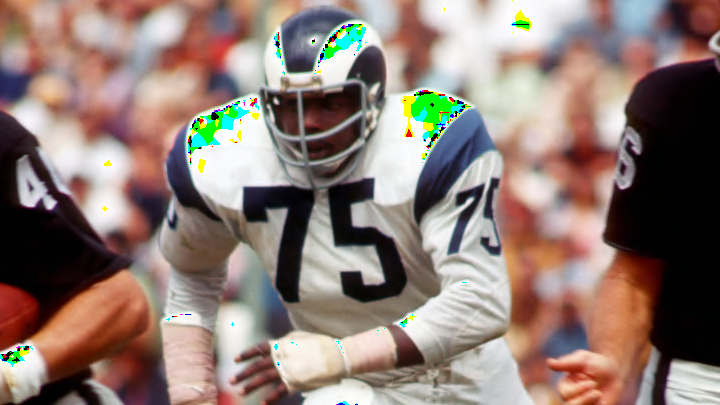
Los Angeles Rams: Deacon Jones, DE
Selection: 1961, 14th round (No. 186)
Jones played in an era before sacks were official in 1982; otherwise, he’d likely be regarded as perhaps the finest defensive end to ever live. Jones was a 14th-round pick out of Mississippi Valley State and became part of the famed Fearsome Foursome in Los Angeles. Jones totaled an unofficial 173.5 sacks in his 14-year career, including at least 21 sacks on three occasions during the 14-game schedule era. A five-time first-team All-Pro, Jones was the benchmark of his era for pass rushing, coining the head slap.
Miami Dolphins: Dan Marino, QB
Selection: 1983, first round (No. 27)
Marino was the fifth quarterback selected in his own draft, taken behind John Elway, Todd Blackledge, Jim Kelly, Tony Eason and Ken O’Brien. He immediately proved an all-time steal, setting records in 1984 for single-season passing yards (5,084) and touchdowns (48). A first-ballot Hall of Famer, Marino was named an MVP, three-time first-team All-Pro and nine-time Pro Bowler while amassing 61,361 passing yards, the most when he retired in 1999.

Minnesota Vikings: Randy Moss, WR
Selection: 1998, first round (No. 21)
Moss fell to the Vikings due to character concerns in 1998 and immediately became one of the best players in the sport. Paired with fellow Hall of Fame receiver Cris Carter, Moss notched 1,313 yards and 17 touchdowns as a rookie, helping Minnesota go 15–1 and reach the NFC title game. For his career, Moss amassed 15,292 yards and 156 touchdowns, spending time with the Vikings, Raiders, Patriots, Titans and 49ers, including his first eight years in purple.
New England Patriots: Tom Brady, QB
Selection: 2000, sixth round (No. 199)
Does anything need to be said? Brady went to the Patriots in the sixth round from Michigan in 2000 and authored the most decorated career in NFL history. He won seven Super Bowls and appeared in 10, and holds the all-time records for passing yards (89,214) and touchdown passes (649). A 15-time Pro Bowler and three-time MVP, Brady is widely regarded as the greatest quarterback ever.
New Orleans Saints: Rickey Jackson, LB
Selection: 1981, second round (No. 51)
A four-time All-Pro and six-time Pro Bowler, Jackson is one of the best to ever wear the Fleur-de-lis on his helmet. The Saints selected Jackson from Pittsburgh in the second round of the 1981 draft, and he immediately flourished with eight unofficial sacks as a rookie. By the time his career ended, Jackson had 136 sacks and was a key member of the Dome Patrol alongside Vaughn Johnson, Sam Mills and Pat Swilling.
New York Giants: Lawrence Taylor, LB
Selection: 1980, first round (No. 2)
Taylor is the greatest defensive player to ever live, making him one of the easiest choices on this list. The No. 2 pick in 1981, Taylor transformed the Giants from a doormat to a dominant team, winning two Super Bowls in ’86 and ’90. Over his 13-year career, Taylor was an MVP, a three-time Defensive Player of the Year, an eight-time first-team All-Pro and a 10-time Pro Bowler, amassing 142 sacks. He was a first-ballot Hall of Famer and changed the game, forcing teams into playing a one-back offense to help block him with a tight end.
New York Jets: Joe Namath, QB
Selection: 1965, first round (No. 2)
Namath’s numbers aren’t spectacular due to injuries and poor teams around him, but nobody has ever been more important in football history. Taken by the Jets in the 1965 AFL draft, Namath became the first quarterback to throw for 4,000 yards in a season, doing so in his third year. In ’68, Namath led the Jets to a massive upset of the favored Colts in Super Bowl III, earning MVP honors that day. In ’85, Namath was elected to the Hall of Famer in his third year of eligibility.
Philadelphia Eagles: Brian Dawkins, S
Selection: 1996, second round (No. 61)
This was between Chuck Bednarik and Dawkins, but Dawkins gets the nod, considering he was a second-round pick and Bednarik was a No. 1 selection. Dawkins is one of the greatest safeties ever as a five-time All-Pro and nine-time Pro Bowler. He notched 37 interceptions and 26 sacks across his 16-year career with the Eagles and Broncos, and was named a Hall of Famer on the second ballot.
Pittsburgh Steelers: Jack Lambert, LB
Selection: 1974, second round (No. 46)
It’s almost impossible to make this pick, considering how many great players the Steelers have drafted. In 1974 alone, they took four Hall of Famers in Lambert, John Stallworth, Lynn Swann and Mike Webster. However, Lambert is the choice as a second-round pick and the epicenter of the Steel Curtain for a decade. Lambert was a six-time first-team All-Pro, a member of both the 1970s and ’80s All-Decade Teams, the Defensive Rookie of the Year and the ’76 Defensive Player of the Year. Few players are more decorated at any position.

San Francisco 49ers: Joe Montana, QB
Selection: 1979, third round (No. 82)
Montana was long viewed as the greatest quarterback of all time before Brady arrived. A four-time champion, Montana was a third-round pick in 1979 from Notre Dame and authored the 49ers dynasty in the ’80s. He was a five-time All-Pro and two-time MVP, known for his 26 fourth-quarter comebacks. Over his 15-year career, Montana went 117–47 and was a first-ballot Hall of Famer in 2000.
Seattle Seahawks: Cortez Kennedy, DT
Selection: 1990, first round (No. 3)
The Seahawks have some great picks over the years, including Richard Sherman and Bobby Wagner, but Kennedy is the choice. A Hall of Famer and the 1992 Defensive Player of the Year, Kennedy gets somewhat overlooked because he played his 11-year career on a bad team in the dreary Kingdome. Still, Kennedy was an eight-time Pro Bowler and four-time All-Pro, earning him induction into Canton in 2012.
Tampa Bay Buccaneers: Derrick Brooks, LB
Selection: 1995, first round (No. 28)
The Buccaneers had one of the best rounds any team has ever enjoyed, taking both Sapp and linebacker Derrick Brooks in the first round of the 1995 draft. Brooks earned the nod here based on being taken 16 picks later while also spending his entire 14-year career in Tampa Bay. The key cog in coordinator Monte Kiffin’s famed Tampa 2 scheme, Brooks was a nine-time All-Pro and the 2002 Defensive Player of the Year, helping the Buccaneers win their first Super Bowl. He was inducted into the Hall of Fame in 2014 on the first ballot.
Tennessee Titans: Earl Campbell, RB
Selection: 1978, first round (No. 1)
Campbell is the greatest figure in franchise history, having arguably the greatest start to a career any NFL player has ever enjoyed. After being taken No. 1 overall out of Texas, Campbell won three consecutive rushing titles, was the 1979 MVP and was runner-up in ‘78 and ‘80. He was a first-team All-Pro in each campaign and made five Pro Bowls before retiring at age 30 due to injuries. Campbell is a Hall of Famer, having rushed for 9,407 yards and 74 touchdowns.
Washington Commanders: Darrell Green, CB
Selection: 1983, first round (No. 28)
Green was the last pick in the famed first round of 1983, and he didn’t disappoint. An ageless wonder who played until he was 41, Green was a three-time All-Pro and seven-time Pro Bowler, totaling 54 interceptions over his 20-year career, all with Washington. Green was named to the 1990s All-Decade Team and eventually the Hall of Fame.
More NFL on Sports Illustrated
 Add us as a preferred source on Google
Matt Verderame is a national NFL staff writer for Sports Illustrated, writing features, columns and more. Before joining Sports Illustrated in March 2023, Verderame wrote for FanSided and SB Nation. He’s a proud husband to Stephanie and father of two girls, Maisy and Genevieve. In his spare time, Verderame is an avid collector of vintage baseball cards.
Follow MattVerderame