%20%20--%3E%0A%3Csvg%20version%3D%221.1%22%20id%3D%22Layer_1%22%20xmlns%3D%22http%3A%2F%2Fwww.w3.org%2F2000%2Fsvg%22%20xmlns%3Axlink%3D%22http%3A%2F%2Fwww.w3.org%2F1999%2Fxlink%22%20x%3D%220px%22%20y%3D%220px%22%0A%09%20width%3D%2239px%22%20height%3D%2240px%22%20viewBox%3D%220%200%2039%2040%22%20enable-background%3D%22new%200%200%2039%2040%22%20xml%3Aspace%3D%22preserve%22%3E%0A%3Cpath%20fill%3D%22%23FFFFFF%22%20d%3D%22M38.5%2C7H28.2v26h10.3V7z%22%2F%3E%0A%3Cpath%20fill-rule%3D%22evenodd%22%20clip-rule%3D%22evenodd%22%20fill%3D%22%23FFFFFF%22%20d%3D%22M26.1%2C25.5c0%2C5.8-4.1%2C7.5-12.9%2C7.5C3.9%2C33%2C0%2C31.2%2C0%2C25.2v-1.1h11.6%0A%09v2.4c0%2C0.7%2C0.1%2C1.4%2C1.2%2C1.4c1%2C0%2C1.2-0.4%2C1.2-1.3v-0.9c0-1.6-0.9-1.6-3.5-2.2C2.2%2C21.7%2C0%2C19.7%2C0%2C15.3v-0.9C0%2C9.3%2C5.5%2C7%2C12.9%2C7%0A%09c10.2%2C0%2C12.8%2C2.6%2C12.8%2C7.4v1.8h-11v-2.9c0-0.6-0.4-1.1-1.2-1.1c-0.6%2C0-1.2%2C0.4-1.2%2C1.1v0.9c0%2C1.5%2C0.9%2C2%2C3.3%2C2.5%0A%09c8%2C1.6%2C10.5%2C3.3%2C10.5%2C7.5V25.5z%22%2F%3E%0A%3C%2Fsvg%3E%0A)
Canada Exits Historic World Cup Run, Leaving Soccer in the Country Forever Changed
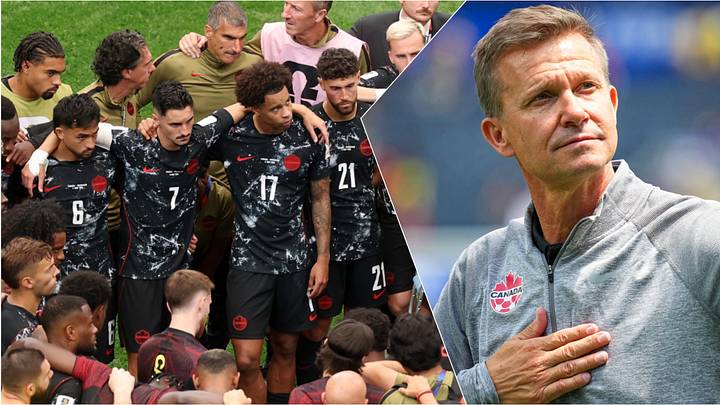
HOUSTON — As the 2026 World Cup enters its final weeks, FIFA has already begun returning stadiums to their previous uses. It’s an incredibly quick process, stripping away branding and restoring the North American sporting cathedrals to their usual glory.
Amid the cleanup on Saturday in Houston, where Morocco advanced to the quarterfinals with a 3-0 win against Canada, a single Canadian flag remained on the floor of NRG Stadium. It was a small paper one, the type given to new Canadians at citizenship ceremonies, and sat discarded, somehow missed by the cleaners.
Hours after Canada’s co-hosting World Cup journey ended with a competitive but eventual loss to the Atlas Lions, it provided a final glimpse into Canada’s historic tournament run, one that could prove to be a turning point for the sport in the nation.
“I just hope that what they watched, they can be proud of, that they saw a Canadian team that was not afraid of anyone, that played how I think we always want all of our Canadian teams to play,” said defender Alistair Johnston, one of the 13 Canadian men to have worn the maple leaf in two World Cups and played every minute in this tournament.
“We all wore our hearts on our sleeves... I can only imagine how many people around the world were watching, and you want everyone to know what Canadians are all about.”
WIN FIFA WORLD CUP 2026™ FINAL TICKETS & OTHER PRIZES

Impressing as Co-Host

Canada entered the tournament ranked No. 30 in the world. While the team had risen from the depths of being ranked No. 122, it still had yet to claim a marquee moment on the sport’s grandest stage.
That case is no more. After entering the tournament with six losses in six World Cup games across 1986 and 2022, Canada impressed on home soil and then in Los Angeles and Houston, qualifying for the round of 16 and outplaying the No. 6-ranked Morocco for the first half of that round.
If strikers had been a little more clinical, if stars like Alphonso Davies, Ismaël Koné and Marcelo Flores had been fit, it all could’ve looked very different. Yet, Les Rouges weren’t hanging their heads, now boasting a pair of World Cup wins, nine goals in the tournament and a competitive showing against one of soccer’s titanic powers.
This summer, Canada proved it more than belonged, that it can be a true North American power and author big moments on soccer’s grandest stage.
“This was a tournament of so many firsts, and I think that’s something that we're all going to look back on with a lot of pride,” Johnston added, reflecting on the streets filled with red and white in Vancouver and Toronto for the group stage, before Canada’s knockout rounds shifted south of the border.
“At those [three] home matches, seeing what it meant, seeing all the videos, the pictures of the Canadian crowds, shutting down streets, walking to the matches… that’s going to resonate most with this team and the country: we really proved to everyone what a footballing country Canada is...I don't think the rest of the world truly knew, and I’m not sure all of Canada truly knew.”
Changing the Soccer Landscape

For decades, soccer has been the most-played sport among Canadian youth, far ahead of ice hockey. The passion for the sport in the stands, though, has been mixed.
While the three Canada-based MLS teams have drawn packed stadiums at times and the Canadian Premier League has grown into its eighth season, there hasn’t been a genuine, hockey-like excitement around the national team.
Over the last month, that changed.
According to TSN, roughly one in four Canadians tuned in to some of Canada’s World Cup journey, with broadcasts during the group stage and round of 32 reaching upwards of 11 million people. Aside from that, supporters packed streets, fan zones and bars in a way previously seen only at the Olympics in men’s ice hockey.
What a view 😍#FIFAFanFestival #WeAreVancouver pic.twitter.com/lLzHonUaDr
— FWC26Vancouver (@FWC26Vancouver) July 4, 2026
The hope now is that a portion of fans will remain invested, either jumping on board with MLS—with the fight ongoing to keep the Vancouver Whitecaps on Canada’s West Coast—or the CPL.
At the same time, there’s hope for increased media attention, particularly as the men’s and women’s national teams prepare to compete in regional tournaments beyond the World Cup.
Multiculturalism Made This Team and Its Future

For a country like Canada, the ability to embrace itself in a global game was a huge opportunity on and off the pitch.
It’s a nation with a multicultural mosaic, and many fans of first-, second-, or third-generation immigrant families had been hesitant to support Canada—a team that had never previously contended in the men’s game. Instead, heritage countries had ruled soccer.
The magic of that mosaic was on display across Toronto and Vancouver, as streets were packed with the likes of Portugal, Ghana, Australia, Egypt and Croatia fans, among others. Still, it also marked the first time that Canadians of all generations truly embraced their own national team, a squad that not only found success on the pitch but also had a roster that fully represented the nation’s multiculturalism.
Feelin’ the passion from the Canadian faithful!
— CANMNT (@CANMNT_Official) July 4, 2026
🇨🇦 🇲🇦 #CANMNT #OurGameNow pic.twitter.com/E1S0ILV9Nh
Canada Soccer, through various coaches and federation leadership, has done an impressive job of recruiting dual-national players, taking advantage of the country’s largely welcoming immigration patterns since Prime Minister Pierre Trudeau began to make the country a top destination in 1971 and instituted federal policies on bilingualism and multiculturalism.
It’s a magic few other nations at the World Cup, outside of the United States, can truly offer, and this tournament marked the culmination of generations of immigration, recruitment and building within the Canadian game on the pitch. In contrast, off the pitch, people of every background embraced the team’s place among the world’s finest.
And it’s near-poetic justice that Saturday’s loss came against the one that got away, Moroccan goalkeeper Yassine Bouno, who was born in Montréal but opted to represent the country he grew up in since he was three years old.
“The fact that you know we were able to be one of the 16 best teams of this World Cup, I think, is amazing for the country and is amazing for this team,” said vice-captain Stephen Eustàquio, who scored the winning goal in the round of 32 against South Africa.
“But we have to start from there, now that we are realizing that the gap isn’t that big, that we have to fight, and hopefully we can get good matches during these next four years that can really prepare us for the next World Cup.”
Canada to Capitalize on World Cup Moment

Canada isn’t lifting the World Cup trophy, but the country is in a better position than it was a month ago to make sure the opportunity doesn’t pass it by sometime in the future.
Often an overlooked aspect of the World Cup, Canada Soccer is bringing in significant prize money from this tournament.
By making the round of 16, Canada earns $18.5 million in prize money—some of which will be shared in a split between the men’s and women’s national team pools, but also will provide a much-needed financial injection to the federation, which oversees everything from the national teams to youth levels, coaching and referee development in the country.
That World Cup windfall, combined with $25 million raised through a Canada Soccer Foundation campaign, should set Canada up to make the most of this moment.
Thank you, Prime Minister! We know EXACTLY what this means to the country 🇨🇦💪#CANMNT #OurGameNow pic.twitter.com/z6K0vH36E5
— CANMNT (@CANMNT_Official) June 19, 2026
For a federation that has spent years operating under financial strain and projected a rare $4.61 million surplus for 2026, having the opportunity to extend its funds at a time when the sport is bound to grow in the country is massive—and a factor that could parlay the newly-kindled passion into tangible, high-performance talents and a significantly larger foothold for the sport in the country.
“The challenge is,” Canada manager Jesse Marsch said. “Can we make sure that we continue to build the depth of what we're doing with the team? Can we build that into our youth national teams? Can we build a real Canadian DNA into the kind of football we want to play, into the kind of infrastructure we want to have, into the kind of academies, and the way we teach the game?”
There’s plenty of time for the future. Marsch is locked into the 2030 cycle on a contract extension, giving him at least another four years to keep this team in contention, while making progress off the pitch.
And although that one paper Canadian flag, waving in the toasty Houston evening, would eventually be picked up, the lasting imprint of this World Cup on Canadian soccer won’t disappear nearly as quickly.
READ THE LATEST WORLD CUP NEWS, ANALYSIS AND INSIGHT FROM SI FC
 Add us as a preferred source on Google
Ben Steiner is an American-Canadian journalist who brings in-depth experience, having covered the North American national teams, MLS, CPL, NWSL, NSL and Liga MX for prominent outlets, including MLSsoccer.com, CBC Sports, and OneSoccer.
Follow BenSteiner00