%20%20--%3E%0A%3Csvg%20version%3D%221.1%22%20id%3D%22Layer_1%22%20xmlns%3D%22http%3A%2F%2Fwww.w3.org%2F2000%2Fsvg%22%20xmlns%3Axlink%3D%22http%3A%2F%2Fwww.w3.org%2F1999%2Fxlink%22%20x%3D%220px%22%20y%3D%220px%22%0A%09%20width%3D%2239px%22%20height%3D%2240px%22%20viewBox%3D%220%200%2039%2040%22%20enable-background%3D%22new%200%200%2039%2040%22%20xml%3Aspace%3D%22preserve%22%3E%0A%3Cpath%20fill%3D%22%23FFFFFF%22%20d%3D%22M38.5%2C7H28.2v26h10.3V7z%22%2F%3E%0A%3Cpath%20fill-rule%3D%22evenodd%22%20clip-rule%3D%22evenodd%22%20fill%3D%22%23FFFFFF%22%20d%3D%22M26.1%2C25.5c0%2C5.8-4.1%2C7.5-12.9%2C7.5C3.9%2C33%2C0%2C31.2%2C0%2C25.2v-1.1h11.6%0A%09v2.4c0%2C0.7%2C0.1%2C1.4%2C1.2%2C1.4c1%2C0%2C1.2-0.4%2C1.2-1.3v-0.9c0-1.6-0.9-1.6-3.5-2.2C2.2%2C21.7%2C0%2C19.7%2C0%2C15.3v-0.9C0%2C9.3%2C5.5%2C7%2C12.9%2C7%0A%09c10.2%2C0%2C12.8%2C2.6%2C12.8%2C7.4v1.8h-11v-2.9c0-0.6-0.4-1.1-1.2-1.1c-0.6%2C0-1.2%2C0.4-1.2%2C1.1v0.9c0%2C1.5%2C0.9%2C2%2C3.3%2C2.5%0A%09c8%2C1.6%2C10.5%2C3.3%2C10.5%2C7.5V25.5z%22%2F%3E%0A%3C%2Fsvg%3E%0A)
James Rodriguez Enters Farewell World Cup Dance As Last of a Dying Breed
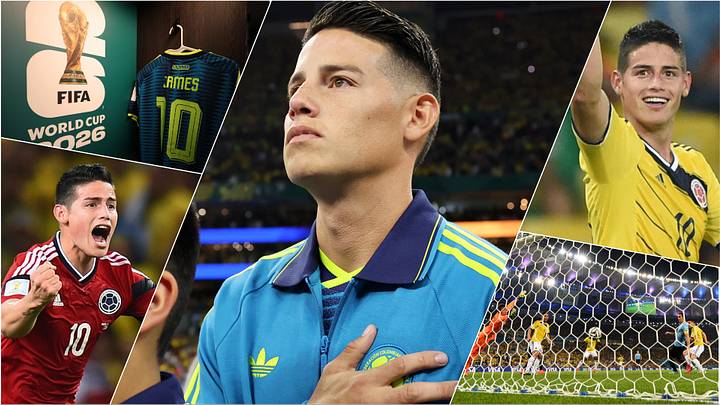
MEXICO CITY — The final rays of a setting sun painted the rapidly darkening sky above the Estadio Azteca, poetically resisting their unavoidable destiny of making way for the moon, the stars and a new chapter. As they did, James Rodríguez led Colombia out to warm up before the start of his last dance at a tournament that will forever define him.
Wearing the captain’s armband for the first time in his third career World Cup, he couldn’t hold back tears as the thousands of Colombian supporters who had invaded the Azteca belted out a powerful rendition of the national anthem. For a moment, it made you question whether you were actually in Mexico City or at the Estadio Metropolitano de Barranquilla.
What followed was not vintage Rodríguez. It wasn’t a poor showing by any means, but there wasn’t that spark of magic in the 72 minutes he spent on the pitch.
What was evident was just how adored Rodríguez is. Yellow Colombian shirts emblazoned with his No. 10 were the most worn jerseys among the near 90,000 fans in attendance. Jubilant roars erupted the first time he appeared on the big screen, and thunderous applause set the scene of his substitution. Rodríguez doubtlessly holds a special place in Colombian hearts, and for good reason.

The Five Games in 2014 That Cemented A Legacy
James Rodriguez against Uruguay (2014). pic.twitter.com/LKUpNdFYSW
— Sports Illustrated FC (@SI_FootballClub) June 5, 2026
Rodríguez manufactured one of the greatest individual World Cup campaigns in history back in Brazil 2014, leading Colombia to its best ever tournament result. In Los Cafeteros’ first World Cup appearance of the 21st century, Rodríguez took over soccer’s biggest stage with eight goal involvements that ignited the nation’s maiden voyage to the tournament quarterfinals.
Radamel Falcao’s devastating knee injury saw many count out Colombia’s ability to make a deep run in 2014. Little did the world know that a then 22-year-old boy-looking attacking midfielder from AS Monaco was ready to introduce the planet to his generational talent.
Colombia won all three of its group stage games with Rodríguez bagging two assists and scoring another three, including a simply spectacular goal against Japan in which he entered the box, did one quick step over that sent a defender to the ground to then beautifully chip the goalkeeper. He became a superstar almost overnight, but what happened next turned him into a World Cup legend.
Twenty-eight minutes into Colombia’s round of 16 matchup against Uruguay, Rodríguez arched his back and turned his chest into the softest pillow in the world, allowing the ball to land comfortably and then fall invitingly towards his prodigious left foot. Rodríguez struck a rocket of a volley on the half-turn that hit the crossbar beyond the reach of Fernando Muslera and bounced into the back of the net. A simply glorious goal.
James Rodríguez in 2014: Iconic 🇨🇴 #FIFAWorldCup pic.twitter.com/FBblp6iCvY
— FIFA World Cup (@FIFAWorldCup) June 6, 2026
The volley at the Maracanã is one of the most gorgeous relics the World Cup boasts, a goal that would win the Puskás Award later that year. In an instant, Rodríguez etched his name in World Cup folklore with golden letters. In Colombia’s biggest win in World Cup history, Rodríguez added a second to complete his brace and steer the nation’s first and only quarterfinals charge.
His 2014 World Cup Golden Boot-winning sixth goal of the tournament wasn’t enough as Colombia was eliminated by hosts Brazil. It was a painful end to an unprecedented campaign, but the 22-year-old had done enough.
Like the rest of the world, Florentino Pérez fell in love with the Colombian star and made him Real Madrid’s newest “Galáctico” signing before the 2014 summer was over. The biggest club in world soccer came knocking and a completely packed Bernabéu attended his unveiling as Real Madrid’s new No. 10.
Rodríguez was on top of the world, yet his time in the sun would turn out to be brief.
The Wasted Potential

Following a promising start to his Real Madrid career, Rodríguez’s imperfections slowly but surely were exposed. His lack of positional discipline—or discipline in general—his fitness, his subpar physicality and his outright refusal to contribute defensively saw managers Rafa Benítez and then Zinedine Zidane essentially erase Rodríguez from Real Madrid’s plans.
Three seasons into his Real Madrid career—the latter two of which he was used sporadically in Champions League winning sides—the talented playmaker was shipped on loan to Bayern Munich, where he spent the next two seasons battling similar problems, particularly injuries. Despite collecting two assists, it was one of those many fitness woes that forced Rodríguez to watch from the sidelines as England eliminated Colombia in the round of 16 of the 2018 World Cup.
Finally, Real Madrid had seen enough and sold him to Everton for the 2020–21 season. Despite a promising start to his Premier League stint, Rodríguez quickly fizzled out and the nomadic portion of his career began. The Colombian hasn’t played more than 35 games for any of the seven clubs he’s represented since he left Madrid.
By the time he was 29, Rodríguez’s career in the European elite was over. Now, on the verge of turning 35, the overwhelming feeling towards his career is of a tremendous talent that never fully exploded outside of that 2014 Brazilian summer.
In hindsight, though, the eventual outcome might’ve been inevitable.
Right Player, Wrong Era

Famed Uruguayan writer Eduardo Galeano once wrote in his book Soccer in Sun and Shadow, “The technocracy in professional sports has imposed a soccer based on pure speed and a lot of physicality that renounces joy, atrophies fantasy and forbids audacity.” Although he undoubtedly contributed to his own failures, Rodríguez is also victim of his context, the soccer Galeano spoke of.
Rodríguez is one of the last remaining classic South American No. 10’s—Enganches, as they are commonly referred too on this side of the world. In simple terms, an enganche is the attacking midfielder that operates between the base of midfield and the forwards, serving as chief creator and attacking brains of a team. In modern soccer, though, it’s a dying breed.
Attacking midfielders nowadays are forced to do more than just create, they must also press high and contribute in all areas, including in defense. Box-to-box midfielders are the new norm—particularly in Europe—or attacking midfielders that also offer energy out of possession, such as Jude Bellingham, Bruno Fernandes or Fermín López.
In the past, especially in South America, Rodríguez’s profile used to thrive. Diego Maradona, Ricardo Bochini, Zico, they all mastered the role, so did Colombian legend Carlos "El Pibe” Valderrama, the greatest player the nation had produced prior to Rodríguez. Modern examples such as Argentina’s Juan Román Riquelme also struggled to adapt to the European game.
Rodríguez is a masterful creator with a magic wand of a left foot, but his aforementioned deficiencies made him an unreliable player for the advanced tactical systems and positional focus of the modern game. Had he been born 30 years earlier, his career might look a lot different.
But if there’s a place where players of Rodríguez’s profile can still not only survive but prosper, it’s international soccer.
Colombia Became An Oasis For James

At club level, teams can select profiles and buy players to build their squads as they wish. In international soccer, teams have a defined pool of players to pick from. Clubs tailor their sides to their wanted style, national teams often tailor their style to the players it has available. Colombia has done exactly that with Rodríguez.
Despite struggling at the club level for the better part of a decade, Rodríguez has saved his best for Colombia during his thirties. He stole the show in the 2024 Copa América, registering six assists to break Lionel Messi’s single tournament record. Colombia fell in extra time in the final against back-to-back champion Argentina, but Rodríguez was named player of the tournament.
He led all of South America with seven assists during the 2026 World Cup qualifiers, three more than any other player. It seems very fitting that Rodríguez has more appearances for Colombia than any team he’s played for in his career.
“The way James transforms when he puts on this yellow shirt is an honor as a sportsman, and having him as a teammate is a dream for the whole team,” Colombian striker Luis Suárez said on the eve of Colombia’s 2026 World Cup debut.

“He’s our captain, our leader, and every time he puts on Colombia’s shirt he transforms,” Luis Díaz, Colombia’s current best player and MVP against Uzbekistan, said in 2025. “I don’t know how much he’s [Rodríguez] got left, I want to enjoy him more, I want him in the national team forever. He is everything for us.”
Rodríguez joined MLS side Minnesota United earlier in the year looking to get some rhythm before the World Cup. But after managing just eight appearances in MLS, his place in Colombia’s roster came under scrutiny. It was never really in doubt, though. The captain was always going to be on the plane and after collecting two assists in the pre-World Cup friendlies, his form at club level was forgotten.
“The “crack” (best player) is back,” Valderrama said on a Colombian TV show after Los Cafeteros’ last tournament friendly.
Eight years and eight different club teams since his final World Cup appearance, Rodríguez finally returned to the stage that turned him into a legend.
One Last Dance

Colombia started the game against Uzbekistan chaotically, making fouls, misplacing passes and regularly booting the ball up the pitch to no one in particular—“nervous,” as manager Nestor Lorenzo described in his postmatch press conference.
Tired of the chaos, Rodríguez dropped deep between the center backs 10 minutes into the match and insisted the ball came to him. Finally, some pausa. Los Cafeteros emphatically dominated what remained of the first half from that moment on, with Rodríguez acting as the team’s lead organizer and distributor.
He was less influential in the area where he’s at his most dangerous and evident signs of his age and lack of rhythm were noticeable. It’s as if his brain can still process the game better than any other player on the pitch, but his body can’t respond as fast as it once did—he’d be the greatest “Sunday league” player of all time.
Yet as he stood near the corner flag with his teammates saluting his traveling loved ones after the final whistle, a sense of reality kicked in: his time is running out. Like Messi, Cristiano Ronaldo, Luka Modrić, Neymar Jr. and Mohamed Salah, the 2026 World Cup is the last Rodríguez will feature in. He’s less hyped than those superstars, and probably rightfully so, but he’s still an icon, a legend of South American soccer.
Only the next couple of weeks will determine if Rodríguez has one final magical chapter awaiting to enhance his undeniable World Cup legacy, if the best Colombian player of all time has one more moment of brilliance that takes us all back to 2014.
Rodríguez’s career might be defined by “what could’ve been?” But the 2026 World Cup isn’t the time to wonder about that, it’s the time to take in what’s left in the tank of one of the last classic No. 10’s, the good, the bad, but above all, take in the last bit of magic that remains in that wonderful left foot.
In Rodríguez’s last appearance on the dance floor of the tournament that turned him into a near deity, he, along with all of Colombia, will do their best to keep dancing until the dying of the light.
READ THE LATEST WORLD CUP NEWS, ANALYSIS AND INSIGHT FROM SI FC
 Add us as a preferred source on Google
Roberto Casillas is a writer for SI FC, focusing primarily on FC Barcelona, the Mexico National Team, Liga MX and all things Latin American football. Born and raised in Mexico City, he developed a deep passion for football from an early age and fell in love with Cruz Azul. The once future star of Mexican football still likes to showcase what’s left of his talent on the Sunday league pitch. He’s also a big fan of the New England Patriots—so much so he moved to the region for four years—, Chicago Cubs and is a life-long Formula 1 follower. When he takes a break from sports, he enjoys traveling the world, watching the latest great TV show, going to concerts and spending plenty of time with friends and family.