%20%20--%3E%0A%3Csvg%20version%3D%221.1%22%20id%3D%22Layer_1%22%20xmlns%3D%22http%3A%2F%2Fwww.w3.org%2F2000%2Fsvg%22%20xmlns%3Axlink%3D%22http%3A%2F%2Fwww.w3.org%2F1999%2Fxlink%22%20x%3D%220px%22%20y%3D%220px%22%0A%09%20width%3D%2239px%22%20height%3D%2240px%22%20viewBox%3D%220%200%2039%2040%22%20enable-background%3D%22new%200%200%2039%2040%22%20xml%3Aspace%3D%22preserve%22%3E%0A%3Cpath%20fill%3D%22%23FFFFFF%22%20d%3D%22M38.5%2C7H28.2v26h10.3V7z%22%2F%3E%0A%3Cpath%20fill-rule%3D%22evenodd%22%20clip-rule%3D%22evenodd%22%20fill%3D%22%23FFFFFF%22%20d%3D%22M26.1%2C25.5c0%2C5.8-4.1%2C7.5-12.9%2C7.5C3.9%2C33%2C0%2C31.2%2C0%2C25.2v-1.1h11.6%0A%09v2.4c0%2C0.7%2C0.1%2C1.4%2C1.2%2C1.4c1%2C0%2C1.2-0.4%2C1.2-1.3v-0.9c0-1.6-0.9-1.6-3.5-2.2C2.2%2C21.7%2C0%2C19.7%2C0%2C15.3v-0.9C0%2C9.3%2C5.5%2C7%2C12.9%2C7%0A%09c10.2%2C0%2C12.8%2C2.6%2C12.8%2C7.4v1.8h-11v-2.9c0-0.6-0.4-1.1-1.2-1.1c-0.6%2C0-1.2%2C0.4-1.2%2C1.1v0.9c0%2C1.5%2C0.9%2C2%2C3.3%2C2.5%0A%09c8%2C1.6%2C10.5%2C3.3%2C10.5%2C7.5V25.5z%22%2F%3E%0A%3C%2Fsvg%3E%0A)
Man Utd Fire Michael Carrick After His One Spell Wears Off
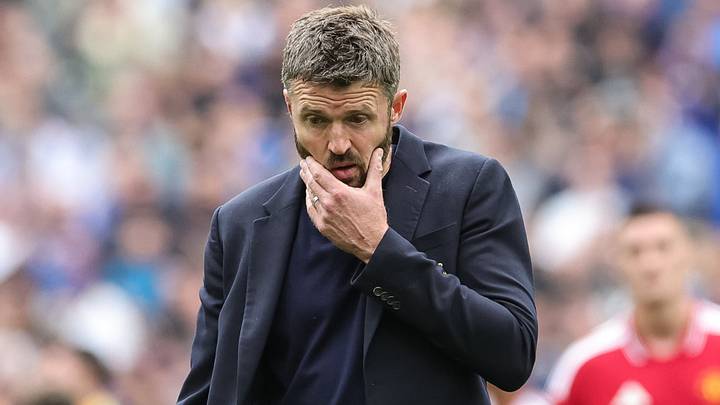
Manchester United have parted company with manager Michael Carrick, with a statement confirming “the club has come to the extremely difficult conclusion that a change is necessary in order to achieve our ambitions.”
Amid the ever-shifting stands beneath Old Trafford, this has at least provided Carrick with some clarity. The beloved former midfielder, a figure whose enduring favor with the fans reportedly played a factor in the extension of his ultimately doomed tenure, has been wobbling through a period of uncertainty since losing 3–0 to Bournemouth on Oct. 25.
After some deliberation, United’s hierarchy gave Carrick another three games in a desperate bid to have their latest hire justify the decision to hand him a two-year contract in the summer. What followed was fitting.
A loss, win and draw captured the roller coaster of chaos which had long since escaped Carrick’s control. United played well before imploding against Chelsea; recovered from one of the most inept 45 minutes Old Trafford has ever witnessed to beat a Roma side which surpassed that nadir in the second half; before stuffing all those phases and more into 98 bonkers minutes against Aston Villa on Sunday.
If there was one common thread snaking through these three concussive, contrasting contests, it’s the complete lack of impact made by Carrick. Lisandro Martínez’s head loss, some favorable penalty decisions and Zion Suzuki’s aerial frailties all played considerably larger roles than the man tasked with righting the listing behemoth that is modern day Manchester United. Carrick wasn’t the first to sink into that sense of helplessness and, if the club’s track record is anything to go by, he won’t be the last.
Next into the spotlight is expected to be U.S. men’s national team manager Mauricio Pochettino. with formal steps already underway to appoint the Argentine.
MORE ON CARRICK’S FIRING, POTENTIAL MAURICIO POCHETTINO HIRING
• The Numbers Behind Carrick’s Failed Man Utd Reign
• Man Utd Make Formal Approach for USMNT Boss Pochettino
• The Story of Man Utd’s 10-Year Interest in Pochettino
• How Pochettino Buyout Clause Compares to Alternatives
Carrick’s Greatest Asset Now Irrelevant

Just as United turned to the endearing former legend Ole Gunnar Solskjær to replace the terse Portuguese disciplinarian José Mourinho, Carrick was hurriedly ushered into the dugout to soothe the wounds torn open by Ruben Amorim in January.
The success which Carrick had across the second half of last season was underpinned by principles of simplicity. United’s form swiftly transformed thanks to little more than common sense. Carrick flipped to 4-2-3-1 and played players in their preferred position, sticking to a core set of individuals with ample time to prepare for each fixture thanks to a uniquely sparse schedule.
Carrick also benefitted from the simple fact that he was not Amorim. After being beaten down by a tactical ideologue obsessed with one (misguided) system and spewing volatile soundbites, the picture of calm, composure and quiet served as a refreshing counterpoint. One of the few interesting things Carrick said was about the term ‘philosophy.’ “I hate that word.”
Yet, once the novelty of Carrick wore off over the summer, the proactive impact he tried to offer never took shape.
“Michael came in with the right ideas of giving the players responsibility, but also some freedom to take the responsibility on the pitch for the decisions that are needed,” Bruno Fernandes claimed at the end of last season. Carrick tightened the leash and the squad bit back.
After being instructing by Carrick and his staff to “half-press” against Como—a doomed tactic at the best of times—Fernandes pointedly rejected that advice, on the pitch and in the media.
Like so many of his predecessors, the upgraded caretaker tried to evolve United’s game so that they weren’t such a one-dimensional unit only capable of counter-attacking. The team’s feeble attempts to press have to be in part attributed to the coaching staff giving out those instructions yet, by the end, Carrick had been relegated to the role of bystander.
Even the act of still being cheered by the fans during the depths of the club’s slide into the relegation zone was damning in its own way; it served as an admission that Carrick had no impact on the club’s fortunes. What’s the point booing someone who can’t change anything?
Starting Diogo Dalot at left back may seem like a bad decision—as Aston Villa proved—but the limited Portuguese defender has started at least half of the Premier League fixtures in five seasons under four different managers. If the club aren’t going to buy a better player, Carrick can’t simply conjure one out of thin air. In the end, he paid the price for his magic inevitably evaporating.
How Carrick Compares to Every Post-Sir Alex Ferguson Man Utd Manager

Rank / Manager | Games (Win %) | Trophies |
|---|---|---|
José Mourinho | 144 (58.3%) | Europa League, League Cup, Community Shield |
Erik ten Hag | 128 (56.3%) | FA Cup, League Cup |
Ole Gunnar Solskjær | 168 (54.8%) | — |
Louis van Gaal | 103 (52.4%) | FA Cup |
David Moyes | 51 (51.0%) | — |
Michael Carrick | 35 (48.5%) | — |
Ruben Amorim | 63 (39.7%) | — |
Stats via Transfermarkt.
Carrick may have emerged with the best standing among fans of any manager in the post Sir Alex Ferguson era, but he has one of the worst records.
Amorim is the only other coach to fail to win more than half of their matches, yet even the combustible Portuguese boss lasted longer in the hot seat than Carrick, who amassed just 35 games across two interim spells and one aborted permanent slump.
David Moyes’s disastrous tenure as Ferguson’s immediate successor no longer looks quite so damning. United slipped to seventh in the league that year—a low point which both Erik ten Hag and Amorim would plough beyond—got to the League Cup semifinals and even made a run to the Champions League quarterfinals, holding Pep Guardiola’s all-conquering Bayern Munich to a 1–1 draw at Old Trafford in the first leg.
“Moyes is a good coach,” the legendary Johan Cruyff said at the time, “just not for Man Utd.” It remains to be seen who actually is a good coach for the club.
 Add us as a preferred source on Google

Grey Whitebloom is an Associate Editor for SI FC. He has more than half a decade of experience in sports media across all its various guises, from the fast-paced demands of news articles and match reports to in-depth research required for features. Whitebloom graduated with a First Class Honours from University College London and found himself named on the Dean’s List—which, despite his initial fears, was a form of praise rather than a punishment. He specialises in the Premier League and Champions League, while also boasting an extensive track record of La Liga coverage.