%20%20--%3E%0A%3Csvg%20version%3D%221.1%22%20id%3D%22Layer_1%22%20xmlns%3D%22http%3A%2F%2Fwww.w3.org%2F2000%2Fsvg%22%20xmlns%3Axlink%3D%22http%3A%2F%2Fwww.w3.org%2F1999%2Fxlink%22%20x%3D%220px%22%20y%3D%220px%22%0A%09%20width%3D%2239px%22%20height%3D%2240px%22%20viewBox%3D%220%200%2039%2040%22%20enable-background%3D%22new%200%200%2039%2040%22%20xml%3Aspace%3D%22preserve%22%3E%0A%3Cpath%20fill%3D%22%23FFFFFF%22%20d%3D%22M38.5%2C7H28.2v26h10.3V7z%22%2F%3E%0A%3Cpath%20fill-rule%3D%22evenodd%22%20clip-rule%3D%22evenodd%22%20fill%3D%22%23FFFFFF%22%20d%3D%22M26.1%2C25.5c0%2C5.8-4.1%2C7.5-12.9%2C7.5C3.9%2C33%2C0%2C31.2%2C0%2C25.2v-1.1h11.6%0A%09v2.4c0%2C0.7%2C0.1%2C1.4%2C1.2%2C1.4c1%2C0%2C1.2-0.4%2C1.2-1.3v-0.9c0-1.6-0.9-1.6-3.5-2.2C2.2%2C21.7%2C0%2C19.7%2C0%2C15.3v-0.9C0%2C9.3%2C5.5%2C7%2C12.9%2C7%0A%09c10.2%2C0%2C12.8%2C2.6%2C12.8%2C7.4v1.8h-11v-2.9c0-0.6-0.4-1.1-1.2-1.1c-0.6%2C0-1.2%2C0.4-1.2%2C1.1v0.9c0%2C1.5%2C0.9%2C2%2C3.3%2C2.5%0A%09c8%2C1.6%2C10.5%2C3.3%2C10.5%2C7.5V25.5z%22%2F%3E%0A%3C%2Fsvg%3E%0A)
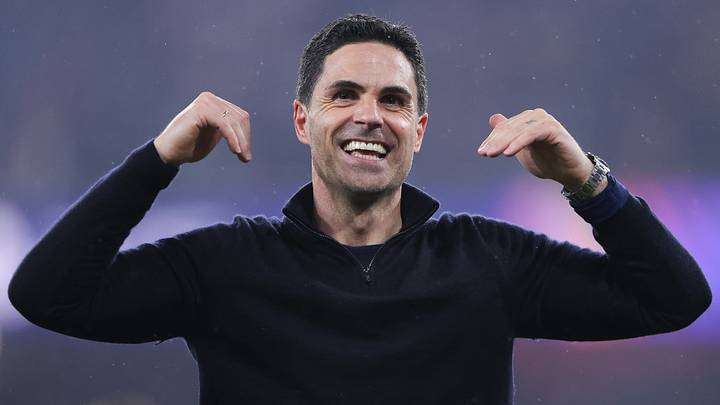
Mikel Arteta’s New Arsenal Contract Is a Reward for the Money He’s Owed
“The vast majority of papers out there say coaches don’t matter,” AC Milan’s data-led former co-owner Luke Bornn once said, presumably out of earshot of San Siro’s dugout. “I’m oversimplifying, but that’s basically it.”
Soccer is a sport which willfully defies statistical analysis. This is a game played with a round ball and the blunt instrument of the human foot on an open field filled with 22 charging bodies. Finding a way to parse that chaos in a spreadsheet has been an ongoing battle for decades.
One of the major breakthroughs was the discovery that a club’s salary bill offered a closer indication of a team’s quality in the long run than almost anything else. It’s an intuitive concept: in the ultimate meritocracy that is competitive sport, the best are often paid the most.
However, as Simon Kuper and Stefan Szymanski note in their seminal historical analysis, Soccernomics, “Player wages’ don’t explain everything about league position—merely almost everything at most clubs. That leaves room for a few good managers to make a difference.”
Mikel Arteta is one of those “few good managers.” His greatest success—and arguably his greatest failure—is that far too many people forget the relative imbalance he has overcome at Arsenal. As the hierarchy in north London have proven with his lucrative new contract, they, at least, are aware of his value.
The Normalization of Arsenal’s Over-Performance Under Arteta

When it looked as though Arsenal were faltering towards a fourth consecutive second-place finish last season, it was almost universally accepted that to miss out on the title to Pep Guardiola’s Manchester City yet again would have been a gross failure for Arteta. The Basque boss himself subscribed to that theory, losing countless nights of sleep to the prospect of history repeating itself.
However, even if Arsenal had slipped to second, it would still have represented a gross over-performance when compared to their position in the financial landscape of the Premier League.
Between the 2022–23 and 2025–26 seasons, Arsenal collected more top-flight points than any other team in the division (narrowly outstripping Manchester City 332 to 329). Yet, across the same span, the Gunners only ranked fifth for money spent on their wage bill.
2022–2026 | Total Spent on Wages | Total Premier League Points |
|---|---|---|
Man City | $2.41 billion | 329 |
Liverpool | $2.22 billion | 293 |
Chelsea | $1.98 billion | 228 |
Man Utd | $1.96 billion | 248 |
Arsenal | $1.75 billion | 332 |
Tottenham | $1.42 billion | 205 |
Aston Villa | $1.29 billion | 260 |
Newcastle | $1.24 billion | 246 |
* Data compiled from official club accounts and valuball’s estimate of the 2025–26 figures.
So, rather than consistently fighting for the title, an average coach would have been expected to skirt around the fringes of Champions League qualification with Arsenal’s wage bill. Throughout Arteta’s entire tenure in north London, the Gunners have never been blessed with the most expensively assembled roster of talent.
This is a consequence of the sort of strict salary control adopted by Daniel Levy across the road at Tottenham Hotspur. Yet, while the revolving door of dramatically contrasting Spurs coaches constantly railed against the restrictions put on the club’s ambition, Arteta simply set about improving what he had been given.
Arsenal Seasons | Wage Bill (League Rank) | League Position (Points) |
|---|---|---|
2020–21 | $321 million (5th) | 8th (61) |
2021–22 | $286 million (5th) | 5th (69) |
2022–23 | $317 million (6th) | 2nd (84) |
2023–24 | $443 million (5th) | 2nd (89) |
2024–25 | $468 million (4th) | 2nd (74) |
2025–26* | $518 million (4th) | 1st (85) |
* Estimated figure per valuball.
Arteta didn’t always sulk quietly through transfer windows. Back in January 2025, he fretted over Arsenal’s “certain limitations” in the market.
“Compared to what other clubs have done in terms of spending, we are really out of touch.”
Later that month, Arteta claimed that he had been left with “one of the thinnest squads in the league.”
Arsenal can scarcely be accused of not matching their manager’s ambition: Since the roster was rejuvenated with a youthful burst of players in 2021 the wage bill has increased each year. The Gunners simply haven’t surpassed the inflation of the Premier League, whose clubs all spend more each season.
Now Arsenal boast the deepest pool of talent in the division, if not across Europe. Yet, Arteta hasn’t been given a blank checkbook. After the close of this summer’s transfer window, the club’s roster cost them $1.15 billion to assemble, which is only the fifth most expensive squad in the Premier League. Alongside some savvy acquisitions, Arteta’s coaching has helped close that perception gap.
Arteta Is His Worst Publicist
Arsenal spend like a team which should be competing with Aston Villa while rivaling Manchester City but Arteta rarely elicits more praise than Unai Emery, let alone the regal figure of Pep Guardiola. That, in part, is his own doing.
Arteta is an easy target. This is a character who let Amazon Prime’s cameras film him preparing his team for a trip to Liverpool’s inhospitable Anfield home by training in front of speakers blaring out crowd noise. They were thumped 4–0. Arteta has hired pickpockets, professional freestylers and bought the squad a dog. Only recently, he freely admitted to deliberately disrupting matchday travel plans to keep his players on their toes in the event of a real-world delay.
The gimmicks aren’t Arteta’s issue, it’s his transparency.
A manager in elite soccer is as much of a cult leader as a tactician. The greatest coaches in the modern era have all deployed various psychological tricks to extract that extra one or 2% out of their players. However, unlike Arteta, they don’t freely admit it.
Guardiola prepared his Barcelona team for the 2009 Champions League final by sitting them down to watch a montage of their season interspliced with clips from the movie Gladiator. It was disastrous. The players were so emotionally drained by the seven-minute DVD that they gave up a glut of chances Manchester United failed to take.
Jürgen Klopp went for the opposite approach when his Liverpool took on Real Madrid in the 2018 European showpiece, lightening the mood by revealing that he was wearing a pair of Cristiano Ronaldo-branded underpants. It would be Ronaldo who collected the winners’ medal two hours later while Klopp watched on beaten and uncomfortable.
A bit of subtlety—when it comes to his wacky ideas or his touchline demeanor—would undoubtedly help Arteta’s universal appeal, but why should he care? Nothing will endear him to his employers more than collecting three more points than Manchester City while spending $660 million less over the last four years.
Arsenal’s Exciting Evolution This Season

The feverish glint in Arteta’s eye was enough to discover that there would be no motivational let up from Arsenal after ending the 22-year wait for glory last season. “I feel good, different, hopefully better,” the 44-year-old announced ahead of the new campaign. “More excited than ever. Hungrier than ever.”
Beyond the simple desire to carry on winning, the first few games of Arsenal’s title defense have shown Arteta coming up with new ways to triumph.
One of the most prominent themes thus far has been a sense of expanded positional freedom. At their most tense, Arsenal could look like they were constricted by a tactical straightjacket, each player pinned in their own very specific sphere of influence. The start of this term has seen a return to the days of Gabriel Jesus and Oleksandr Zinchenko bamboozling opponents in 2022–23 with their horizontal and lateral roaming. There is more swash and buckle.
Riccardo Calafiori is the most obvious example of this tactical anarchy with his barrelling around the final third from left back, but it is also a new part of Martin Ødegaard’s game.
Martin Odegaard’s Purposeful Wandering

Ødegaard has bounded into the new campaign with “a point to prove,” according to Arteta. Norway’s historic World Cup run clearly rejuvenated the stagnating lynchpin of Arsenal’s attacking thrust, who is now purposefully wandering across the entire width of the pitch in search of the ball. The left half-space (dotted in red above) was once a zone which Ødegaard quickly vacated, scuttling through with all the haste of someone walking past their ex’s apartment. Now it’s a new fertile area from which he can create. Reconciliation has been had.
There’s more scope for Ødegaard on the left now that Declan Rice’s role has evolved once again. The England international has been the lone source of ballast, a rampaging force down the left or half of a double act during his three years in north London. Now he appears to be doing all that and more in the same game.
“When you’re a midfielder, you’re a midfielder,” Arteta has explained, “not a six, eight or 10. If we want a total team, we’d better have total players to do that, to be comfortable and dominant in any area of the pitch, to dominate every phase of play. Declan is certainly evolving in that direction.”
Rice, the rest of his teammates and the entire club as a whole, is being guided in that direction of evolution by the all-consuming force of will that is Arsenal’s manager.
 Add us as a preferred source on Google
Grey Whitebloom is an Associate Editor for SI FC. He has more than half a decade of experience in sports media across all its various guises, from the fast-paced demands of news articles and match reports to in-depth research required for features. Whitebloom graduated with a First Class Honours from University College London and found himself named on the Dean’s List—which, despite his initial fears, was a form of praise rather than a punishment. He specialises in the Premier League and Champions League, while also boasting an extensive track record of La Liga coverage.