%20%20--%3E%0A%3Csvg%20version%3D%221.1%22%20id%3D%22Layer_1%22%20xmlns%3D%22http%3A%2F%2Fwww.w3.org%2F2000%2Fsvg%22%20xmlns%3Axlink%3D%22http%3A%2F%2Fwww.w3.org%2F1999%2Fxlink%22%20x%3D%220px%22%20y%3D%220px%22%0A%09%20width%3D%2239px%22%20height%3D%2240px%22%20viewBox%3D%220%200%2039%2040%22%20enable-background%3D%22new%200%200%2039%2040%22%20xml%3Aspace%3D%22preserve%22%3E%0A%3Cpath%20fill%3D%22%23FFFFFF%22%20d%3D%22M38.5%2C7H28.2v26h10.3V7z%22%2F%3E%0A%3Cpath%20fill-rule%3D%22evenodd%22%20clip-rule%3D%22evenodd%22%20fill%3D%22%23FFFFFF%22%20d%3D%22M26.1%2C25.5c0%2C5.8-4.1%2C7.5-12.9%2C7.5C3.9%2C33%2C0%2C31.2%2C0%2C25.2v-1.1h11.6%0A%09v2.4c0%2C0.7%2C0.1%2C1.4%2C1.2%2C1.4c1%2C0%2C1.2-0.4%2C1.2-1.3v-0.9c0-1.6-0.9-1.6-3.5-2.2C2.2%2C21.7%2C0%2C19.7%2C0%2C15.3v-0.9C0%2C9.3%2C5.5%2C7%2C12.9%2C7%0A%09c10.2%2C0%2C12.8%2C2.6%2C12.8%2C7.4v1.8h-11v-2.9c0-0.6-0.4-1.1-1.2-1.1c-0.6%2C0-1.2%2C0.4-1.2%2C1.1v0.9c0%2C1.5%2C0.9%2C2%2C3.3%2C2.5%0A%09c8%2C1.6%2C10.5%2C3.3%2C10.5%2C7.5V25.5z%22%2F%3E%0A%3C%2Fsvg%3E%0A)
To Make World Cup History, the USMNT First Has to Overcome It
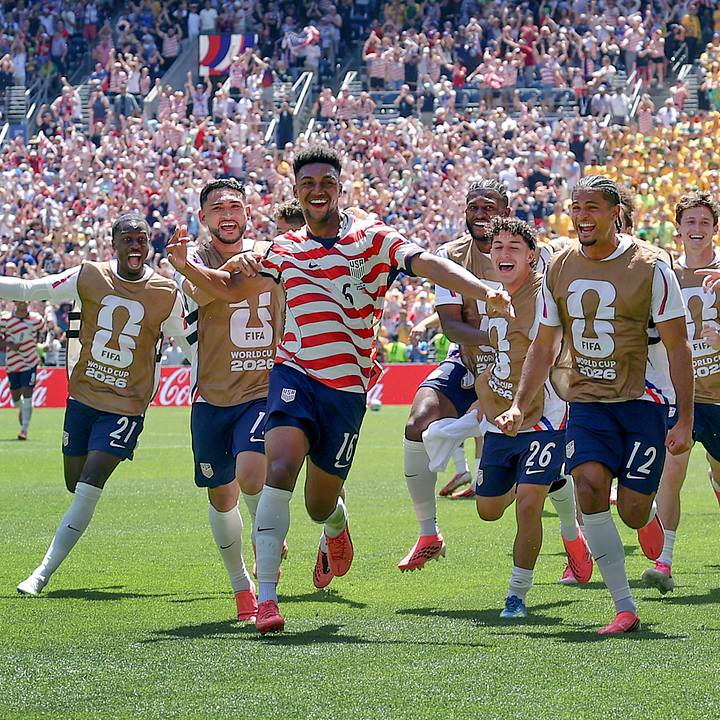
Trending closer to midnight than anyone would have liked last Thursday in Inglewood, Calif., U.S. men’s national team manager Mauricio Pochettino appeared slightly dumbfounded. After all, his side had put together two of the finest efforts the program had seen in modern World Cup play, featuring back-to-back victories over Paraguay and Australia by a combined 6–1 margin, to win Group D with a match to spare.
He was not going to let a last-minute, dead-rubber loss to already-eliminated Türkiye take the shine off the team’s group stage success.
“Maybe I am confused but maybe the mood, or the vibes, is like we go home tonight and Türkiye stays,” Pochettino said.

Featuring heavy rotation in which few U.S. regulars started, things were still going well as the USMNT and Türkiye traded goals and looked set for an entertaining draw. Fans all around the nearly packed SoFi Stadium began cheering on the final whistle that would signal the next step in the team’s journey had arrived.
Except the XI on the field seemed to sense the impending end too, as if ready to take a victory lap for getting the country fired up for the world’s game, which it had swiftly made its own the past two weeks. Switching off from full tilt just momentarily, opposing forward Arda Güler nutmegged U.S.star Christian Pulisic and found a teammate, who helped get it over to an unmarked Kaan Ayhan near the back post.
With the last kick of the game in the 98th minute of a match, the Ayhan slotted it home to ensure that the U.S. would be entering the next round coming off a still-hard-to-fathom 3–2 loss. It was Debbie Downer putting an end to the raucous party which had swelled considerably in recent days.
“The objective was to finish first. We are first. Now is the next stage,” said Pochettino afterward, puffing his bottom lip slightly and shaking his head when asked if momentum from the team had been halted. “It’s going to be a final and we are ready and we are much better [after Türkiye] because we have players with 90 minutes in their legs and performing and ready to help. I think it’s all positive. I am so positive and I am happy. Maybe I’m not showing it because your questions are a little bit weird.”

Ninety seconds later, he could not let it go. The urge to say something was too great for Pochettino as questioning continued to focus on the near-term result and not the process that led to a long-term goal for a host nation.
“At the moment, no one has congratulated us on finishing first in a very difficult group,” he added. “I congratulate the players, the staff and USA and the fans for finishing first in a very difficult group.”
He was not wrong, the United States did top a fairly stout group of closely bunched teams. But he also was not spot-on either.
What Pochettino was hinting at is something he has quickly learned as an Argentine coaching in this country: Americans are, generally, irrationally optimistic about their sports teams. How else do you explain why there are still legions of New York Jets fans, or others who still attend Sacramento Kings games, or a swath of folks that still willingly put themselves through hours upon hours of Pittsburgh Pirates baseball each summer?
Yet there is a slight exception that Pochettino may have a hard time coming to grips with or even truly understanding.

Be it the diehards seeking out information from all corners of the globe before the dawn of the internet or the casuals who have only recently gotten into the sport as it has proliferated across domestic broadcasters, to follow the USMNT on the pitch is an exercise in going against the grain, of being fairly pessimistic at nearly every turn in sharp contrast to nearly every other sport we consume.
Because, unlike the current manager, who can compartmentalize wins and losses after decades as a professional player and coach, USMNT fans have scars that are constant reminders of how their support fared.
Two years ago it was the incredibly early exit from a rare stateside Copa América. There was the infamous 2017 Hex, a slate of World Cup qualifiers which led to an ignominious loss to Trinidad and Tobago and failure to qualify for the 2018 tournament. Ghana’s extra-time goal in the 2010 World Cup round of 16 is memorable for all the wrong reasons. There’s the shame of being in the top five in the FIFA rankings in 2006 and finishing fourth in the group. Blowing a 2–0 halftime lead against Brazil in the 2009 Confederations Cup final. Just about everything to do with the 1998 World Cup. Getting run off the pitch by Mexico for ages. Too many manager missteps to recall.
Perhaps most infuriating of all, U.S. Soccer leadership muddling through an obvious decision it eventually corrects after the fact time after time.
It is a lot of anguish interspersed with fleeting moments of national joy, and the reason why a loss to Türkiye dwells for some in the front of mind more than two cathartic wins do.
This year, however, could represent a monumental shift in such thinking as something different seems to be bubbling up from coast-to-coast. It is surfacing in ways that are typical of countries that host this event, but done with a general American exceptionalism meeting a far more connected nation than previous touchpoints like 1994—when a World Cup berthed a domestic professional league in MLS—and 1999, when the U.S. women launched a dynasty.
There seems to be a general belief spreading across the country rooted in the current team far more than just chanting “I Believe That We Will Win” as American Outlaws supporters frequently do. There are millions upon millions of fans desperately willing the team to victory as World Cup fever has broken out. From packed watch parties in New England to thousands more braving sweltering temperatures to the west, to scores wearing jerseys like the latest fashion trend, to millions watching at home, it is no longer niche to like soccer. It is en vogue, in fact.
A combined audience of 23 million watched the USMNT against Australia across broadcast and streaming, while domestic rightsholder Fox says the opener against Paraguay was the most-watched World Cup telecast in English-language history in the United States. Even the loss to Türkiye peaked with more than 18 million viewers—not far off from numbers generated by the recent College Football Playoff semifinals in January.

Kit supplier Nike has barely been able to keep up with the demand it's seeing as well. As of Tuesday morning, it was completely sold out of authentic stars and stripes-inspired home jerseys for men online—no small feat at $175 to $210 a pop. Even the goalkeeper shirts were out of stock. The same could be said for every iteration of a U.S. jersey for women.
“It’s been really, really cool to see the country rally around this sport with what seems like the strongest it ever has,” said Gio Reyna on Monday. “[The fans are] always great but so far this World Cup, they’ve taken it up a level. We can’t thank them enough. We hope to use that momentum and their support to do something great this tournament.”
The bracket itself lends credence to doing just that.
Wednesday’s round of 32 opponent Bosnia and Herzegovina needed to win a playoff to make the World Cup, finished as only the fifth-best third place team from the group stage and is ranked No. 61 in the latest FIFA rankings. With a win, a date in Seattle, which already displayed incredible support for the home team against Australia, beckons against either a Senegal side the U.S. beat 3–2 at the end of May or against a familiar nemesis in Belgium. The Red Devils feature some big names and dominated the USMNT in Atlanta earlier this year, but were rather pedestrian in Group G with their only win coming against New Zealand—the lowest-ranked team at the World Cup.
If the U.S. advances to the quarterfinals in Los Angeles, tournament favorite Spain or frequent foe Portugal likely awaits. Still, in a one-off match at home against a motivated side, anything is possible.

“It’s knockout football. You lose, you go home, so this is the business end,” said striker Folarin Balogun. “This is the stage where, in my opinion, the big players step forward, and the big players carry the pressure and make things happen."
That has not transpired much in the past, and is a reason why scars from previous failures still remain fresh for veteran observers of the Stars and Stripes.
The men’s team has played eight knockout games at the World Cup all-time going into this week and won just one. That lone result came before some of the current roster was even born, back in the 2002 round of 16, over Mexico in what was the sweetest of all Dos a Cero scorelines. What’s worse, the U.S. failed to score more than a single goal in seven of the eight knockout matches and has not beaten a European side in almost five years (coincidently, it came against Bosnia and Herzegovina in 2021).
There is reason for optimism though that such statistics can be left in the past.
To start with, the player pool has produced one of USMNT’s highest ceilings in recent memory, finally showing more than flashes when the first-choice lineup is on the field, as the early group stage wins indicated. Pochettino’s presence cannot be overlooked as one of the game’s elite managers between the lines with a fiery personality off it, which has been evident in many of his team talks.
Plus, there is the added element of playing the knockout stage on home soil, starting in Santa Clara, Calif., in front of what should be an overly partisan crowd anxious to witness history firsthand.

“We’re so focused on the here and now, playing and making sure we’re in the best possible condition to get results and put in performances that the country, the fans, friends and family are proud of,” captain Tim Ream said on the team’s last guaranteed day at its training base in Southern California this week.
“I haven’t really thought about what I want the team to be remembered by. The easy answer is we want to be remembered for going and winning a World Cup. If we can do that, it’s going to take everything that we possibly have to do that, but that would be the most special outcome.”
On Wednesday night in the Bay Area, as World Cup fever reaches its latest crescendo, the USMNT will take its first step towards that special outcome.
Whether it can overcome years of history, dozens of prior missteps and more than enough bad luck to finally seize the moment that it seems capable of reaching won’t be known until the final whistle blows.
Should the Americans wind up as winners though, their manager will be far from the only one stepping up to congratulate them.
More USMNT from Sports Illustrated
 Add us as a preferred source on Google
Bryan Fischer is a staff writer at Sports Illustrated covering college sports. He joined the SI staff in October 2024 after spending nearly two decades at outlets such as FOX Sports, NBC Sports and CBS Sports. A member of the Football Writers Association of America’s All-America Selection Committee and a Heisman Trophy voter, Fischer has received awards for investigative journalism from the Associated Press Sports Editors and FWAA. He has a bachelor’s in communication from USC.
Follow bryandfischer