%20%20--%3E%0A%3Csvg%20version%3D%221.1%22%20id%3D%22Layer_1%22%20xmlns%3D%22http%3A%2F%2Fwww.w3.org%2F2000%2Fsvg%22%20xmlns%3Axlink%3D%22http%3A%2F%2Fwww.w3.org%2F1999%2Fxlink%22%20x%3D%220px%22%20y%3D%220px%22%0A%09%20width%3D%2239px%22%20height%3D%2240px%22%20viewBox%3D%220%200%2039%2040%22%20enable-background%3D%22new%200%200%2039%2040%22%20xml%3Aspace%3D%22preserve%22%3E%0A%3Cpath%20fill%3D%22%23FFFFFF%22%20d%3D%22M38.5%2C7H28.2v26h10.3V7z%22%2F%3E%0A%3Cpath%20fill-rule%3D%22evenodd%22%20clip-rule%3D%22evenodd%22%20fill%3D%22%23FFFFFF%22%20d%3D%22M26.1%2C25.5c0%2C5.8-4.1%2C7.5-12.9%2C7.5C3.9%2C33%2C0%2C31.2%2C0%2C25.2v-1.1h11.6%0A%09v2.4c0%2C0.7%2C0.1%2C1.4%2C1.2%2C1.4c1%2C0%2C1.2-0.4%2C1.2-1.3v-0.9c0-1.6-0.9-1.6-3.5-2.2C2.2%2C21.7%2C0%2C19.7%2C0%2C15.3v-0.9C0%2C9.3%2C5.5%2C7%2C12.9%2C7%0A%09c10.2%2C0%2C12.8%2C2.6%2C12.8%2C7.4v1.8h-11v-2.9c0-0.6-0.4-1.1-1.2-1.1c-0.6%2C0-1.2%2C0.4-1.2%2C1.1v0.9c0%2C1.5%2C0.9%2C2%2C3.3%2C2.5%0A%09c8%2C1.6%2C10.5%2C3.3%2C10.5%2C7.5V25.5z%22%2F%3E%0A%3C%2Fsvg%3E%0A)
Why USMNT’s Alex Freeman, Son of NFL Legend, Chose Soccer Over Football
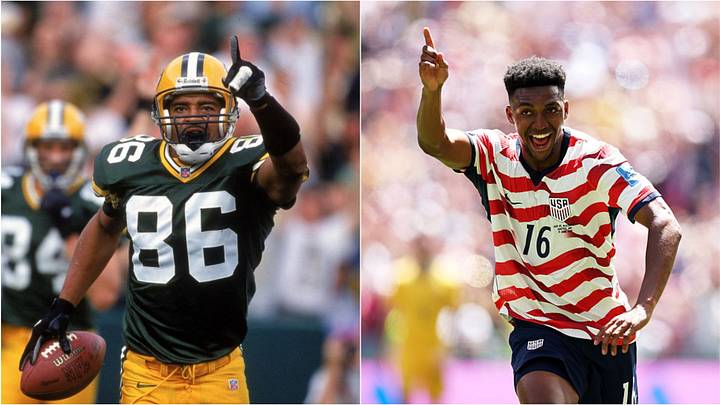
You are certainly familiar with the name “Alex Freeman” now.
The U.S. men’s national team dominated Australia 2–0 in its second World Cup match on Friday, and the 21-year-old defender, making his World Cup debut this summer, put his cape on and played a major part in the crucial victory under the Seattle sun.
When Freeman wasn’t battling the Socceroos’ explosive counterattacks, he was slashing their midfield lines and igniting the U.S.’s attack. He made a Super Man-esque leap into the air, soaring above Australia’s 6'3" goalkeeper to header the U.S.’s second goal in the 43rd minute, crushing Australia’s spirits and hammering home the victory.
The resulted, followed up by Paraguay’s surprise defeat of Türkiye, cemented the Stars and Stripes’ place atop Group D and punched their ticket to the knockout stages with a match to spare. Freeman left the pitch a hero with his first-ever World Cup goal.
Yet, before Friday, there was another “Freeman” whose name echoed throughout American households for nearly a decade: Antonio Freeman, Alex’s father. The former NFL wide receiver, now 54, starred for the Green Bay Packers, playing eight of his nine total seasons in Wisconsin, including back-to-back Super Bowl appearances (1996, 1997) and winning Super Bowl XXXI (1996). In 1998, the elder Freeman took the league by storm with 1,424 receiving yards and 14 touchdowns on 84 receptions, earning a Pro Bowl selection and First-Time All-Pro honors. It ultimately landed him in the Packers’ Hall of Fame.
Yet if Antonio dominated the game of “football,” why did Alex choose “fútbol” instead?

‘This Happiness on the Soccer Field’

Alex, born in 2004 as the youngest on the USMNT roster, started out playing both American football, soccer and even a bit of basketball growing up; however, it quickly became evident that soccer was his primary love.
“I had dreams of coaching him in football and basketball and showing him how to shoot a 3-pointer, make a pump fake and different things,” Antonio told ESPN. “But his joy was on that soccer field, and when he became a teenager, he just played more and more soccer.”
“It was soccer every day, all day. He was watching it on his iPad, he was kicking the balls around the house against the furniture, which you're not supposed to do. He kicked everything. It didn't matter what it looked like, he would just kick it. And he just grew into the sport.”
It didn’t hurt that Alex had quite a knack for soccer, too.
“It was almost mesmerizing going to his soccer games and just every other word from all of the kids, was ‘Freeman, Freeman, Freeman, Freeman, Freeman,’” Antonio added. “And he just had this smile and this happiness on the soccer field. Even though he was good at other sports, that one seemed to come the easiest.”

Antonio knew Alex was always going to choose soccer, yet the decision didn’t appear as crystal clear to his son.
“I had my doubts when I first chose soccer,” Alex told ESPN. “In my heart, I wanted to continue playing football, but I knew that if I wanted to be the best, I had to limit my area of concentration and I had to limit it all to soccer at that point.”
Alex joined Orlando City’s youth academy in 2020 as young teen, slowly working his way up the ranks of the MLS side before making his first team breakthrough in the 2025 season. His career skyrocketed from there, seeing him secure a spot in the 2025 MLS All-Star Game and debuting for the USMNT in June of that year.
He moved up to Spanish La Liga’s Villarreal this January for a transfer fee of $4 million with incentives up to nearly $7 million, becoming the third-biggest outgoing transfer in Orlando City’s history and the most expensive academy product that the club had ever sold.
Antonio had a limited knowledge of soccer, yet as a highly successful athlete, he still ingrained values in Alex that the young star relies on today.
“As a football player, I think they have so much competitiveness, and it just kind of rubbed off on me a lot,” Freeman told CNN Sports before the World Cup. “And for me, it was just to have that role model that I could always look up to for any questions, any motivation I needed and just to be able to have that guy to look up to. It meant so much.”
Antonio was overjoyed when he discovered that Freeman had made Mauricio Pochettino’s final World Cup roster, as the youngster certainly wasn’t a lock for this summer.
“You always want to see your kids do better and to reach the heights...that I reached, which is pretty high,” Antonio said. “And then you have your kid come along and not even go from a national superstar but go to a global star, that's next level. We see coach on the video congratulate him on making the team. And man, I just went ecstatic, man. I just lost it, ran around the room, kind of crazy.”
Alex isn’t the only USMNT player with a famous athlete for a parent. Winger Timothy Weah’s father is soccer legend George Weah of Liberia, the only African to win the Ballon d’Or and FIFA World Player of the Year, winning both awards in 1995. Midfielder Giovanni Reyna’s parents both played for U.S. Soccer. Claudio Reyna was the captain of the USMNT and played in three World Cups (1998, 2002, 2006), while Danielle Egan Reyna was a star at the University of North Carolina before featuring six times for the USWNT in 1993. Midfielder Sebastian Berhalter’s father, Gregg Berhalter, is the former manager of the USMNT (2018–23, 2023–24) and played for the squad himself between 1994–2006.
READ THE LATEST USMNT NEWS, ANALYSIS AND INSIGHT FROM SI FC
 Add us as a preferred source on Google
Sophia Vesely is a writer, reporter and editor for SI FC, with an emphasis on North American coverage. Her experience comes from regional journalism as a former sports reporter for the Orlando Sentinel, Dallas Morning News and Seattle Times. Vesely graduated from Swarthmore College, where she played collegiate soccer as a wingback. She specializes in MLS, NWSL and NCAA soccer.