%20%20--%3E%0A%3Csvg%20version%3D%221.1%22%20id%3D%22Layer_1%22%20xmlns%3D%22http%3A%2F%2Fwww.w3.org%2F2000%2Fsvg%22%20xmlns%3Axlink%3D%22http%3A%2F%2Fwww.w3.org%2F1999%2Fxlink%22%20x%3D%220px%22%20y%3D%220px%22%0A%09%20width%3D%2239px%22%20height%3D%2240px%22%20viewBox%3D%220%200%2039%2040%22%20enable-background%3D%22new%200%200%2039%2040%22%20xml%3Aspace%3D%22preserve%22%3E%0A%3Cpath%20fill%3D%22%23FFFFFF%22%20d%3D%22M38.5%2C7H28.2v26h10.3V7z%22%2F%3E%0A%3Cpath%20fill-rule%3D%22evenodd%22%20clip-rule%3D%22evenodd%22%20fill%3D%22%23FFFFFF%22%20d%3D%22M26.1%2C25.5c0%2C5.8-4.1%2C7.5-12.9%2C7.5C3.9%2C33%2C0%2C31.2%2C0%2C25.2v-1.1h11.6%0A%09v2.4c0%2C0.7%2C0.1%2C1.4%2C1.2%2C1.4c1%2C0%2C1.2-0.4%2C1.2-1.3v-0.9c0-1.6-0.9-1.6-3.5-2.2C2.2%2C21.7%2C0%2C19.7%2C0%2C15.3v-0.9C0%2C9.3%2C5.5%2C7%2C12.9%2C7%0A%09c10.2%2C0%2C12.8%2C2.6%2C12.8%2C7.4v1.8h-11v-2.9c0-0.6-0.4-1.1-1.2-1.1c-0.6%2C0-1.2%2C0.4-1.2%2C1.1v0.9c0%2C1.5%2C0.9%2C2%2C3.3%2C2.5%0A%09c8%2C1.6%2C10.5%2C3.3%2C10.5%2C7.5V25.5z%22%2F%3E%0A%3C%2Fsvg%3E%0A)
Italy’s Olympic Renaissance Thrives Thanks to Home Cooking and Seasoned Vets
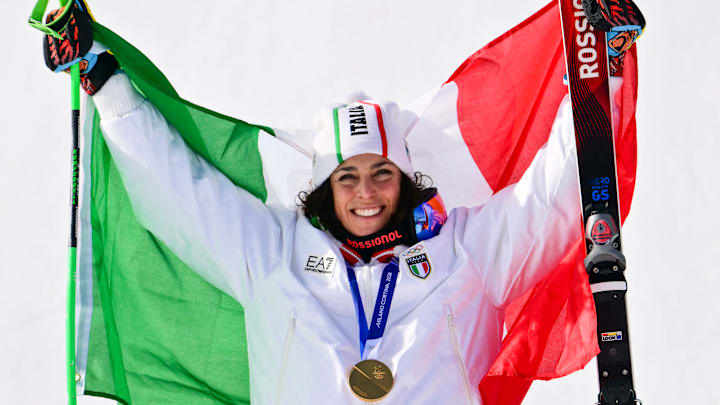
CORTINA d’AMPEZZO, Italy — Before the women’s giant slalom medal ceremony, rejoicing fans unfurled a giant tricolore flag in the grandstand at Olympia delle Tofane on Sunday afternoon. Framed by the jagged Dolomites and beneath a piercing blue sky, green, white and red reigned. In a nation that has been known to produce some art, this was quite a compelling visual.
Alpine skier Federica Brignone, perhaps the most inspiring star in this ongoing Italian Renaissance, stood on the top step of the medal podium, pumping her fists. And for a record-setting eighth time, “Il Canto degli Italiani” was heard.
The English translation of the opening lines of the national anthem: “Brothers of Italy, Italy has risen.”
It sure has. But don’t forget the sisters of Italy, who are doing their part as well.
As of Sunday afternoon, our suave and spirited host nation for the Milan Cortina Olympics has now officially won more gold medals (eight) and total medals (22) than in any previous Winter Games—and there is still a week to go. From the slopes and the sliding track in Cortina to the speedskating oval in Milan to the freestyle skiing venue in Livigno, the Italians are on fire. As of Sunday afternoon, the only nation enjoying more success is the cold-weather athlete factory of Norway (11 golds, 24 total medals).
Italy has not finished in the top 10 in the medal table at the Winter Games since 2006. Its best performance was fourth in 1994, with seven golds and 20 medals total. A top-three finish seems attainable this time around.
This breakthrough is impressive but not completely unforeseeable. Sports Illustrated’s pre-Olympic medal projections predicted Italy would earn 28 total medals, including seven gold. The home-nation bump in performance is commonplace—familiarity of surroundings and competition venues helps, as does the boost from home crowds. (French swimmer Leon Marchand might well have won four gold medals anywhere on the planet last summer, but the Paris fans provided him a tangible home-pool advantage.)
Mostly, there is an inevitable urgency from the host government. Money is spent to ensure that the host country’s athletes and teams are peaking when the world arrives.
Italy’s Federica Brignone wins GOLD for the second time on home slopes! 🇮🇹 pic.twitter.com/scDSPIDQuf
— NBC Olympics & Paralympics (@NBCOlympics) February 15, 2026
“We have been growing all the sports the last four years,” says Brignone, who has 25% of Italy’s gold-medal total after winning both the Super-G and the giant slalom. “To have the home Olympics, the opportunity, it’s like another show. The more investing, the more good training, the better.”
Until it happened, Brignone was a highly unlikely medalist. The 35-year-old won a silver medal and two bronze in previous Olympics, but a horrific crash last spring seemed like it would keep her out of Cortina—or, at best, she would be a shadow of herself.
“I ruined completely my knee and leg,” she said, and there is photographic evidence to support that statement—she had 42 stitches in the leg, stretching from nearly the ankle to her upper thigh. Brignone said she went three months without walking and nearly 300 days without ski training before returning to competition in late January.
After placing sixth in a World Cup race on Jan. 20, she was ready to give the Olympics a try. But pain was still her constant companion; as one of Italy’s four flag bearers in the opening ceremony, she asked curler Amos Mosaner to carry her on his shoulders to help her make it through the event.

Yet six days later, she was the surprise winner of the Super-G. Andrea Panzeri, chief physician for the Italian winter sports federation’s medical commission, declared Brignone’s gold medal “unthinkable.” And then three days after that, she claimed a second gold.
Showing up with absolutely no expectations for herself turned out to be liberating.
“If I was coming here to make gold medals, I would go home with no medals,” Brignone said. “To carry the flag was almost the biggest thing. Not the gold medal, I didn’t care. I had medals, I had World Cups, I had everything I wanted in my life. So I came here just to enjoy it, and be grateful to be here for a home Olympics. I think that’s why I won.”
Among those admiring Brignone’s performance: American Mikaela Shiffrin, whose relationship with the Olympics remains complicated. We’ll get to that momentarily. In the meantime, her thoughts on Brignone’s comeback:
“It’s very, very cool to see that,” Shiffrin said. “Her injury was so bad, and the amount of rehab that she’s been going through, and the mentality she has to trust sending it down the hill—I wish I could explain how impressive that is.”
By my count, 11 athletes competing in their 4th or 5th Olympics have won either their first Olympic medal or first Olympic gold medal at these Games -- seven of them Italians. Austrian Janine Flock in skeleton just now.
— Nick Zaccardi (@nzaccardi) February 14, 2026
The race beyond Brignone was compelling as well. Thea Louise Stjernesund of Norway and Sara Hector of Sweden tied for silver, but that only begins to tell the story—the two produced identical times in both runs, down to the hundredth of a second. They completed the first run in one minute, 3.97 seconds, and the second one in 1:10.15.
As one competitor after another failed to knock them off the podium and they clinched at least a tie for bronze, Stjernesund and Hector jumped up and embraced. The Scandinavian rivalry between the two countries melted a bit in that moment. Lutefisk for everyone.
Shiffrin, the most accomplished World Cup skier in history, with 108 victories, finished 11th. That ran her streak of non-podium Olympic finishes to eight, with two here and six in the Beijing nightmare of 2022.
Shiffrin came into the Olympics ranked fourth in the World Cup standings in the giant slalom, but it’s not her best event—the slalom is where she has thoroughly dominated. After an uninspiring 15th place in the slalom while teamed with Breezy Johnson in the team combined event last week, expectations were not high for her Sunday.

Shiffrin was sharper, but ultimately one of many racers in a tightly bunched pack between second and 12th—all of them way behind Brignone. Still, Shiffrin was upbeat afterward, heaping praise upon her competitors.
“It was such a stacked competition,” she said. “I’m three-tenths off of the podium—that is such a high level of competition. It was really, really cool that we as athletes were able to showcase that on this day. There were so many positives from today.”
As for the slalom run that went awry in the team combined, Shiffrin said, “My mentality was not matching the day. We could see a very similar situation [Wednesday], and I will try to handle it differently in my head.”
Getting out of her head and into attack mode, like Brignone has been, would be a welcome sight for Shiffin fans. As it stands, the touted U.S. women’s Alpine team has produced a modest yield: one gold (Johnson in the downhill) and one bronze (Jackie Wiles and Paula Mortzan in the team combined). The men have a single medal: Ryan Cochran-Siegle’s silver in the Super G.
Italy, by contrast, has slashed its way to five Alpine skiing medals—three by the women and two by the men. It’s part of a national record haul, as the Italian Renaissance rolls on.
More Winter Olympics on Sports Illustrated
 Add us as a preferred source on Google
Pat Forde is a senior writer for Sports Illustrated who covers college football and college basketball as well as the Olympics and horse racing. He cohosts the Others Receiving Votes podcast for SI and is a regular contributor to the Tony Kornheiser Show podcast. He previously worked for Yahoo Sports, ESPN and The (Louisville) Courier-Journal. Forde has won 28 Associated Press Sports Editors writing contest awards, has been published three times in the Best American Sports Writing book series, and was nominated for the 1990 Pulitzer Prize. A past president of the U.S. Basketball Writers Association and member of the Football Writers Association of America, he lives in Louisville with his wife. They have three children, all of whom were collegiate swimmers.
Follow ByPatForde