
Clay Holmes Could Solve an Astros Rotation Need but Comes With Real Risk
In this story:
Well, you already know how many problems the Houston Astros had stabilizing their pitching, especially their starting rotation, which ended up using 19 different pitchers, the new franchise record.
Then, the fact that reliever AJ Blubaugh had to start Game 1 of the Wild Card Series, I think, says a lot about how the Astros reached the playoffs and what the actual capabilities of the roster were. Blubaugh himself led the relievers with 96 innings pitched in 64 appearances during his second season with Houston, but that is not the most revealing statistic about his great ability to remain available throughout the season, but rather that he ended up accumulating more innings than 17 of the Astros’ 19 starters over the entire year.
Why Holmes Could Be an Interesting Piece and What the Risks of a Trade Are

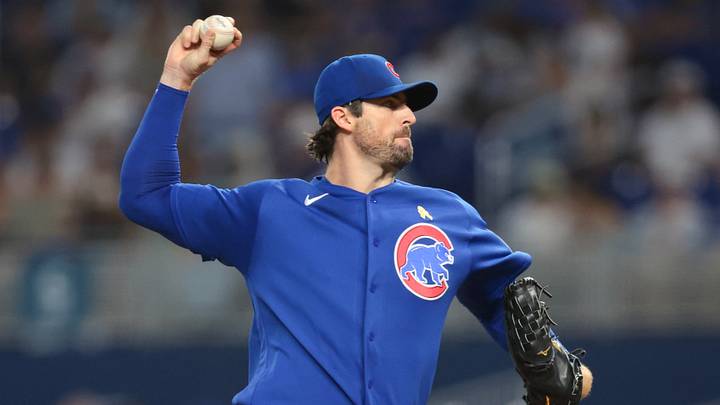
In 2026, Holmes finished his second season as a starter and posted a 3.29 ERA in 101 ⅓ innings, with 78 strikeouts and 1.4 bWAR. He pitched to a 2.39 ERA in 52 ⅔ innings with the New York Mets and, after suffering a fractured fibula, was sent to the Chicago Cubs in the second half of the season, where his performance suffered a considerable decline and his xFIP jumped from 3.68 to 4.12.
Hitters basically continued producing the same BABIP against Holmes -- the .250 allowed in New York rose slightly to .252 -- and he even generated a higher ground-ball rate, but home runs became the main problem, as his HR/FB rate increased from 7.1% to 11.1%.
That said, I think Holmes can work as a mid-rotation starter, with projections to pitch more than 100 innings, which makes him an interesting piece among the options the Astros have, as they had only two starters who were able to surpass 100 innings pitched: Peter Lambert, with 155 ⅔, and Hunter Brown, with 107 ⅓.
The projected cost of between $35-40 million -- with an AAV that could range between $17-20 million -- could be somewhat high for a pitcher like Holmes, whose main concerns are related to control and his ability to generate whiffs. In 2026, he finished in the 23rd percentile in Whiff%, while his 18.6% strikeout rate and 10% walk rate placed him in the 24th and 29th percentiles, respectively.
That combination limited his ability to dominate hitters and exposed him more frequently to contact, although he somewhat compensated for those problems with his extraordinary 60.5% ground-ball rate, which placed him in the 99th percentile.

Of course, this has a lot to do with his transition from reliever to starter, where the workload changes and, therefore, Holmes had to make some key adjustments, such as restructuring his repertoire, adding a curveball, a changeup, and a cutter with a greater presence over the last two seasons.
In the process, he has also had to battle the loss of approximately four miles per hour in velocity, and now his profile depends more on reducing hard contact.
It is not that he has completely lost his ability to strike batters out, but Holmes’ key has been moving more toward his efficiency in keeping the ball on the ground and generating ground balls.
As long as that effect continues to flow, he will keep moving forward, and his track record has shown it, as he has just finished his sixth consecutive year recording a ground-ball rate in the 94th percentile or better, a stretch that includes several years in the 100th percentile.
 Add us as a preferred source on Google

Yirsandy is a baseball writer specializing in MLB coverage with experience across multiple teams and storylines. He currently writes for Diamond Centric, where he covers the New York Mets, San Diego Padres, Chicago Cubs, Milwaukee Brewers, and Kansas City Royals. My work focuses on game coverage, player analysis, and storytelling that connects performance with context. My Substack has also been an important part of my writing development, where I’ve built much of my baseball coverage and storytelling voice over time. I’m passionate about combining reporting, research, and thoughtful analysis to produce engaging baseball content for readers.
Follow Yirsandy