%20%20--%3E%0A%3Csvg%20version%3D%221.1%22%20id%3D%22Layer_1%22%20xmlns%3D%22http%3A%2F%2Fwww.w3.org%2F2000%2Fsvg%22%20xmlns%3Axlink%3D%22http%3A%2F%2Fwww.w3.org%2F1999%2Fxlink%22%20x%3D%220px%22%20y%3D%220px%22%0A%09%20width%3D%2239px%22%20height%3D%2240px%22%20viewBox%3D%220%200%2039%2040%22%20enable-background%3D%22new%200%200%2039%2040%22%20xml%3Aspace%3D%22preserve%22%3E%0A%3Cpath%20fill%3D%22%23FFFFFF%22%20d%3D%22M38.5%2C7H28.2v26h10.3V7z%22%2F%3E%0A%3Cpath%20fill-rule%3D%22evenodd%22%20clip-rule%3D%22evenodd%22%20fill%3D%22%23FFFFFF%22%20d%3D%22M26.1%2C25.5c0%2C5.8-4.1%2C7.5-12.9%2C7.5C3.9%2C33%2C0%2C31.2%2C0%2C25.2v-1.1h11.6%0A%09v2.4c0%2C0.7%2C0.1%2C1.4%2C1.2%2C1.4c1%2C0%2C1.2-0.4%2C1.2-1.3v-0.9c0-1.6-0.9-1.6-3.5-2.2C2.2%2C21.7%2C0%2C19.7%2C0%2C15.3v-0.9C0%2C9.3%2C5.5%2C7%2C12.9%2C7%0A%09c10.2%2C0%2C12.8%2C2.6%2C12.8%2C7.4v1.8h-11v-2.9c0-0.6-0.4-1.1-1.2-1.1c-0.6%2C0-1.2%2C0.4-1.2%2C1.1v0.9c0%2C1.5%2C0.9%2C2%2C3.3%2C2.5%0A%09c8%2C1.6%2C10.5%2C3.3%2C10.5%2C7.5V25.5z%22%2F%3E%0A%3C%2Fsvg%3E%0A)
Which NFL Coaches Are on the Hot Seat and Why More Jobs May Open Than You Expect (Again)
In this story:
We are now four games into a 17-game season, which may feel too early to bring up the term “hot seat.” But I promise you, it’s not. With teams like the Raiders and Giants enjoying fast starts after recent seasons that resulted in top-five picks, owners are once again keyed on the simplest and most cost-effective fix for their underperforming organizations: a coaching change.
When discussing the state of affairs with one industry source this week, we wondered whether this season would buck the trend where there’s typically a quiet year on the coaching turnover front after a season of large-scale change. There were 10 coaching changes in the NFL last offseason, which would lead one to believe that there might not be much turnover on the horizon. There are a few factors that I think may challenge that truism:
• Last season’s coach hiring cycle was defined largely by the names that got interviews but did not get hired: the very young trio of Grant Udinski, Davis Webb and Nate Scheelhaase. Add in Declan Doyle, the Ravens’ new OC; David Blough, who is keeping the Commanders competitive with Marcus Mariota under center; and Klay Kubiak, the 49ers’ OC and brother of Raiders head coach Klint Kubiak (whom we’ll talk more about in a second). You have a possible glut here of the NFL’s most valuable resource—an ace play-caller with head coaching potential—ripening before our eyes. It’ll be a “get it now or watch someone else do it” kind of winter.
• We’re seeing what happens to these teams when they lose those play-callers, which has to enhance their value on the open market. While the Lions’ offense has kept pace in terms of efficiency (somewhat), it’s clear the team has not been the same without Ben Johnson, who now continues to work miracles in Chicago. The same can be said of the Buccaneers and Liam Coen and the Buccaneers and Dave Canales. I’m not saying that Blough, Webb, Udinski, Doyle or Kubiak are Coen, Canales or Johnson—but I’m saying there’s a reason Sean Payton surrendered play-calling duties to keep Webb in Denver another year, just like there’s a reason the Commanders promoted Blough as he was getting interest for the Lions’ offensive coordinator job.
• Mike Tomlin, as soon as he is done recreating the Palace of Versaille in Minecraft, will be ready to interview for head coaching jobs. Having the Steelers fall apart in his absence will likely only aid his stock. While it’s not quite the same as when Payton lorded over the NFL for a season from the booth—Payton is a play-caller and a Super Bowl champion—a team in shambles could do worse than the former Super Bowl winner now working for NBC.
With that in mind, we’re discussing a broad list of potential change candidates here. We’re doing so with full knowledge that the season is still very young and knowing that the NFL will dramatically shapeshift between now and late December. Winning streaks will happen. Narratives will shift.
Consider this a ranking from the hottest seat, to the least hot, of the coaches that we should consider in this sort of category. I’ve also added tiers, not to complicate the whole ordeal, but to make it clear that there is a pretty wide gap between certain teams and changes that feel somewhat imminent versus a more speculative approach toward the middle and bottom of these rankings.
TIER I: The hottest seats
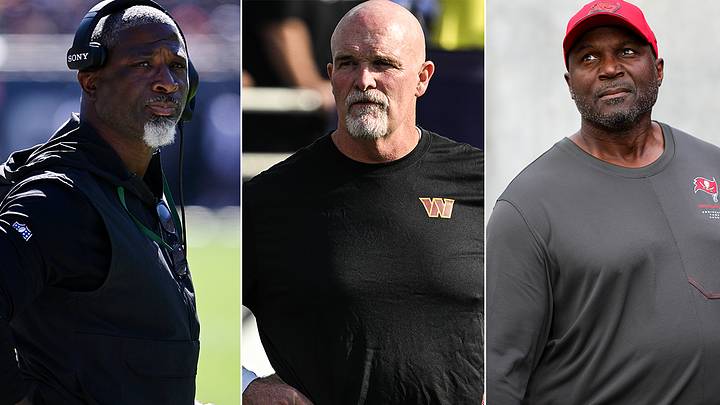
1. Todd Bowles, Tampa Bay Buccaneers
The Tampa Bay job is a good one that—I imagine—would draw top candidates. Like with any Jason Licht team, there are pieces. The NFC South is a winnable division and there is at least a serviceable quarterback in place, though Tampa, with more than a few heavy hitters remaining on its schedule, could also be in a position to add some competition to the roster. The Buccaneers rarely part ways with a head coach before a thorough evaluation. Since Jon Gruden was fired in January 2009, only the Greg Schiano and Lovie Smith eras lasted fewer than three seasons. Let’s be real: When your own local beat writers are asking both the head coach himself and key players if you’re still supported, there is a strong likelihood that moves are already being made in that direction (unless you coach in New York or Philadelphia, when it’s more of a weekly occurrence).
Bowles is at the phase of coaching when a once-creative idea—like dropping the athletic Vita Vea into coverage; or stopping his blitz-heavy approach against the Packers of all teams, a club that struggles mightily in pass protection and is signing reserve offensive linemen left and right simply to patch the lineup—takes place in a critical goal-line situation and ends up feeling ridiculous, even if there was some kind of intellectual underpinning to it all. Bowles has had at least a three-game losing streak in every season on the job and four-game losing streaks in each of his past three seasons on the job. There are a few examples of headlining clock mismanagement over the years, but perhaps the most damning indictment is that Bowles’s defense from Weeks 12 to 18 last season was among the 10 worst in the NFL in EPA per play surrendered and is dead last through the first month of this season.
2. Aaron Glenn, New York Jets
Last year, we wondered whether the Jets should have taken a page out of the Patriots’ book and realized a failed investment before it grew into something larger and more toxic. New England’s case to replace Jerod Mayo was rare in that Mike Vrabel was a franchise legend coming off a gap year riding the tailwind of a well-constructed (it seemed at the time!) PR campaign. I don’t know if the Jets would have been in the mix for someone like Klint Kubiak, who, I was told, was incredibly cautious and asked some pointed questions during his interview process. The kind the Jets may have struggled to answer after firing Robert Saleh in the middle of the season before, for example. The same goes for John Harbaugh, who eliminated several teams—including the Titans—pretty quickly.
Entering season two, Glenn seemed to at least tread water with the hiring of his offensive coordinator (Frank Reich), but continues to struggle at the most critical tenets of the job. More clock management issues underline losses—as Rich Cimini of ESPN pointed out, Glenn has one of the worst point differentials in the NFL with four minutes to go in the half and in the game—and Glenn continues to demonstrate an inability to navigate the market. After a loss to the Bears on Sunday, Glenn began conjuring the media’s tendency to bring up the Jets’ historical playoff drought and stood determined to prevent such thoughts from creeping into the locker room. We’ll see if he succeeds, though Glenn has always suffered at the hands of the bigger picture: With three first-round picks on tap for 2027, it’s incredibly unlikely that an organization would entrust Glenn to have a heavy hand in what could be the franchise’s most pivotal draft since 2006, when the team scored both D’Brickashaw Ferguson and Nick Mangold in the first round. So far this season, the team’s No. 2 pick, rookie edge rusher David Bailey, hasn’t tracked anywhere near Arvell Reese, believed to be the other option the Jets weighed for Glenn and his talent-starved defense.
TIER II: An impossible evaluation
3. Dan Quinn, Washington Commanders
Quinn stands alone in Tier II, but I wanted to note a gap between him and Glenn. Quinn’s team stunned the Seahawks in Week 3 and hung around against the Colts for almost three quarters with a third-string quarterback under center this past Sunday in London. We’ll talk about the Steelers in a moment, and I view Pittsburgh’s situation and the Commanders’ situation pretty similarly. Both teams seemed to be leaning toward up-and-coming play-calling candidates with their respective openings in 2024 and ’26. The Commanders had the infamous plane ride turnaround with Ben Johnson and the Steelers, from what I understand, really liked Klay Kubiak. I’m not saying that Quinn or Mike McCarthy were consolation prizes, but the hires did represent a kind of quick, safe, compromise pivot away from where—at least I personally—felt their searches were headed. In Quinn’s case, he took an incredible rookie season from Jayden Daniels in 2024, in which the Commanders posted one of the greatest drive-by-drive offenses in recent NFL history, and parlayed that success into an aggressive 2025 in which Washington saw its franchise quarterback injured and the limitations of its defense start to show.
Since Quinn’s arrival in 2024, only the Cowboys have had a worse defense by EPA per play allowed. Sonny Styles, the team’s first-round pick, has been excellent, as has free-agent addition Odafe Oweh. Washington’s defense has improved and, strangely, in the moments that Quinn loses his franchise quarterback, you tend to see the strength of his leadership skills. Blough’s emergence adds an interesting subtext to the situation given what we’ve seen from teams losing out on great offensive play-callers at the cost of keeping a more experienced head coach. But, ultimately, I think many of Quinn’s supposed failings are more roster-related than coaching-related. Still, the head coaching position in Washington will be under fierce evaluation if the Commanders don’t rediscover a spark when Daniels is back in the lineup.

TIER III: Established names battling staleness, time and circumstance
4. Matt LaFleur, Green Bay Packers
LaFleur’s contract extension at the end of last season essentially prolonged the lame-duck season for one year, putting LaFleur in a position now that is similar to what he faced at this time last year. At 2–2, the Packers are barreling into an optical nightmare of a matchup against the Bears, having barely survived a road trip to Tampa and a team that happened to be starting an undrafted free agent at quarterback. Ben Johnson is already adding to the theatrics of this game, as he’s done since the moment he took the job.
LaFleur’s roster right now is a nightmare. I think his situation is comparable to Quinn’s in that the nature of the injuries makes it impossible to get a full evaluation of how he’s actually doing. There were some well-blocked runs on Sunday against Tampa Bay that, for example, with a more explosive back, could have resulted in a flashy score. Green Bay has something like 30% of its total salary cap either on injured reserve or the commissioner exempt list. Edgerrin Cooper sustaining an Achilles injury elicited an understandably terse response from LaFleur in the team’s post-game interview session. Of course, Micah Parsons is set to return at some point, and the porous Cowboys and Lions are coming up behind the Bears on the schedule, offering the ideal setting for a new get-right game with some gravitas.
The LaFleur argument is a fascinating one in that Green Bay is also being dragged down by what you would normally describe as coaching-related ailments—penalties, fumbles and drops. Green Bay had a string of high-improbability losses last season and already saw a divisional game against the Vikings turn violently on the heels of a strange fourth-down decision. But LaFleur has also been making tuna salad out of a dreadful situation in 2026. Jordan Love’s hit total went way down on Sunday, and the Packers’ rushing game looked like it improved marginally. He deserves credit for that.
5. Zac Taylor, Cincinnati Bengals
The Bengals exiting a loss to the Jaguars having almost completely reverted to the 2025 version of themselves officially took the polish off what was a promising Zac Taylor offseason. Whether Joe Burrow simply cannot play in a play-action-oriented offense or this is not the version of said offense that works for Burrow remains to be seen. The quarterback has to know that dropping back 54 times against an athletic, opportunistic defense is a recipe for disaster. Posting 17 total rushing yards from the team’s running backs is inexcusable at a time when there are more tools at a play-caller’s disposal to generate a steady ground game than ever. It’s difficult to fathom that a team with Burrow, Tee Higgins and Ja’Marr Chase cannot generate more light box situations for Chase Brown, who has one of the highest percentages of eight-man boxes in the NFL, but has by far the best quarterback out of any running back ahead of him (Drake Maye and Rhamondre Stevenson are on that list, but the Patriots are drained at wide receiver; and Lamar Jackson and Derek Henry are also on that list, but Henry’s presence in the lineup automatically demands a heavier defensive personnel).
Taylor is still riding off the fumes of a surprise Super Bowl berth in 2021, which was followed by a conference title game appearance in 2022. Since that season, the Bengals have yet to make the playoffs. Last year, we ran up against a bizarre situation in which it was revealed that the Bengals quietly extended Taylor, though the team and the coach declined to address it. Taylor is under contract through the 2027 season, making this the offseason where he would either sign a Band-Aid, LaFleur-style extension or separate from the Bengals for good. Taylor will always be under the microscope given the ticking clock on Burrow’s prime. With teams like the Bills making similar pivots in the offseason to turn away from successful, established head coaches, and a likely surge in interested candidates, the Taylor conversation will likely become a weekly fixture if the Bengals remain mired in mediocrity.
6. Mike McCarthy, Pittsburgh Steelers
The first of two first-year coaches on this list, McCarthy is here for three simple reasons: He is about to turn 63, the Steelers have one of the 10 worst offenses in the NFL (likely worse had it not been for an inexplicable Bengals defensive breakdown in Week 3) and he is an unlikely candidate to spearhead the team through what will eventually be a massive roster overhaul. As I mentioned above, Pittsburgh really liked Klay Kubiak and, if you look at the list of candidates the Steelers compiled, McCarthy feels like a true outlier. This is just my personal read on the situation, but given that McCarthy is both a local fixture and had established ties with Aaron Rodgers, he felt like an ideal fallback or pivot option if one of the team’s A-list candidates did not materialize. In that way, I think a disappointing season would not put McCarthy out of the realm of being one-and-done. While this would be a stunning turn of events for a team that has long celebrated the low turnover at the head coaching position, the quickest way to right the ship is not by lingering on a bridge candidate.
While I have made the point that McCarthy has similar career bona fides as Sean Payton and has had some impressive coaching seasons when disaster strikes at the quarterback position—his Cooper Rush–Cowboys era deserves more credit—the Steelers are looking increasingly like a team that is not just a few players away. Between McCarthy and Rodgers jawing on television and T.J. Watt picking up the phone on Thursday Night Football and hollering into the booth, this is not a team that looks like it has grown together over its first season as a collective.
7. Shane Steichen, Indianapolis Colts
Steichen and GM Chris Ballard are a two-headed tandem that received a blanket warning from ownership after a disappointing late-season collapse last year. The fourth-year head coach has won nine, eight and eight games in his first three seasons, respectively, and has yet to advance to the postseason. All of this, however, comes with a major caveat. The Colts have consistently been one of the top rushing offenses in the NFL and overcame a massive swing-and-miss at the quarterback position with Anthony Richardson Sr. in the 2023 draft. The pivot to Daniel Jones hasn’t been seamless, but a Steichen-called offense is rarely out of a game. The Colts are fourth in rushing success rate and lead the NFL in rushing EPA. Back-to-back grind-it-out wins against the Texans and then the Commanders in London show a team that has not jumped ship, and the Colts remain one of the best scripted-drive teams in the NFL, which, to me, indicates a coach’s ability to dial it up when necessary.
Steichen has come under fire for clock management issues, most notably the handling of the end-of-game situation against Kansas City in Week 2 (although a narrow loss to the 4–0 Chiefs looks a lot different in hindsight). The Chiefs game brought a streak of losses in one-possession games to six, and the Texans game was another example of time management issues that placed Steichen’s ability to manage possessions under the microscope. All that said, I think the theme of this tier, with the exception of McCarthy, is that if any of these coaches were let go, they would be immediate factors on the interview circuit.
8. Nick Sirianni, Philadelphia Eagles
I agree with a somewhat controversial take by WIP’s Eliot Shorr-Parks that Nick Sirianni did not have a bad game despite the Eagles’ collapse against the Rams on Sunday. The fact that this team was “up” enough emotionally to storm to an early lead and outplay the Rams through three quarters can be chalked up to coaching, especially without eight of the team’s nine best players available. Seriously, by the end of the game they had no Saquon Barkley, Lane Johnson, Quinyon Mitchell, Landon Dickerson, Dallas Goedert, DeVonta Smith, Zack Baun or Jonathan Greenard and they were hanging with the best team in football. That says something, particularly about the kind of coach Sirianni totes himself as.
The fourth-down decision at the goal line was grounded in sound reasoning, given that a field goal would have put the Eagles up by 13, though I suppose Sirianni should have pushed for a more conservative suite of play calls from the 2-yard line if he was eyeing it as four-down territory. His other fourth-down decisions had far less analytical underpinning and felt sloppily conceived.
Ultimately, though, Sirianni is on this list because he is a non-play-calling head coach and the Eagles’ Achilles heel has been the turnover at the offensive coordinator position. Philadelphia’s second-half offensive woes this year are abhorrent and Sean Mannion may or may not get the kind of leeway he needs to grow into a job with a hyper-particular quarterback like Jalen Hurts and a Barkley who looks like a shadow of his 2024 self. For that reason, there will always be a strong analytical argument for rebooting the coaching staff around a play-caller who can grow with an offense, instead of investing in the needs of a CEO-style head coach who, if he’s not dazzling with in-the-margin type victories, is not making a strong case for an owner-GM tandem that has been notoriously quick with their trigger on declining regimes.

TIER IV: If the floor totally collapses, we may have a conversation on our hands
9. Jim Harbaugh, Los Angeles Chargers
The Chargers are having a season from hell. Despite the near comeback attempt against the Seahawks on Sunday, the state of the union is depressing: Down to a bare-bones offensive line again—literally, the last healthy linemen on the roster—the Chargers look like a team whose big-ticket coaching move (Mike McDaniel) is totally mismatched with the personnel on the roster, while a quarterback is taking another season-long beating as his most reliable targets struggle to stay on the field. Over the past two weeks, the Chargers’ defense has improved despite Derwin James being inactive on Sunday with a hamstring injury, which bodes well for Harbaugh’s ability to replace one-time star defensive coordinator Jesse Minter.
Harbaugh’s grasp on this job long term will depend on his finesse. His erratic press conference moments, once adorable and endearing, must give way to legitimate showmanship as the focus shifts toward a 2027 season with equally high expectations and a division that, as difficult as it is to imagine, turns into even more of a hellscape as the Raiders develop under Klint Kubiak. The Chargers will not fire a coach who won 11 games in each of his past two seasons unless vintage, owner-clashing 49ers-era Jim Harbaugh rears his head over the coming months. Given that there is no college head coaching job to escape to, my guess is that the operation will least appear more buttoned-up the closer we get to November and December. If not, Harbaugh would begin the following year as one of the leading replacement candidates in the NFL.
10. Robert Saleh, Tennessee Titans
Saleh, unlike Mike LaFleur in Arizona or Jeff Hafley in Miami, had some degree of expectation entering the season. Tennessee’s roster needed work and we may be finding out in real time that Cam Ward is not the answer as a franchise quarterback—at least at this stage of his development and maturation. The Titans probably will not make a move because ownership has seen the dramatic impact of full-scale change over the past half-decade. Mike Vrabel and Jon Robinson became Mike Vrabel and Ran Carthon, which became Ran Carthon and Brian Callahan, which became Brian Callahan and Mike Borgonzi, which became Mike Borgonzi and Robert Saleh. My sense of the Titans’ hiring process was that it felt a little disjointed, though that is often the case when you’re trying to merge the thoughts and ideas of ownership and management.
Saleh is doing his job. The Titans’ defense, which was one of the four worst units in the NFL last year, is starting to round into a top-half-of-the-league outfit. Over the past two weeks of the season, the Titans are 12th in EPA per play allowed. First-round pick Carnell Tate also had his true breakout game, logging nine catches on 12 targets for 145 yards. The issue is going to become where this progression line hits at the midseason point because, as we’ve mentioned many times in this space, the Titans need to generate interest in a new stadium that is set to open in 2027. I guarantee we will not arrive at that place without one major splash maneuver from management and ownership, which could ultimately be similar in nature to Saleh’s recruitment of Aaron Rodgers to play for the Jets. However, I don’t think Saleh will fully be able to stiff-arm the idea that he should be the splash move if the team continues a winless streak deep into October and into November. Again, the signs of progress are there, but a run of quality opponents coming up—Houston, Cleveland, Indianapolis and Cincinnati—demands at least one signature early-season victory to solidify the idea of progress.
11. Dan Campbell, Detroit Lions
I don’t think Campbell will ever reap the proper amount of credit he deserves for reviving the Lions after the end of the Matt Patricia era. I think Campbell is one of the NFL’s “culture-first” CEO-type head coaches who actually has a track record of buy-in and an ability to generate a certain style of play and recognize when that standard has dropped off. He entered the season with the friendliest strength of schedule in the NFL, which was supposed to provide the foundation for a major turnaround. Now, his big test will be what happens in the wake of Sunday night’s loss to the Panthers, where Tetairoa McMillan demolished a beaten-down Lions secondary, which barely managed to steal the headline from a dominant rushing performance from the Panthers as well.
Help is on the way for Detroit, but this is Campbell’s moment to both break away from the growing optical heaviness of his record without Ben Johnson and to prove he has his finger on the pulse of the locker room. What we saw on Sunday, the disaffected faces of stars Amon-Ra St. Brown and Jameson Williams, can be infectious if not addressed. So far, Campbell has taken two separate opportunities to double down on his support of DC Kelvin Sheppard—a move that could either solidify his popularity in an alpha-heavy locker room, or, perhaps, show its limitations.
12. DeMeco Ryans, Houston Texans
Again, we’re in the not gonna happen category. But blame has finally arrived at the doorstep of Ryans, who has been able to sidestep many of Houston’s woes since becoming head coach thanks to instability at quarterback, offensive coordinator and quarterbacks coach. This was not the case on Sunday, when the Texans saw their defense picked apart by their in-state rivals in a game that could have been a panic-quelling win for the one-time Super Bowl hopefuls. The Cowboys were able to shift the Texans’ defense into oblivion and create ideal matchups for CeeDee Lamb, despite the Texans seeming to want Derek Stingley Jr. on the all-world Dallas wideout exclusively. Yes, there are injuries to take into account, but Houston is nowhere near the suffering endured by other disappointing contenders.
Ryans makes the list because we heard him at the podium promising real and actionable change after Houston’s fourth consecutive loss to begin the season. His head coaching acumen may be judged on how the Texans respond, with a more generous stretch of the schedule ahead. Ryans was hired in the archetype of Campbell in Detroit and was successful in instilling a similar culture. Campbell’s ultimate success, though, was landing on a lights-out offensive coordinator who remained with the team for three starlit seasons. Ryans continues to shuffle his personnel and has not yet hit on a lineup that can allow his strengths to take hold at full force.
 Add us as a preferred source on Google
Conor Orr is a Senior Writer for Sports Illustrated with more than 15 years of experience covering the NFL. His work has been cited in Best American Sportswriting and has won a PFWAA award. Prior to Sports Illustrated, he covered both the Giants and Jets for The Star-Ledger. Conor lives in New Jersey with his amazing wife and three children.
Follow author