%22%3E%0A%3Cpath%20d%3D%22M0%2010.5564H4.01662L8.58953%2016.223V10.5564H12.8513V23.4077H9.03267L4.26176%2017.477V23.4077H0V10.5564Z%22%20fill%3D%22white%22%2F%3E%0A%3Cpath%20d%3D%22M13.9635%2018.4482V18.4105C13.9635%2015.4216%2016.1133%2013.1399%2019.121%2013.1399C22.6851%2013.1399%2024.3351%2015.6196%2024.3351%2018.6651C24.3351%2018.882%2024.3351%2019.146%2024.3162%2019.3628H17.8764C18.1687%2020.2397%2018.8664%2020.7017%2019.7622%2020.7017C20.5165%2020.7017%2021.1388%2020.3528%2021.7988%2019.674L24.0334%2021.456C23.0433%2022.7383%2021.629%2023.6434%2019.4604%2023.6434C16.1793%2023.6434%2013.9541%2021.5691%2013.9541%2018.4482H13.9635ZM20.5353%2017.5337C20.441%2016.5814%2019.8753%2016.0251%2019.1399%2016.0251C18.4044%2016.0251%2017.9424%2016.6096%2017.8199%2017.5337H20.5353Z%22%20fill%3D%22white%22%2F%3E%0A%3Cpath%20d%3D%22M24.2604%2013.3849H28.2393L29.267%2017.4204L30.4739%2013.3472H33.7928L35.0185%2017.4581L36.084%2013.3849H40.0157L36.9514%2023.4736H33.4628L32.1239%2019.1835L30.7473%2023.4736H27.2776L24.251%2013.3849H24.2604Z%22%20fill%3D%22white%22%2F%3E%0A%3Cpath%20d%3D%22M45.5879%2010.5564H56.544V14.0827H49.8119V15.3839H56.0914V18.4859H49.8119V19.8814H56.6383V23.4077H45.5879V10.5564Z%22%20fill%3D%22white%22%2F%3E%0A%3Cpath%20d%3D%22M57.7604%2013.3849H61.9279V14.7803C62.569%2013.9506%2063.5779%2013.1492%2064.9922%2013.1492C67.1042%2013.1492%2068.4242%2014.5446%2068.4242%2016.7981V23.4076H64.2568V18.1369C64.2568%2017.2789%2063.7476%2016.7792%2063.1159%2016.7792C62.4842%2016.7792%2061.9185%2017.2789%2061.9185%2018.1369V23.4076H57.751V13.3849H57.7604Z%22%20fill%3D%22white%22%2F%3E%0A%3Cpath%20d%3D%22M69.452%2025.1237L70.7344%2022.6063C71.8564%2023.1909%2072.9689%2023.5586%2074.3455%2023.5586C75.9013%2023.5586%2076.731%2022.7477%2076.731%2021.3617V21.0694C76.1653%2021.7106%2075.2224%2022.446%2073.827%2022.446C71.2435%2022.446%2069.3672%2020.6074%2069.3672%2017.8354V17.7977C69.3672%2014.9879%2071.2718%2013.1399%2073.5912%2013.1399C75.0621%2013.1399%2075.9201%2013.6868%2076.6556%2014.4411V13.3756H80.823V20.862C80.823%2022.7194%2080.4365%2023.9829%2079.5219%2024.8975C78.6262%2025.7932%2077.2496%2026.3683%2075.0055%2026.3683C72.7615%2026.3683%2071.0644%2025.9252%2069.4426%2025.1237H69.452ZM76.7498%2017.8259V17.7882C76.7498%2016.9302%2076.0898%2016.2325%2075.081%2016.2325C74.0721%2016.2325%2073.4121%2016.9491%2073.4121%2017.8259V17.8637C73.4121%2018.7217%2074.0721%2019.4005%2075.081%2019.4005C76.0898%2019.4005%2076.7498%2018.7028%2076.7498%2017.8259Z%22%20fill%3D%22white%22%2F%3E%0A%3Cpath%20d%3D%22M82.1797%2010.0093H86.3472V23.4074H82.1797V10.0093Z%22%20fill%3D%22white%22%2F%3E%0A%3Cpath%20d%3D%22M87.3281%2020.5602V20.5225C87.3281%2018.5236%2088.8179%2017.4016%2091.1467%2017.4016C91.9953%2017.4016%2093.0702%2017.5807%2093.5133%2017.7693V17.5996C93.5133%2016.685%2092.9476%2016.1476%2091.6559%2016.1476C90.6282%2016.1476%2089.7702%2016.3644%2088.8839%2016.7133L88.1484%2013.9412C89.3081%2013.4981%2090.6282%2013.2058%2092.3725%2013.2058C94.4091%2013.2058%2095.7291%2013.6301%2096.6154%2014.507C97.3697%2015.2613%2097.662%2016.2324%2097.662%2017.6844V23.3888H93.4945V22.3799C92.7968%2023.1342%2091.8633%2023.6245%2090.6093%2023.6245C88.6859%2023.6245%2087.3281%2022.5213%2087.3281%2020.5413V20.5602ZM93.5416%2019.6927V19.2684C93.3059%2019.1742%2092.9382%2019.1082%2092.5893%2019.1082C91.7596%2019.1082%2091.307%2019.6079%2091.307%2020.2302V20.2679C91.307%2020.8525%2091.7313%2021.239%2092.2593%2021.239C92.9948%2021.239%2093.5416%2020.6545%2093.5416%2019.7022V19.6927Z%22%20fill%3D%22white%22%2F%3E%0A%3Cpath%20d%3D%22M98.9072%2013.3849H103.075V14.7803C103.716%2013.9506%20104.725%2013.1492%20106.139%2013.1492C108.251%2013.1492%20109.571%2014.5446%20109.571%2016.7981V23.4076H105.404V18.1369C105.404%2017.2789%20104.894%2016.7792%20104.263%2016.7792C103.631%2016.7792%20103.075%2017.2789%20103.075%2018.1369V23.4076H98.9072V13.3849Z%22%20fill%3D%22white%22%2F%3E%0A%3Cpath%20d%3D%22M110.523%2018.467V18.4292C110.523%2015.2518%20112.428%2013.1397%20114.804%2013.1397C116.322%2013.1397%20117.171%2013.7998%20117.812%2014.5163V10H121.979V23.3982H117.812V22.1724C117.133%2022.9079%20116.36%2023.6433%20114.842%2023.6433C112.419%2023.6433%20110.533%2021.5313%20110.533%2018.467H110.523ZM117.897%2018.4104V18.3727C117.897%2017.3827%20117.18%2016.5718%20116.228%2016.5718C115.275%2016.5718%20114.559%2017.3638%20114.559%2018.3727V18.4104C114.559%2019.4192%20115.275%2020.2113%20116.228%2020.2113C117.18%2020.2113%20117.897%2019.4192%20117.897%2018.4104Z%22%20fill%3D%22white%22%2F%3E%0A%3Cpath%20d%3D%22M128.146%2010.5564H133.925C137.338%2010.5564%20139.667%2012.0838%20139.667%2015.1293V15.167C139.667%2018.2691%20137.301%2019.9191%20133.831%2019.9191H132.436V23.4077H128.146V10.5564ZM133.595%2016.8548C134.698%2016.8548%20135.434%2016.355%20135.434%2015.4405V15.4027C135.434%2014.4693%20134.755%2013.9884%20133.614%2013.9884H132.436V16.8548H133.595Z%22%20fill%3D%22white%22%2F%3E%0A%3Cpath%20d%3D%22M139.799%2020.5602V20.5225C139.799%2018.5236%20141.289%2017.4016%20143.617%2017.4016C144.457%2017.4016%20145.541%2017.5807%20145.984%2017.7693V17.5996C145.984%2016.685%20145.418%2016.1476%20144.127%2016.1476C143.099%2016.1476%20142.241%2016.3644%20141.355%2016.7133L140.619%2013.9412C141.779%2013.4981%20143.099%2013.2058%20144.843%2013.2058C146.88%2013.2058%20148.2%2013.6301%20149.086%2014.507C149.84%2015.2613%20150.133%2016.2324%20150.133%2017.6844V23.3888H145.965V22.3799C145.267%2023.1342%20144.334%2023.6245%20143.08%2023.6245C141.157%2023.6245%20139.799%2022.5213%20139.799%2020.5413V20.5602ZM146.012%2019.6927V19.2684C145.777%2019.1742%20145.409%2019.1082%20145.06%2019.1082C144.23%2019.1082%20143.778%2019.6079%20143.778%2020.2302V20.2679C143.778%2020.8525%20144.202%2021.239%20144.73%2021.239C145.465%2021.239%20146.012%2020.6545%20146.012%2019.7022V19.6927Z%22%20fill%3D%22white%22%2F%3E%0A%3Cpath%20d%3D%22M152.057%2020.0414V16.5905H150.878V13.3754H152.057V10.8579H156.224V13.3754H158.534V16.5905H156.224V19.1269C156.224%2019.8812%20156.573%2020.1546%20157.233%2020.1546C157.619%2020.1546%20158.063%2020.0414%20158.496%2019.8434V23.0586C157.836%2023.4075%20156.846%2023.6243%20155.837%2023.6243C153.377%2023.6243%20152.057%2022.4835%20152.057%2020.0414Z%22%20fill%3D%22white%22%2F%3E%0A%3Cpath%20d%3D%22M159.543%2013.3848H163.71V15.4026C164.276%2014.0448%20165.2%2013.1585%20166.85%2013.234V17.656H166.407C164.644%2017.656%20163.71%2018.6272%20163.71%2020.8523V23.4075H159.543V13.3848Z%22%20fill%3D%22white%22%2F%3E%0A%3Cpath%20d%3D%22M167.604%2010.0093H171.913V12.6682H167.604V10.0093ZM167.67%2013.3847H171.838V23.4074H167.67V13.3847Z%22%20fill%3D%22white%22%2F%3E%0A%3Cpath%20d%3D%22M172.884%2018.4294V18.3917C172.884%2015.5631%20175.232%2013.1399%20178.532%2013.1399C181.832%2013.1399%20184.151%2015.5253%20184.151%2018.354V18.3917C184.151%2021.2203%20181.803%2023.6434%20178.503%2023.6434C175.203%2023.6434%20172.884%2021.258%20172.884%2018.4294ZM180.153%2018.4294V18.3917C180.153%2017.4017%20179.418%2016.6096%20178.503%2016.6096C177.589%2016.6096%20176.891%2017.4017%20176.891%2018.354V18.3917C176.891%2019.3817%20177.626%2020.1737%20178.541%2020.1737C179.456%2020.1737%20180.153%2019.3817%20180.153%2018.4294Z%22%20fill%3D%22white%22%2F%3E%0A%3Cpath%20d%3D%22M185.754%2020.0414V16.5905H184.575V13.3754H185.754V10.8579H189.921V13.3754H192.231V16.5905H189.921V19.1269C189.921%2019.8812%20190.27%2020.1546%20190.93%2020.1546C191.317%2020.1546%20191.76%2020.0414%20192.194%2019.8434V23.0586C191.534%2023.4075%20190.544%2023.6243%20189.535%2023.6243C187.074%2023.6243%20185.754%2022.4835%20185.754%2020.0414Z%22%20fill%3D%22white%22%2F%3E%0A%3Cpath%20d%3D%22M192.524%2022.1913L193.938%2019.8247C195.145%2020.579%20196.512%2020.9467%20197.644%2020.9467C198.049%2020.9467%20198.247%2020.8524%20198.247%2020.6167V20.579C198.247%2020.381%20198.068%2020.249%20197.05%2019.9944C194.514%2019.3721%20192.958%2018.6932%20192.958%2016.6189V16.5812C192.958%2014.3749%20194.721%2013.1492%20197.323%2013.1492C198.973%2013.1492%20200.604%2013.5735%20201.821%2014.3089L200.501%2016.7886C199.435%2016.2041%20198.153%2015.8552%20197.304%2015.8552C196.899%2015.8552%20196.72%2015.9683%20196.72%2016.1663V16.2041C196.72%2016.4021%20196.937%2016.5341%20197.946%2016.7886C200.482%2017.4109%20202%2018.1087%20202%2020.1641V20.2018C202%2022.3893%20200.369%2023.6527%20197.653%2023.6527C195.711%2023.6527%20193.948%2023.153%20192.515%2022.2007L192.524%2022.1913Z%22%20fill%3D%22white%22%2F%3E%0A%3Cpath%20fill-rule%3D%22evenodd%22%20clip-rule%3D%22evenodd%22%20d%3D%22M211.368%204.36764C217.191%20-1.45588%20226.632%20-1.45588%20232.456%204.36764C238.279%2010.1912%20238.279%2019.6324%20232.456%2025.4559L221.912%2036L211.368%2025.4559C205.544%2019.6324%20205.544%2010.1912%20211.368%204.36764ZM214.009%207.55761C213.948%207.86849%20213.916%208.39718%20213.916%209.14566V10.4189C213.916%2011.1832%20213.948%2011.7198%20214.013%2012.0267C214.078%2012.3317%20214.278%2012.6168%20214.617%2012.8762C214.956%2013.1376%20215.403%2013.3316%20215.958%2013.4623C216.512%2013.593%20217.1%2013.6584%20217.837%2013.6584C218.573%2013.6584%20219.217%2013.591%20219.769%2013.4524C220.322%2013.3158%20220.761%2013.1178%20221.086%2012.8604C221.411%2012.6029%20221.605%2012.3178%20221.666%2012.0069C221.728%2011.6961%20221.759%2011.1674%20221.759%2010.4189V9.14566C221.759%208.38134%20221.728%207.84473%20221.662%207.53781C221.597%207.23287%20221.397%206.94971%20221.058%206.68834C220.72%206.42696%20220.272%206.23291%20219.718%206.10223C219.163%205.97154%20218.536%205.90619%20217.839%205.90619C217.102%205.90619%20216.459%205.97352%20215.906%206.11213C215.352%206.24875%20214.914%206.44677%20214.589%206.70418C214.265%206.9616%20214.071%207.24673%20214.009%207.55761ZM219.276%2024.8638C222.876%2024.8638%20224.557%2024.2064%20224.557%2021.862V21.858V21.3155C224.557%2019.6581%20223.516%2018.971%20220.252%2018.3136C219.278%2018.1136%20218.908%2017.9136%20218.908%2017.3136V16.9414C218.908%2016.6543%20219.177%2016.5117%20219.413%2016.5117C219.749%2016.5117%20219.918%2016.7137%20219.918%2016.9414V18.1136H224.391V17.3988C224.391%2015.4563%20223.347%2014.4266%20219.177%2014.4266C216.15%2014.4266%20213.896%2015.3414%20213.896%2017.3711V17.7433C213.896%2019.5155%20214.805%2020.3155%20218.201%2021.0303C218.28%2021.0472%20218.355%2021.063%20218.427%2021.0781C219.329%2021.2674%20219.647%2021.3341%20219.647%2021.9174V22.2897C219.647%2022.6619%20219.546%2022.8045%20219.142%2022.8045C218.67%2022.8045%20218.637%2022.5471%20218.637%2022.262V21.2897H213.894V21.7471C213.894%2024.149%20215.476%2024.8638%20219.276%2024.8638ZM225.424%2024.5569H229.925V14.7355H225.424V24.5569ZM226.955%2013.5019H229.925V6.06064H227.092V9.411L225.193%206.06064H222.359V13.5019H225.193V10.1199L226.955%2013.5019ZM218.269%2012.152C218.204%2012.2688%20218.055%2012.3262%20217.825%2012.3262L217.827%2012.3282C217.604%2012.3282%20217.459%2012.2767%20217.398%2012.1758C217.336%2012.0748%20217.305%2011.8074%20217.305%2011.3758V7.90068C217.305%207.51852%20217.352%207.28684%20217.445%207.20962C217.538%207.13239%20217.675%207.09279%20217.851%207.09279C218.059%207.09279%20218.198%207.14031%20218.265%207.23734C218.332%207.33239%20218.366%207.55416%20218.366%207.90068V11.3203C218.366%2011.7579%20218.334%2012.0352%20218.269%2012.152Z%22%20fill%3D%22white%22%2F%3E%0A%3C%2Fg%3E%0A%3Cdefs%3E%0A%3CclipPath%20id%3D%22clip0_15232_2855%22%3E%0A%3Crect%20width%3D%22237%22%20height%3D%2236%22%20fill%3D%22white%22%2F%3E%0A%3C%2FclipPath%3E%0A%3C%2Fdefs%3E%0A%3C%2Fsvg%3E%0A)
Patriots Comprehensive Blueprint to Beating Texans Defense
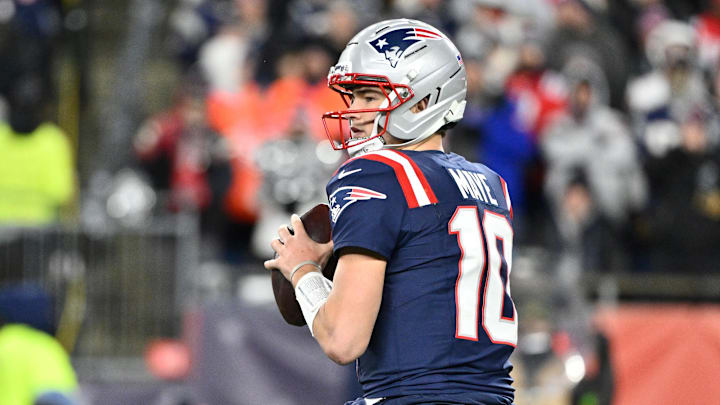
In this story:
Once in a blue moon, a defense comes around that completely challenges every aspect of your football mind. One that, hours and hours of film later, leaves you flabbergasted with the simplest question imaginable.
How do you possibly beat this?
Welcome to the 2025 Houston Texans defense.
A defense that, without exaggeration, may be the best defense the league has seen since the 2017 Jacksonville Jaguars — an opinion we adamantly hoped to be untrue at the beginning of film study, only for it to be reinforced repeatedly over hours of tape.
As the New England Patriots prepare for their divisional-round matchup, this article is the most comprehensive possible blueprint on how the Patriots offense can find success against the best defense of this decade.
We will dissect each layer of the Texans’ defense — defensive line, linebackers, and secondary — identifying both strengths and exploitable weaknesses for New England’s offense. At the end, we will present a list of keys that will allow the Patriots to emerge victorious from this weekend's battle in their quest for Lombardi number seven.
A Simple Defensive Philosophy
The Texans’ defensive philosophy is really simple.
“We’re just better than you.”
Much of the discourse around the Houston defense has appropriately centered around a lack of scheme complexity — and correspondingly, their elite personnel.
In the era of exotic safety rotations and funky combo coverages, this defense has managed to dominate with traditionally “vanilla” looks. When they line up in a two-high look, it’s usually a cover two-man or a match quarters. When they line up in a one-high look, it’s usually a cover-one man or a match-three.
Of course, there’s a lot of nuance even within these coverage looks — for example, Houston loves split-field coverages, often opting to put their corners in press-man on the field side with a boundary-side zone look. But even then, they stay in the same shell throughout the play.
The Texans defense also doesn’t blitz very often. Generating most of their pressure through their front four, their blitz rate of 22% is among the lowest in the league. In fact, with a good portion of their blitz being “green dog blitzes” (i.e. a linebacker only blitzing because their assigned running back/tight end in man coverage is in pass protection), their true blitz rate is even lower.
Another unique wrinkle is that most of Houston’s defensive snaps against opponents' base offensive sets come from a 4-2-5 nickel package. This means that the Texans only use traditional base personnel against heavier offensive personnel (jumbo sets, 12/22 personnel, etc). Despite their lighter personnel, each player is somehow speedy, sticky in pass coverage, and powerful against the run.
A defense predicated on winning first down and third down, the team thrives on limiting positive yardage early in series, forcing offenses to play off their back foot. Winning first down is tantamount to winning the game.
Defensive Line: The Texans’ Greatest Strength
A defensive line full of superstars is headlined by Will Anderson Jr., a first-team All-Pro with zero weaknesses on film. Simply put, he is the engine to this defense’s success. Numerous open deep shot opportunities in the secondary have never even been attempted because of his ability to meet the quarterback within three seconds of the snap. While teams did try to chip him at the line of scrimmage with a tight end, this generally didn’t make a difference.
He is so good, in fact, that the greatest trick he ever pulled is convincing the world that Danielle Hunter doesn’t exist. Hunter, a second-team All-Pro edge rusher this season (who probably should have been first-team over Micah Parsons), would be the best edge on 30 teams in the league.
Collectively, both edge rushers can consistently apply pressure with a combination of power and speed. It is their contribution that allows the team to avoid sending extra defenders to blitz.
Against the run, both are stalwarts in setting the edge, and both can consistently shed blocks to blow up zone runs.
In their tape against the Indianapolis Colts, there were numerous instances of the Colts running power run concepts that, against any other defensive line, should have sprung a touchdown. However, these plays ended with Anderson either shedding the key block at the point of attack or chasing the play from the backside, saving points in the process.
As if their individual prowess wasn’t enough, their designed alignment on the line is also genius in maximizing each’s skillset. Both primarily line up in a “wide-9” alignment, meaning they line up extremely wide on either side of offensive tackles; though this alignment is typically a pass-rushing alignment, it also gives the defensive ends a sharper angle to set the edge. This effectively negates running backs’ ability to bounce any kind of inside zone/outside zone (the most common run plays in football) outside the tackles, funneling everything towards the linebackers, making the second level’s job much easier on sideline-to-sideline stretches. From a passing perspective, this also functions as a de facto contain, preventing mobile quarterbacks from extending plays beyond the pocket.
On the inside of the defensive line are Tommy Togiai and Sheldon Rankins, two elite run- and pass-stopping presences. Both can compress the pocket centrally, find vertical penetration against zone runs, and consistently bat down balls at the line of scrimmage. Togiai especially popped on film as a threat against the backside of zone runs, even giving elite Indianapolis Colts guard Quinton Nelson fits in the process.
Beating the Texans DL:
Former head coach Bill Belichick did one thing better than anyone in the history of the game: he could negate the opponents’ biggest weapon. For the Patriots' offense, the gameplan starts with addressing Anderson Jr.
Though tight end chips have historically been ineffective, dedicated double teams could be viable. Designed tight end help or six offensive linemen sets could do enough to stall Anderson’s inevitability to lend quarterback Drake Maye sufficient time in the pocket. New England’s offensive line can theoretically stop Hunter and Rankins — it just can’t stop Hunter and Rankins AND Anderson Jr.
Moving pocket plays, such as bootlegs, will probably also see use, with Maye’s mobility allowing escapes when needed.
Along the same vein, any time Anderson is on the sideline for a breather, his substitute, Dylan Horton, is a liability who can be the point-of-attack on running plays.
In fact, where the Houston defensive line does seem to have some vulnerability is in the run game. Though the EPA numbers don’t necessarily agree, the film shows numerous plays where the run defense is a shed block away from giving up a home run.
One of the more unlikely offenses to give the Texans fits, the Las Vegas Raiders, demonstrated this idea well. Raiders runningback Ashton Jeanty ran for 128 yards at a 5.3 yards-per-carry rate against the Houston line. Hidden in the game film is the Texans’ difficulty in stopping one specific run play: duo.
Duo is a gap scheme running play involving double-teaming both interior defensive linemen before climbing to the second level. With Las Vegas consistently finding chunk yardage with duo through the game, it’s no surprise that the playcall was behind Jeanty’s 51-yard rushing touchdown late in the game.
Applying this philosophy more generally, it seems like one way to attack this defensive line is for the Patriots double interior linemen and not be scared to run the ball down the A/B gap. It’s a lot like the philosophy that makes Boston Red Sox ace Garrett Crochet so effective against New York Yankees slugger Aaron Judge; while most pitchers are scared to pitch in the zone to the Judge, Crochet attacks the zone from the beginning, setting up favorable counts and consistently finishing their at-bats with strikeouts (11, to be exact).
This approach also allowed the Raiders to somewhat successfully use split zone and inside zone later in the game; the key of solid double teams at the point of attack will define the offense’s success rate.
Because of this, there is a possibility that some run patterns from New England’s 2018-19 Super Bowl run make a resurgence, with power and duo gap runs headlining the call sheet. Given the wide-9 alignment, crack blocks coming from tight end Hunter Henry from a slot-alignment could spring big plays on Hunter’s side of the line.

Linebackers: Speedy and Versatile, but…
As a 4-2-5 defense, Houston usually uses just two linebackers: Azeez Al-Shaair at the Sam/Mike, and Henry To’oTo’o at the Will. Against heavy personnel, the defense switches to a traditional 4-3 look with E.J. Speed taking over the Sam role.
Each is speedy in the run game and able to cover a significant sideline-to-sideline range on zone runs, staying disciplined on their run fits in the process. In addition, their physicality prevents them from being supremely overpowered on A/B gap runs.
Yet, of the three, Al-Shaair is the beating heart of the corps. His tenacity against inside runs and range in covering tight ends is central to why the Houston defense functions as effectively as it does. His absence against the Raiders was, no doubt, a major reason for the team’s struggles against the ground game.
In addition, his speed when matched up against tight ends is the biggest reason why the Texans defense is ranked near the top in tight end production allowed; for young and veteran quarterbacks alike, tight end offer a safety blanket. Having the ability to match up a single linebacker on the tight end provides a distinct numbers advantage that has been crucial in both the run and pass game.
Since the defensive line is so skilled at generating pressure, the linebackers don’t have to blitz and are therefore able to focus solely on either their run fits or pass coverage depending on the play. This makes it difficult for quarterbacks to scramble, since the rangey linebackers are always free in coverage to track the quarterback.
Beating the Texans Linebackers:
Of all three levels in the Houston defense, the linebackers are the “weak link.”
While downfield tight ends are effectively eliminated because of Al-Shaair’s coverage abilities, the linebacking corps showed some instances of miscommunication on “push” coverage. In addition, the linebackers have had trouble accounting for tight end leak plays — given New England tight end Austin Hooper’s extra speed in space, the offense may opt to run some design “leak” plays with him.
In addition, though Al-Shaair is sticky in pass coverage and able to effectively eliminate tight ends in man coverage downfield, he is probably the only linebacker who isn’t a coverage liability.
One of the Patriots’ keys to this game has to be to target To’oTo’o, especially if he is lined up against a running back. Since the Houston defense is fairly straightforward in terms of its personnel matchups (ie a weakside linebacker like To’oTo’o will almost always be covering running back), any indication they see that To’oTo’o is in man-to-man coverage on the running back should result in motioning the running back out wide as a receiver. The Raiders ran a similar play with Jeanty as the X receiver with To’oTo’o in coverage, leading to a 60-yard touchdown reception.
Offensive coordinator Josh McDaniels, especially in the Tom Brady-era, has a history of knowing how to line up non-receivers wide to draw unconventional coverage assingments; for example, he occasionally had fullback James Devlin line up as an X receiver against corner Jalen Ramsey in the 2017 AFC Championship since he knew that Ramsey would track whoever lines up at X, not the actual player.
In this context, we may even see New England line up with slot receiver DeMario Douglas as a running back, motioning out wide pre-snap to create the man-to-man mismatch against To’oTo’o for an easy downfield completion.
In addition, To’oTo’o also has a habit of setting up too wide in his zone; because of this, multiple quarterbacks have been able to complete seams to slot receivers behind him; this would be a bread and butter throw for Maye, especially with Henry or Douglas in the slot running the route.
Another interesting wrinkle is the linebacking corps’ inexperience against designed quarterback runs. The Texans faced very few designed quarterback run plays in the regular season; notably, Indianapolis quarterback Riley Leonard was able to find some success on a design run, though the Colts only ran the play once; interestingly, the read option was successfully executed despite Anderson Jr. being the read defender. Being largely untested against read options and speed options, this dimension of Maye’s game could keep the defense off-rhythm and the offense ahead of the chains.
Since Houston matches bigger personnel with a base 4-3, any personnel group that brings more Texans linebackers to the field is a win. Despite the linebackers’ intensity against the run, power from heavy sets will probably be too overwhelming, especially over the course of a whole game. This liability was apparent on film, especially when linebackers aligned in a “double mug” front, which is when two linebackers line up directly over the inside offensive line.

Over the course of the game, it’s likely running backs Rhamondre Stevenson and TreVeyon Henderson see significant involvement in the pass game; similar to Super Bowl LI, testing the linebackers’ lateral coverage through an entire game will compound their fatigue. As the game progresses, the easy running back passing rhythm for Maye should continue while the linebackers’ coverage and tackling capabilities erode.
Secondary: Almost Lockdown
The Texans’ corners are (pun intended) the cornerstones of a secondary that leads the league in interceptions.
Derek Stingley, coming off his second first-team All-Pro season, arguably isn’t even the best corner on the team this year. Second-year corner Kamari Lassiter has proven himself to be a mostly lockdown presence in man and zone as well. At nickel, Jalen Pitre’s aggression against the run and stickiness against shifty slot receivers make him an invaluable Swiss army knife for the defense.
Scheme-wise, Houston tends to leave Stingley isolated on the X receiver in a press alignment, allowing him to take opposing X receivers one-on-one in man in split-field looks; this ability to rely on Stingley’s lockdown capabilities create an overwhelmingly favorable numbers matchup on the backside of the field, allowing another lockdown corner in Lassiter to use extra coverage help when needed.
The Texans defense runs man coverage at a 32% rate and zone at a 68% rate; this ratio allows a fairly even balance in disguising man vs pattern-match looks, keeping defenses off balance. In addition, the coverage shell tends to alternate each play in a series of downs. If the team opens first down with a middle-of-field closed look, they will play second down in a middle-of-field open look; this does just enough to keep opposing offenses out of rhythm.
As a whole, the secondary is exceptionally efficient in their roles; coverage handoffs are mostly seamless, receivers struggle to generate separation, and each corner has elite ball skills. Where there are windows present, they are generally tight and require sharp throws. There is genuinely no straight one-on-one matchup that is explicitly favorable against the Houston secondary; in addition, by the time coverage lapses do present themselves, the defensive line has already finished the play.
Beating the Texans’ Secondary:
Beating the secondary first requires holding off the defensive line. If this Texans secondary has demonstrated a single weakness, it’s Stingley and Lassiters’ inconsistency in playing the deep ball; attacking these deep opportunities will be critical for the Patriots to win, but it first and foremost requires time to let this routes develop.
Statistically, Stingley has struggled to cover the deep ball this season. One reason for this may be his oblique strain. The obliques are an abdominal muscle that allow for torquing of the upper body; as one can imagine, this would make it more difficult to play contested deep balls or back shoulder throws, both of which require upper body flexibility from a defensive back.
Another reason for Stingley’s deep ball woes may also be his lack of physicality at the line of scrimmage; though he usually lines up in press man, he generally plays in a mirror technique instead of jamming. In matchups against larger physical receivers, this technique has led to him being stacked and beat deep.
Didn't expect targeting Derek Stingley Jr. to be one of my game keys pic.twitter.com/ES6Z1xjyqb
— Taylor Kyles (@tkyles39) January 14, 2026
In fact, Stingley has allowed deep touchdowns to just two receivers in the last two seasons: Cortland Sutton and Kayshon Boutte. Boutte was, of course, Stingley’s teammate at LSU, meaning his rep-count against Stingley does give him an advantage in the matchup.
On the other side, Lassiter has also allowed multiple deep completions this season. These have come in two major categories: assignment confusions and double routes. As an aggressive young corner, Lassiter tends to get caught with his eyes in the backfield, especially in zone coverage; sometimes in overcorrecting, he gets too deep too quickly, leaving underneath hole shots open. In match-quarters coverage, his relative inexperience with coverage rules resulted in busted coverages during assignment handoffs.
Against the Colts, for example, Lassiter allowed a 66-yard touchdown to receiver Alec Pierce. While playing the deep fourth in “palms” coverage, he bit on an intermediate 11-yard hitch from the #2 receiver in the formation; this, however, was meant to be the safety’s responsibility. The 11-yard depth is right in the grey area of responsibility handoff, causing the defensive miscommunication. As a result of this miscommunication, Pierce, the #1 receiver in the formation, is able to get open deep down the sideline for a walk-in touchdown.
In the Wild Card game against the Pittsburgh Steelers, Lassiter got beat deep four times. Three of these were to receiver Calvin Austin, who was able to separate in a variety of ways; double moves, stutter steps, and speed releases all gave Austin the opportunity to stack Lassiter vertically. However, because of the defensive line and Aaron Rodgers’ declining arm strength, balls were consistently underthrown or not thrown at all.
Throughout the Steelers matchup, it was actually clear that they saw the same deep weakness on film, especially with Lassiter; since they were unable to convert on their opportunities, however, their offense couldn’t generate rhythm.
It’s clear that the Patriots should aim to challenge the corners on deep sideline routes. Route concepts with an inside/slot receiver that helps muddle coverage rules should help to create confusion in the secondary, allowing for Maye to attack during broken coverage handoffs. Since the Houston defense relies on basic coverages with assignment discipline, testing the secondary’s understanding of their coverage rules with grey-area route concepts will inevitably create weak points.
Personnel-wise, Douglas, Stefon Diggs, and Boutte are all reliable targets that have generated downfield separation throughout the season; rookie Kyle Williams could also crown himself a playoff hero given how well his skillset matches up against the Texans’ secondary’s weakness. Each can reliably run vertical routes and intermediate crossers fairly well; Diggs’ double move capabilities could prove especially potent in matchups against Lassiter, as long as Maye has the time to throw to him.
Putting it All Together: Keys for the Patriots to Win
1. Absolutely NOTHING is possible without good pass protection up front; a repeat of last week’s offensive line performance against the Los Angeles Chargers is a death spell. This responsibility also lies on Maye; it is imperative for the young quarterback to understand his protection schemes up front and anticipate his time in the pocket/lack thereof. Forcing hero-ball plays and taking strip sacks will lose the game.
2. The Texans’ strength lies in their familiarity with a basic scheme and set of personnel; any maneuvers that take them out of their comfort zone will inherently create an advantage. Using six offensive line sets will force them into base 4-3 personnel, forcing a weaker linebacking corps to deal with power runs. Using tight end doubles may force Houston to send green dog blitzes, creating more space in the second level for Maye to use his legs or audible into hot reads — the later would be especially effective.
Further, it is possible we see the Patriots start with dedicated double teams on Anderson Jr. As the game continues to progress, dedicated tight end double teams may turn into tight end leak plays, especially given the linebacking corps’ difficulty in accounting for these. In these plays, Hooper may play a crucial role on late third down conversions.
3. Win first down. Houston thrives on creating second-and-long situations to remain aggressive. Three-yard gains on first down are a win — it’s important for the offense to stay ahead of the sticks in any way necessary.
4. Take field goals. In the wildcard, four points was enough to win; in a defensive showdown like is being anticipated, a single point is worth significantly more of a “win.”
Along the same lines, dominating time of possession will be crucial. In defensive showdowns, progressively wearing out an opposing defense is just as important as scoring points. In a situation where the first team to score a touchdown will win the game, having the time of possession advantage is monumental.
5. Elements of a smashmouth offense can work, provided the team does so properly from a heavy set. Challenging the linebackers with hard-nosed A/B gap runs can set the tone and spring big plays later in the game. If the Texans get cute with double mug fronts or have Anderson Jr. on the sideline, dominating the line of scrimmage will pay dividends beyond just a single drive.
6. Don’t hesitate to hit home runs, as these shot plays will define the game. New England’s gameplan will likely produce 5-10 deep ball opportunities down the sideline this game. If Maye hits these, the team wins.
On the ground, there will similarly be 1-2 power/duo runs that could create a touchdown chance; in these scenarios, look to Henderson to deliver on a trademark home run.
7. Maye needs to be a surgeon — deliberate, calm decision-making should dictate the flow of the offense’s rhythm. Any hesitation in deciding whether to throw a tight window or scramble will likely lead to the defensive line getting home before a decision can be made.
8. Use Maye’s mobility smartly. With limited blitzing and LBs being available in coverage to spy, his scrambling alone won’t be enough to keep the game afloat like it was against the Chargers. However, using his mobility in design runs will test the defense with looks they haven’t seen yet, creating favorable numbers matchups in blocking. His mobility can also be an asset in moving pocket plays, isolating a specific part of the field. The caveat here is, of course, to keep Maye safe from unnecessary hits, emphasizing sliding over Jaxson Dart-like decisions.
If you were to think of the prototypical quarterback to beat this Texans defense — a mobile quarterback capable of design runs with an elite deep ball and consistent intermediate passing who thrives against zone — you’d be hard pressed to describe Maye more perfectly.
This is the perfect opportunity for Maye to define his early playoff legacy. Though premature, the film conveys one thing very clearly: if Maye performs well in this game and New England emerges victorious, this will be right up there with the most impressive wins in Brady’s extensive portfolio — this defense is really that good.
- Patriots Get Bad News From Viral Toddler Picks Curse
- Patriots' Will Campbell Must Back Up Big Talk Against Texans
- Patriots' Josh McDaniels Has Family Ties in Texans Playoff Game
- Patriots Should Be Rooting for Steelers to Win
- Patriots DC Returns to Team Facility Amidst Cancer Battle
 Add us as a preferred source on Google
Arnav Sharma is a writer and medical analyst for Patriots On SI. He first started writing for Patriots On SI in 2020, covering the team for two years remotely and in-person at Gillette. He has since contributed to numerous additional team pages through both the NFL and NBA. His works specialize in draft coverage, film breakdown, data analytics, and medical analysis. His pieces have since been featured on SBNation, Bleacher Report, and more. Arnav is currently a medical student at Duke University School of Medicine interested in specializing in spinal neurosurgery.
Follow ArnavSharmaNFL