%20%20--%3E%0A%3Csvg%20version%3D%221.1%22%20id%3D%22Layer_1%22%20xmlns%3D%22http%3A%2F%2Fwww.w3.org%2F2000%2Fsvg%22%20xmlns%3Axlink%3D%22http%3A%2F%2Fwww.w3.org%2F1999%2Fxlink%22%20x%3D%220px%22%20y%3D%220px%22%0A%09%20width%3D%2239px%22%20height%3D%2240px%22%20viewBox%3D%220%200%2039%2040%22%20enable-background%3D%22new%200%200%2039%2040%22%20xml%3Aspace%3D%22preserve%22%3E%0A%3Cpath%20fill%3D%22%23FFFFFF%22%20d%3D%22M38.5%2C7H28.2v26h10.3V7z%22%2F%3E%0A%3Cpath%20fill-rule%3D%22evenodd%22%20clip-rule%3D%22evenodd%22%20fill%3D%22%23FFFFFF%22%20d%3D%22M26.1%2C25.5c0%2C5.8-4.1%2C7.5-12.9%2C7.5C3.9%2C33%2C0%2C31.2%2C0%2C25.2v-1.1h11.6%0A%09v2.4c0%2C0.7%2C0.1%2C1.4%2C1.2%2C1.4c1%2C0%2C1.2-0.4%2C1.2-1.3v-0.9c0-1.6-0.9-1.6-3.5-2.2C2.2%2C21.7%2C0%2C19.7%2C0%2C15.3v-0.9C0%2C9.3%2C5.5%2C7%2C12.9%2C7%0A%09c10.2%2C0%2C12.8%2C2.6%2C12.8%2C7.4v1.8h-11v-2.9c0-0.6-0.4-1.1-1.2-1.1c-0.6%2C0-1.2%2C0.4-1.2%2C1.1v0.9c0%2C1.5%2C0.9%2C2%2C3.3%2C2.5%0A%09c8%2C1.6%2C10.5%2C3.3%2C10.5%2C7.5V25.5z%22%2F%3E%0A%3C%2Fsvg%3E%0A)
Why Barcelona’s 2025–26 Champions League Elimination Had Been Coming
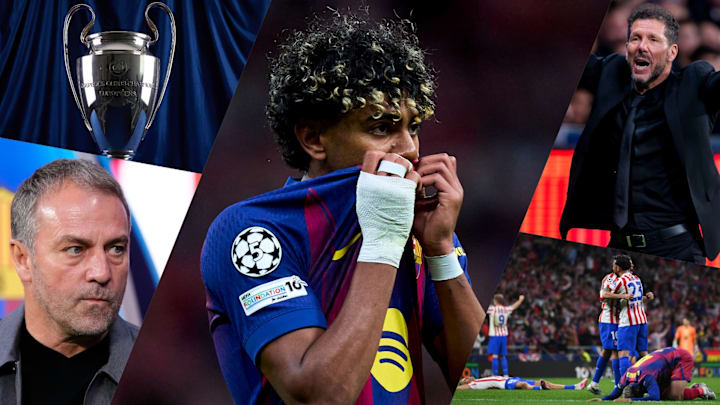
Winning the Champions League was Barcelona’s main objective entering 2025–26 and despite a valiant effort from a resilient side, they ultimately failed to accomplish their mission ... and you could see it coming from a mile away.
Barcelona fought until the final whistle but exited the Champions League in the quarterfinals, losing 3–2 on aggregate against Spanish rivals Atlético Madrid. For the second season in a row, Hansi Flick’s men erased a two-goal deficit but couldn’t capitalize on momentum and conceded again to exit the competition.
For the 11th straight season, Barcelona will go into the summer without adding that much-desired sixth Champions League title to their trophy cabinet.
As painful as the Blaugrana heartbreak endured on Tuesday night in Spain’s capital was, it was also unquestionably predictable. The seeds of Barcelona’s latest Champions League failure were planted and carefully harvested throughout the season until, finally, Flick’s side met their unavoidable destiny at the Metropolitano.
A multitude of factors contributed to their demise, but there are three glaring pillars that laid the foundation for Barcelona’s latest European downfall.
The Repercussions of Barcelona’s Financial Woes

Barcelona boast one of the strongest lineups in Europe due in large part the the club’s brilliant academy and in spite of the club’s equally awful—and well documented—financial situation that’s handicapped them for years, most notably in the transfer market.
Since Flick’s arrival in the summer of 2024, Barcelona have made just four permanent signing across as many transfer windows. Joan García is a regular starter and Dani Olmo contributes often, but Roony Bardghji—despite his potential—is still a project and Pau Víctor is no longer with the club.
Marcus Rashford and João Cancelo are the only two other reinforcements acquired in that timeframe via loan. In total, Barcelona have spent a little under $105 million (€88 million) since Flick took over, less than Real Betis and Villarreal have spent in that span, let alone Real Madrid or Atlético.
It’s almost poetic that Atlético Madrid’s three goalscorers in the quarterfinals tie against Barcelona joined the club over the past two seasons. Julián Álvarez, Alexander Sørloth and Ademola Lookman landed in Spain’s capital for combined transfer fees in the neighborhood of $160 million (€135 million). The trio of Atléti investments guided them to the semifinals.

Newly re-elected Barça president Joan Laporta has significantly improved the club’s finances since his return to office in 2021, which was a major reason why he’s back for a second straight term. But there’s still significant improvement needed in that area, because as proud as Barça can be of La Masia’s success, a club looking to compete for the biggest trophies in Europe can’t be operating with considerable constraints in the transfer market.
Laporta and Barcelona sporting director Deco face a critical summer for the club’s future, with important positions needed to be addressed. As formidable as Barcelona’s lineup is on paper, the depth of the team is not.
And that became blatantly obvious thanks the next item on this list.
Crucial Injuries

Barcelona were lucky on the injury front for the most part during Hansi Flick’s debut season in charge, but that luck ran out in 2025–26. To make matters worse, the two most important Barça players outside of Lamine Yamal became the face of the club’s injury crisis throughout the term.
There was arguably no player more important for Barcelona than Raphinha a season ago. But muscular problems have plagued the Brazilian this term. After bagging 59 goal contributions for Barça in 2024–25, Raphinha has 27 so far this term.
Crucially, Raphinha missed the quarterfinal bouts against Atlético with his second hamstring injury of the term. Rashford, who arrived on loan as his replacement, failed to capitalize on his chances in the first leg and was dropped from the XI for the return leg, where Fermín López missed a clear chance to put Barça up by three. Had the Brazilian been on the pitch, it’s not unrealistic to assume Barcelona would’ve scored more than two goals across both legs.
But muscular problems also tormented another key Barça player all season. Pedri, the brains behind Flick’s entire operation, hasn’t looked like his dominant self for weeks now, and he once again looked like a shell of himself at the Metropolitano.

After enjoying an injury-free 2024–25 and leading the team with 59 appearances, Pedri’s recurring hamstring problems resurfaced this season. Twice the midfield maestro had to miss over a month of the term, with his second injury coming in January. When he came back in February, he was immediately forced to play nearly every minute due to Frenkie de Jong’s own hamstring problems and Gavi’s long-term knee problems.
The result? Pedri never got back to his pre-injury form and it’s clear he’s still not fully fit, evidenced by Flick’s admission that he substituted the midfielder in the first leg against Atléti because he was nursing some issues.
With De Jong injured for the past month, teenager Marc Bernal had to feature prominently until his own ankle injury kept him out of the second leg, where Gavi started for only the second time this season. Simply put, a compromised Pedri plus a makeshift midfield wasn’t enough to overcome Atlético.
Speaking of makeshift, Barcelona’s backline has been exactly that all season, but apart from injuries, there’s another glaring factor that contributed to the defense becoming Barça’s Achilles heel.
Hansi Flick’s Unwillingness to Adjust Defensively

Had you asked anyone how Barcelona were going to be eliminated from the Champions League this season, the likely response would’ve been that their defensive high line would be exploited. And that’s exactly what happened.
For all the good things Flick has done in his two seasons in charge, he must be questioned for his stubbornness to stick with his preferred aggressive defensive system despite a mountain of evidence that it had been figured out.
Against Inter Milan in the 2024–25 semifinals, Barcelona conceded eight goals across both legs. As early as the third game of the season in 2025–26, Rayo Vallecano exposed the blueprint to punish Barça. By the October international break, it became abundantly clear Flick needed to adjust, but he refused and it ultimately became a major reason for Barcelona’s European demise.
Baiting Barcelona’s high press, a striker dragging a defender by dropping slightly deep to receive the ball, immediately sending a pass over the top for a runner down the channel behind the backline to finish the action himself or to set-up an incoming runner on the other side for a tap-in. That’s it, that’s all it takes to score against Flick’s Barça, and it happened over and over and over and over again all season.

Flick’s insistance on sticking with a defensive system that wasn’t working looks even worse with added context. Barcelona never replaced 2024–25 starter Iñigo Martínez, Andreas Christensen was unavailable for much of the term and Ronald Araújo dealt with personal issues and never looked confident.
Former La Masia left back Gerard Martín had to be converted into a center back halfway through the season and he became Pau Cubarsí’s most frequent partner in the heart of defense. Eric García was the other alternative, but in the quarterfinals, both García and Cubarsí received red cards in almost carbon-copy actions, denying Atlético of a clear goalscoring opportunity after they had bypassed the high line.
The high-risk, high-reward defensive system has helped Barcelona become the most prolific attack in Europe over the past two years, scoring over 300 goals in the German boss’s tenure. But it’s also resulted in Barcelona conceding the most goals in the Champions League since Flick took over and setting the record by a Spanish team for consecutive games in the competition without keeping a clean sheet with 15.
Teams figured out Barça’s backline and with a less-than-ideal cast of characters available, Flick’s once novel, creative and reliable high line became the team’s biggest issue—one he was adamant on ignoring until it was too late.
What’s Next For Barcelona in the Champions League?

Barcelona are all but guaranteed to enter 2026–27 as back-to-back La Liga champions, yet as it became the trend during the latter years of the Lionel Messi era in Catalonia, no domestic success will feel complete until European glory is conquered once again.
The mission will remain the same next season, but if Barcelona want to avoid making it 12-straight years without a Champions League title, changes are necessary.
There’s no denying Barcelona are currently one of the best teams in Europe, but it’s also true that this season’s version never reached the sustained performance peak experienced during Flick’s debut term.
A concentrated effort from the team’s hierarchy to bring in reinforcements is necessary. Flick and Co. must learn from their mistakes and acknowledge their wrongdoings—especially in straight elimination ties. Finally, the squad must also take it on the chin and accept that in many cases, there was a clear drop in form compared to last season.
This young Barcelona side has the potential to continue improving and possess the quality to win the Champions League. Still, the weight of a decade-plus title drought will keep growing heavier with every passing year and with every opportunity squandered.
The semifinals elimination against Inter in 2024–25 was nothing if not a heartbreak. This year’s quarterfinals elimination against Atlético Madrid—a team 22 points back of Barcelona in La Liga—is simply inexcusable.
The pressure will intensify come 2026–27 and Barcelona must embrace it. Because once again, they’ll enter the new season with one foremost priority, and everyone already knows what it is.
READ THE LATEST BARCELONA NEWS, ANALYSIS AND INSIGHT FROM SI FC
 Add us as a preferred source on Google
Roberto Casillas is a writer for SI FC, focusing primarily on FC Barcelona, the Mexico National Team, Liga MX and all things Latin American football. Born and raised in Mexico City, he developed a deep passion for football from an early age and fell in love with Cruz Azul. The once future star of Mexican football still likes to showcase what’s left of his talent on the Sunday league pitch. He’s also a big fan of the New England Patriots—so much so he moved to the region for four years—, Chicago Cubs and is a life-long Formula 1 follower. When he takes a break from sports, he enjoys traveling the world, watching the latest great TV show, going to concerts and spending plenty of time with friends and family.