%20%20--%3E%0A%3Csvg%20version%3D%221.1%22%20id%3D%22Layer_1%22%20xmlns%3D%22http%3A%2F%2Fwww.w3.org%2F2000%2Fsvg%22%20xmlns%3Axlink%3D%22http%3A%2F%2Fwww.w3.org%2F1999%2Fxlink%22%20x%3D%220px%22%20y%3D%220px%22%0A%09%20width%3D%2239px%22%20height%3D%2240px%22%20viewBox%3D%220%200%2039%2040%22%20enable-background%3D%22new%200%200%2039%2040%22%20xml%3Aspace%3D%22preserve%22%3E%0A%3Cpath%20fill%3D%22%23FFFFFF%22%20d%3D%22M38.5%2C7H28.2v26h10.3V7z%22%2F%3E%0A%3Cpath%20fill-rule%3D%22evenodd%22%20clip-rule%3D%22evenodd%22%20fill%3D%22%23FFFFFF%22%20d%3D%22M26.1%2C25.5c0%2C5.8-4.1%2C7.5-12.9%2C7.5C3.9%2C33%2C0%2C31.2%2C0%2C25.2v-1.1h11.6%0A%09v2.4c0%2C0.7%2C0.1%2C1.4%2C1.2%2C1.4c1%2C0%2C1.2-0.4%2C1.2-1.3v-0.9c0-1.6-0.9-1.6-3.5-2.2C2.2%2C21.7%2C0%2C19.7%2C0%2C15.3v-0.9C0%2C9.3%2C5.5%2C7%2C12.9%2C7%0A%09c10.2%2C0%2C12.8%2C2.6%2C12.8%2C7.4v1.8h-11v-2.9c0-0.6-0.4-1.1-1.2-1.1c-0.6%2C0-1.2%2C0.4-1.2%2C1.1v0.9c0%2C1.5%2C0.9%2C2%2C3.3%2C2.5%0A%09c8%2C1.6%2C10.5%2C3.3%2C10.5%2C7.5V25.5z%22%2F%3E%0A%3C%2Fsvg%3E%0A)
‘Built in the Dark’: How Jake Dickert and John Currie Quietly Turned Wake Forest Into a Juggernaut
In this story:
John Currie was driving back to Winston-Salem from Charlotte earlier this week. He had some Atlantic Coast Conference business to attend to in the Queen City, but also a prominent Wake Forest booster to visit. If you’re the athletic director of the Demon Deacons, there is no time like the present to check in with donors.
“This is a really special moment in time with a really special team,” Currie says. “It’s a proud moment for Wake Forest.”
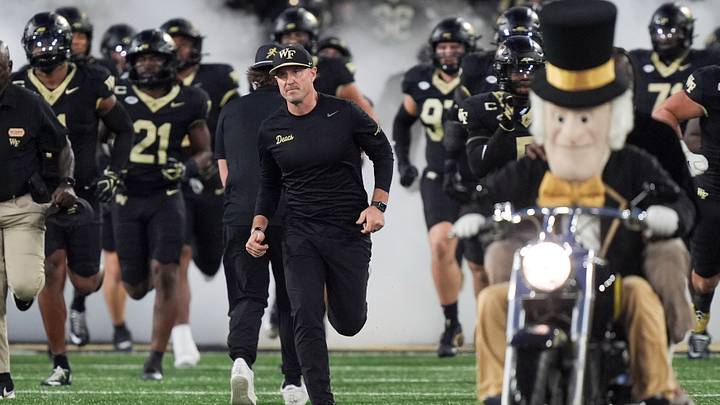
It took a couple of weeks longer than it should have, but Wake currently is in a place it had never been—on the right side of the College Football Playoff bubble. With two games left in the regular season, the Deacons check in at No. 11, which is the last at-large spot in the 12-team playoff. A win at Georgia Tech Saturday potentially secures a spot in the ACC championship game, and would make Wake the first team in the 13-year CFP Era to win six road games against power-four conference opponents.
MORE COLLEGE FOOTBALL FROM SI: Podcast | Forums | Newsletter | Bracket Challenge
America is just now a-Wake-ning to the reality that the 9–1 Deacons are a rampaging beast of a football team. Their seven-game winning streak is the longest in school history, and the last six of them have been utter beatdowns—an average winning margin of 45.9 points. They haven’t allowed a first-half point since Oct. 10, and they have a 145–0 scoring margin in the first half over their last four games.
The Deacons are on a heater the likes of which have only been seen in the ACC from powerhouse Florida State and Clemson teams. The largest cumulative scoring margins over a seven-game span by ACC teams are from the 2013 Seminoles (who won the national championship) and the 2019 Tigers (who reached the CFP final). Those margins at their peak: 337 points for Florida State and 306 for Clemson. Wake has won its last six by 275, so a blowout of Tech in Atlanta could put it alongside two historic heavyweights.
For Currie, this is the ultimate validation of his hiring acumen, something that came under assault during his time as the athletic director at Tennessee. Fired from that job nine years ago amid a vigilante fan revolt while searching for a replacement to Butch Jones, Currie found his comfort zone at Wake—and ultimately found his dream coach.
Jake Dickert kept the Washington State program alive after the Pac-12 collapsed, but he wasn’t considered a sure thing at Wake after longtime coach Dave Clawson’s surprise retirement in mid-December 2024. The ACC was a step up and a long way from Dickert’s comfort zone — he’d never worked east of the Mississippi River. Was he the guy to jump-start a program that had been slow to embrace the NIL era?
“There was a lot of, really, that guy?” recalls Chad Chatlos, whose search firm, ZRG Turnkey, assisted Currie in the process. “I’ll give John credit, he wasn’t about winning the press conference.”
He’d rather win games. Which is what has happened.

They’re calling it “Jake Forest” these days. Dickert is 18–5 in Winston-Salem, going from a surprise 9–4 last year to a step up this year. If the season ends with an ACC championship game appearance and a CFP bid, Dickert will be on the short list of the best P4 hires of the 2020s. The others: Curt Cignetti at Indiana; Marcus Freeman at Notre Dame; Dan Lanning at Oregon; Bob Chesney at UCLA; Mario Cristobal at Miami; Morgan Scalley at Utah; Kalen DeBoer at Washington. All those programs have inherent advantages over the one Dickert leads.
Wake Forest has the smallest undergraduate enrollment of any P4 school, slightly less than 6,000. Its stadium capacity of 31,500 ranks 89th in FBS. The school is 74th nationally in average home attendance this season at 30,077.
Yet the Demon Deacons bristle at the “small” label. In terms of scale, yes—there is not a massive alumni base like Indiana or a ticket demand that necessitates 100,000 seats. But they have enough of what matters to succeed at an elite level, as this season is proving.
Wake already had the requisite facilities—“all paid for,” Currie notes, “no debt service.” The House vs. NCAA settlement took some of the inequity out of the NIL market, paving the way for the school to fully fund its revenue-share cap. Membership in a P4 conference had its advantages without a near-impossible level of competition, as in the SEC. All the Deacons needed was the right guy to replace Clawson.
Clawson and his predecessor, Jim Grobe, hit some high notes at Wake. Clawson went 11–3 in 2021, finishing 15th in the AP poll. Grobe went 11–3 in 2006, with an ACC title, an Orange Bowl bid and a No. 18 final ranking. Prior to that, this was a football desert—just three other ranked teams in school history, in 1945, ’48 and ’92—but flowers had bloomed in Winston-Salem.
Clawson actually did Currie the courtesy of informing him that he was considering retirement, giving the school his blessing to go ahead and start a contingency search process. It was a bit awkward—if we have an opening, would you be interested?—and it was a bit late in the hiring cycle by December. Currie said the pool of candidates who went through initial zoom interviews was between four and seven. After that, he sat down face-to-face with three.
“Jake killed the interviews,” Chatlos says. “Jake did the convincing. After John spent time with him, he got it. I told John, ‘The intangibles this guy has, the desire, it’s going to resonate at your place.’
“There’s risk in every hire, and there certainly was risk in this one. There are some coaches that are very regional fits and will struggle outside that region. With Jake, his characteristics transfer anywhere.”
Dickert’s success has allowed Currie to permanently put to bed the Tennessee tenure. His initial choice to replace Jones was Greg Schiano, who at the time was an assistant to Urban Meyer at Ohio State after at stint in the NFL and breathing life into Rutgers from 2001 to ’11. Tennessee fans were apoplectic, mounting a campaign against Schiano that included some cheap shots tying the former Joe Paterno assistant to the Jerry Sandusky scandal at Penn State.



With support collapsing for Schiano, Currie diverted his search elsewhere. He’d flown to Los Angeles to try to lock up Mike Leach, then at Washington State, when school administrators summoned him back to Knoxville and fired him. (Tennessee replaced Currie with former football coach Phil Fulmer, who made the ignominious decision to hire Alabama assistant Jeremy Pruitt. End result: a 16–19 record on the field, with 11 of those victories vacated for rampant NCAA rule-breaking.)
Currie was out at Tennessee after less than a year on the job. He made one lasting contribution to the school by hiring baseball coach Tony Vitello, who led the Volunteers to the 2024 NCAA title and three College World Series appearances, but his career was at a crossroads.

About 14 months later, Currie got his rebound opportunity at his alma mater, Wake Forest. The school has won NCAA titles in men’s tennis and women’s golf during his tenure, though men’s basketball has languished without an NCAA tournament since 2017. Nailing the football hire has been Currie’s crowning achievement.
It should be noted that mere days after neighboring rival North Carolina was making an outlandish splash with the hire of Bill Belichick, Wake Forest was quietly getting someone better. Dickert in year one was a revelation. Dickert in year two has been a force.
“The most impressive thing is how much better he is this year than last year,” Currie says. “He keeps sharpening that saw.”
Wake was not going to outspend the behemoth programs for top established transfer talent. It has, however, been among the sharpest at identifying lower-level players who can succeed in the ACC and then developing them. The program mantra under Dickert has been “Built in the Dark,” a nod to a team doing the work outside the sport’s spotlight with unsung players.
Leading tackler Vincent Firenze arrived from FCS Dayton. Edge rusher Langston Hardy, a Nagurski Award finalist, came from Connecticut. Standout cornerback Deuce Blades II was at Florida International. Offensive line starters transferred in from New Hampshire, Weber State and Oregon State. Star wide receiver Carlos Hernandez followed Dickert from Washington State.
The key addition in elevating from good to great has been quarterback Gio Lopez, who struggled last year under Belichick at North Carolina. The Tar Heels recruited over Lopez in the portal, grabbing Wisconsin transfer Billy Edwards—who was also being courted by Wake, until the Heels dropped a bigger bag. That freed up Lopez to reunite with Deacons offensive coordinator Rob Ezell, who had coached him to great success at South Alabama in 2024.
Lopez’s bounce-back season has pushed him into Heisman Trophy consideration. He’s seventh nationally in pass efficiency, with a 19-to-1 touchdown-to-interception ratio. (His only pick came Sept. 18 in Wake’s only loss, to Miami.) He’s also seventh in total offense yards per play and 13th in yards per game.
“They rebuilt his confidence early on,” Currie says.
Lopez’s leadership traits have blossomed as well. Currie noted that when the team returned from an overnight, cross-country flight home routing California last month, Lopez and offensive lineman George Steih deplaned and immediately began carrying bags to the bus to campus.
Wake’s runaway train of a season hit its highest point last week—first, Dickert agreed to a new contract extension, and then the Deacons utterly destroyed SMU on the road. The Mustangs were still in ACC championship contention at the time but that ended quickly. Wake roared to a 42–0 halftime lead, on the way to a 49–7 final.
It was the performance the program needed to make a skeptical nation believe.
“It’s a little scary maybe—how can Wake Forest be doing this?” Currie says. “People don’t understand how we’re being successful. We have an appreciation for being in this position and now we’re understanding what it takes to stay in this position. There’s nothing small about Wake Forest.”
PODCAST: Listen to Sports Illustrated’s college sports podcast, Others Receiving Votes, hosted by Pat Forde, on Apple and Spotify. Watch the show on SI’s college YouTube channel or on SI TV.
 Add us as a preferred source on Google

Pat Forde is a senior writer for Sports Illustrated who covers college football and college basketball as well as the Olympics and horse racing. He cohosts the Others Receiving Votes podcast for SI and is a regular contributor to the Tony Kornheiser Show podcast. He previously worked for Yahoo Sports, ESPN and The (Louisville) Courier-Journal. Forde has won 28 Associated Press Sports Editors writing contest awards, has been published three times in the Best American Sports Writing book series, and was nominated for the 1990 Pulitzer Prize. A past president of the U.S. Basketball Writers Association and member of the Football Writers Association of America, he lives in Louisville with his wife. They have three children, all of whom were collegiate swimmers.
Follow ByPatForde