
Breaking Down the Toronto Blue Jays' Odd Defensive Problem
In this story:
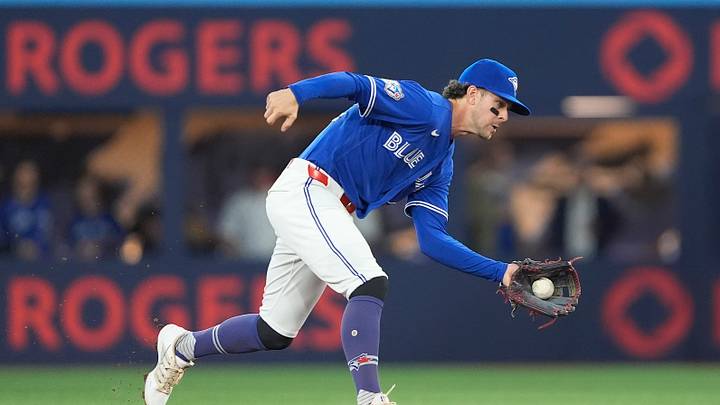
As of Sept. 9, the Blue Jays had allowed an MLB-high 143 infield hits excluding bunts, according to Sportsnet. On the surface, that would seem to suggest Toronto has struggled to turn playable balls on the infield into outs.
But a deeper looks shows that is not the case, in fact, defense is one of the defining traits of this team. Entering Tuesday, the Blue Jays rank fifth in total defensive runs saved, ninth in outs above average, second in fielding run value, and first in catcher framing according to Fangraphs.
There could be a deeper reason for Toronto’s high number of infield hits allowed, and one possible factor is the athleticism of the players occupying the infield.
Is Footspeed The Actual Problem

It only feels right to start with the Jays’ half-billion-dollar slugger. Vladimir Guerrero Jr. ranks 56th among MLB defenders in Outs Above Average and fifth among first basemen, according to Statcast. His directional numbers are particularly interesting: Guerrero has been worth seven OAA moving to his left and has been neutral moving to his right, but sits at -2 when coming in on the baseball.
First base is a position that depends more on reflexes and short-area movement than pure speed, but Guerrero’s negative mark moving in is still worth monitoring. Charging a ball requires an infielder to react quickly and have enough burst to field it before the runner reaches the bag. Given that Guerrero ranks in just the 26th percentile in sprint speed, those plays may be a little harder for him to make, which can allow weakly hit balls to turn into infield hits.
Ernie Clement required a bit more scrolling to find in Statcast’s database, which is surprising given how well-regarded his glove was last season.
This year, though, he ranks 32nd among second basemen with -4 OAA. Clement has been neutral when charging balls, but his biggest weakness has come moving to his left, where his -7 OAA is the worst mark among second basemen. Speed does not appear to be the issue. Clement ranks in the 70th percentile in sprint speed, which goes against the idea that Toronto’s infield-hit problem can simply be blamed on a lack of athleticism. He also spent more time at third base last season than second, so his struggles could have more to do with how his skills translate to the middle infield than with pure footspeed and range.
The reason Clement has spent more time at second base is Toronto’s Japanese import, Kazuma Okamoto, who ranks 33rd out of 43 third basemen with -3 OAA. His directional numbers reveal where some of the trouble has come from: Okamoto sits at -4 OAA moving to his right and -2 when moving back toward the outfield.
That profile carries some similarities to Guerrero’s. Neither corner infielder’s biggest issue necessarily comes down to straight-line speed; instead, the concern may be short-area quickness, reaction time and lateral mobility. Those traits matter more at positions that require less range.
Andrés Giménez comes in last, but certainly not least. His 19 OAA ranks second among shortstops, trailing only Bobby Witt Jr. Giménez is not among baseball’s absolute fastest players, sitting in the 60th percentile in sprint speed, but his range has remained elite. He has produced seven OAA when charging balls, a strong mark even if it trails shortstops such as Witt, Geraldo Perdomo and Masyn Winn. Giménez might not possess elite straight-line speed, but his positioning and ability to read the ball makes him one of the best defensive shortstops in baseball.
This sportswriter has to wave the white flag and admit the initial hypothesis was wrong. Speed and range matter, but Toronto’s infield does not show a clean relationship between sprint speed and its ability to turn balls in play into outs. Giménez is the clearest example, as he does not possess elite straight-line speed yet remains one of baseball’s best defenders and has excelled when charging the ball.
Instead, the Blue Jays’ strange infield-hit problem appears to be more complicated. Rather than an open-and-shut case of poor overall range, Toronto appears to have a collection of specific defensive weaknesses that may combine to produce an unusually high number of infield hits allowed.
 Add us as a preferred source on Google
Wesley Dixon is a sports writer focused on thoughtful analysis, roster-building angles, player development and feature-style storytelling. He has covered the Philadelphia 76ers and the NBA, with work centered on breaking down team direction, player fit and the larger stories behind the game. Wesley is a lifelong MLB fan, following multiple teams throughout the league. He is excited to bring that same detail-oriented approach to On SI.