%20%20--%3E%0A%3Csvg%20version%3D%221.1%22%20id%3D%22Layer_1%22%20xmlns%3D%22http%3A%2F%2Fwww.w3.org%2F2000%2Fsvg%22%20xmlns%3Axlink%3D%22http%3A%2F%2Fwww.w3.org%2F1999%2Fxlink%22%20x%3D%220px%22%20y%3D%220px%22%0A%09%20width%3D%2239px%22%20height%3D%2240px%22%20viewBox%3D%220%200%2039%2040%22%20enable-background%3D%22new%200%200%2039%2040%22%20xml%3Aspace%3D%22preserve%22%3E%0A%3Cpath%20fill%3D%22%23FFFFFF%22%20d%3D%22M38.5%2C7H28.2v26h10.3V7z%22%2F%3E%0A%3Cpath%20fill-rule%3D%22evenodd%22%20clip-rule%3D%22evenodd%22%20fill%3D%22%23FFFFFF%22%20d%3D%22M26.1%2C25.5c0%2C5.8-4.1%2C7.5-12.9%2C7.5C3.9%2C33%2C0%2C31.2%2C0%2C25.2v-1.1h11.6%0A%09v2.4c0%2C0.7%2C0.1%2C1.4%2C1.2%2C1.4c1%2C0%2C1.2-0.4%2C1.2-1.3v-0.9c0-1.6-0.9-1.6-3.5-2.2C2.2%2C21.7%2C0%2C19.7%2C0%2C15.3v-0.9C0%2C9.3%2C5.5%2C7%2C12.9%2C7%0A%09c10.2%2C0%2C12.8%2C2.6%2C12.8%2C7.4v1.8h-11v-2.9c0-0.6-0.4-1.1-1.2-1.1c-0.6%2C0-1.2%2C0.4-1.2%2C1.1v0.9c0%2C1.5%2C0.9%2C2%2C3.3%2C2.5%0A%09c8%2C1.6%2C10.5%2C3.3%2C10.5%2C7.5V25.5z%22%2F%3E%0A%3C%2Fsvg%3E%0A)
Albert Breer’s Takeaways: Caleb Williams’s Humbling Process Helped Him Become a Confident QB Today
In this story:
Jump to a topic
- Caleb Williams
- Colts QB Daniel Jones
- Vikings’ QB decision
- Browns’ QB decision
- Devon Witherspoon extension
- More on the Seahawks
- Green Bay Packers
- Joe Brady–Sean Payton comp
- Atlanta Falcons
- Quick-hitters
I have 18 camps under my belt, and will be back on the trail by the time you read this. Here’s what we have from the road …
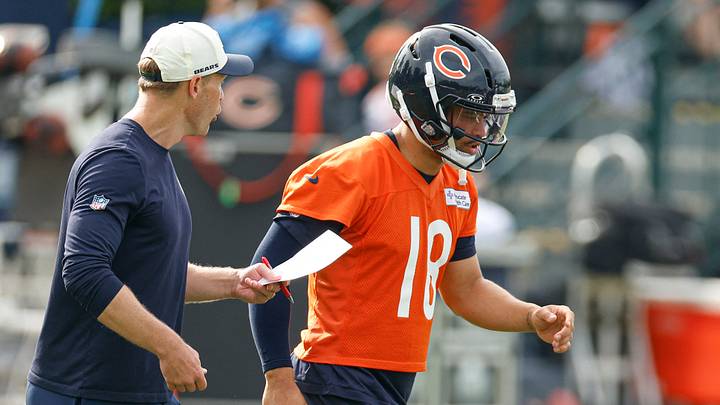
Caleb Williams
This summer isn’t like last summer for Caleb Williams.
Last summer, you’ll remember, there were big questions surrounding the former Heisman Trophy winner and No. 1 pick. He was swimming in a sea of schemes that new head coach Ben Johnson was flooding him with. There were days when the narrative—and maybe even the reality—was that he wasn’t even the best quarterback on the Bears’ roster. As long as those practices were open to the media, he struggled to find his stride and string together even so much as a good week.
And that, as we wound up seeing, was all by design.
This summer, he’s carrying himself with confidence, helping his coaches direct the offense in practice. The ball is coming out fast, and spinning off his hand with the sort of authority that can only happen when a quarterback knows what he’s doing. Here’s something else that Williams knows: Point A and B in this 18-month story, dating back to Johnson’s hire in January 2025, are inextricably and undeniably connected.
“It did everything for me,” Williams said of the humbling process Johnson laid out. “It built more confidence, it built mental fortitude, it built more strength, it built more maturity for me, learning and having to grow and look at myself and figure out what I need to do better. And it’s gonna be a year-to-year base, for me to be able to step up and grow up every single year in different ways. Every team is different, every moment is different, and so just taking it one step at a time and not being results-based. That’s something we’re big on, not being results-based but being able to focus on the process.
“And when it comes time that we need to choke it down a little bit and slow things down or cut back on a bunch of verbiage and a bunch of play calls, that’s season time when it’s time to go win games and the results matter. But for training camp and OTAs and preseason, it’s drink through a fire hose, try and get as much in as you can, and from there, Coach can figure it out, that’s his part. My part is to follow him, do exactly what he says to the best of my ability.”
Suffice it to say, Williams is happy he, to steal a cliché, trusted Johnson’s process, even as Chicago talk shows and opinion-makers widely panned his 2025 camp performance.
He also had to ride out losses in Chicago’s first two games, games that Williams says now were instructive for him and led to what the quarterback says was his pivot point—the days leading into a Week 3 win over Dallas. Johnson saw the turning point more over the Bears’ Week 5 bye, after which the team’s run game came alive. But wherever you place it, proof of Johnson’s tough-love concept came pretty quickly for Williams.
Williams finished with 3,942 yards and 27 touchdowns against just seven picks in 17 starts and the Bears won the NFC North, then posted their first playoff win in 15 years.
“It’s a young quarterback, a lot of things are foreign to him,” Johnson says. “And so we need to see what the threshold is, what’s too much, how far we can push the envelope. And so camp was the time to do that. We didn’t want to find out during the season. We needed to find out early on. And so I think we got a good foundation, just in terms of how we can best help him. And when you’re making all these mistakes, that’s where you learn the best anyway.
“We wanted mistakes to happen, and they came in bunches. And now they’re still happening, but it’s at a much lower clip than what it was a year ago at this time. That’s how you gauge growth.”
As Williams said, as the season got closer last year, the Bears narrowed the volume of schemes they were working in, with the knowledge of what was working and what wasn’t. Now, a year later, they’re able to reintroduce some things that didn’t quite work in 2025, but Williams and his teammates have some recall on them.
The upshot now is that with improved play, Williams has more capital with his teammates to direct and lead. Which, ultimately, allows Johnson to give him ownership of the offense.
“Every year for me is being able to go back and look at what I could have done better,” Williams says. “My first year, one of the biggest things for me was being able to be as stoic as possible, and that’s gonna be a year-to-year thing. The plays and the playbook, just trying to be able to learn them as best that I can, the formations, the motions, just the overall process to be able to provide confidence in myself, and then from that, my confidence being able to flow and exude through me to my teammates is big.
“It starts with myself, getting myself right, getting myself together, making sure I’m on top of my game every single day, every single game, every single week, and then from there, the confidence, the belief, the maturity, all those different things, they seem like a lot more. And it’s just my confidence growing in myself and understanding what I need to do for the guys.”
Johnson added, “It’s little victories along the way, and you always try to highlight those as a coach, just to continue to build your own credibility. There’s no question about that. But he’s jumped in from Day 1, hook, line and sinker, as far as I’m concerned. There has been very little pushback to the coaching. He’s believed in us and what we’re looking to do.”
There’s proof, too, in how Williams is following their lead this summer. Every few days, Johnson asks him for his favorite play of the day. Inevitably, it’s something small, “and it’ll be one where we call four verts [vertical routes], and they give us two-high, or it’s quarters and none of the outside stuff is there, it’s not good, so he checks it down to the back immediately.”
It’s something few people, in other words, would notice. But it goes back to a point of emphasis for the summer from the coaches—“I’m not changing too much other than just to take the easy ones,” he says—and shows there’s now a synergy between the staff and its quarterback. That was the point of making things so hard in the beginning.
🏕️🏕️ 5⃣ from @ChicagoBears 🏕️🏕️
— Albert Breer (@AlbertBreer) August 10, 2026
🏈 Caleb Williams' next steps.
🏈 Colston Loveland 📈📈📈.
🏈 One OT spot rock solid, other in flux.
🏈 Meet the South African 3-tech.
🏈 Safety a question with Coby Bryant out.https://t.co/skYPbn6HpX
The Bears expect the payoff to come, as it did last year, in the fall. With a quarterback who’s chipping away on subtle changes that, he hopes, will be anything but in his performance.
“I see the same guy, talented, can make plays for the team, can show up when the guys need him and show up when it’s needed most,” Williams says. “And then this year, I think it’s just gonna be an ability to manage the year, the season, understanding what the guys need from me. Because like I said, each year is different. But I see the same guy. I see a guy that attacks, I see a guy that wants to bring that killer to the game and to each down and every moment.
“Being able to have that, being able to have that energy, those moments show up and the guys know and believe and trust that we’re gonna find a way to get out of every situation and go win the game is most important for me.”
And clearly that’s what matters most to the coaches he’s playing for, too.
Colts QB Daniel Jones
Daniel Jones is the most fascinating figure you’re not talking about this summer. The Colts’ quarterback, you’ll remember, fractured his fibula in a Week 12 loss last year to the Chiefs, then tore his Achilles against the Jaguars in Week 14.
Before that, he was statistically among the best quarterbacks in football.
Through 10 games (going into Week 12), he was third in the league in passing yards (2,659) and fourth in yards per attempt (8.34), completing 69.9% of his throws with 15 touchdowns against seven interceptions, boasting a 101.6 passer rating. The Colts were 8–2 and ranked No. 1 in the league in total offense, sitting at third in both passing and rushing offense. Running back Jonathan Taylor and receiver Alec Pierce were both off to monster starts.
And then the whole thing came undone, first with a painful injury Jones played through, then with the season-ending Achilles tear. That, of course, can cloud the public’s collective memory on just how well he and the Colts were playing.
“Tops of the league,” coach Shane Steichen says. “He was playing right there at the top, with the top, whatever, three guys, or he could have been the best at that point in time. His numbers were off the charts, so it was just really encouraging to see that.”
Steichen then added, “Obviously, our goal is to recreate that all season this year.”
Now the best news: Jones already looks like he’s all the way back. He has competed through training camp without any restrictions. He thinks the one piece he’s still working to get back is his explosiveness. The guys coaching and leading the organization agree.
But even there, the signs are good. In a scrimmage last week, he ripped off a 40-yard run on a scramble and hit 19.5 mph on the GPS.
“Yeah, I’d like to hit a 20 or 21 at some point; I’d feel better about that,” he laughed. “But yeah, I think I’m almost there. I told Alec after the fact, he was like, That’s your top speed? I was like, Come on … I used to be a little faster than that. I’ll get back to it.”
Based on what they’ve already seen, there’s every reason to believe Jones will—and a big part of that is not just where he is now, but how he got here.
From the start, there has been no gray area in his approach. In the immediate aftermath of the injury, when a lot of players would retreat, Jones jumped right back into quarterback meetings and even rode a scooter out to practice. There was a therapeutic benefit to that. There was football upside in it, too, particularly after Philip Rivers improbably came aboard.
“It’s like, What else am I going to do?” Jones says. “Here, this is my job, this is what I’m doing, so I’m going to be here. And I still enjoy those parts of it, to be honest. It’s tough not being out there, and you miss that. You feel a little bit like you’re missing that. But it was still fun being around, being with [backup quarterbacks] Riley [Leonard], being with Anthony [Richardson], and then we brought in Philip. And that was a lot of fun to learn from him.”
Specifically in watching Rivers, Jones says there was stuff that was “not exactly what you’re going to learn in football 101, quarterbacking 101.” It was how Rivers would read a defender’s eyes before the snap to decipher what zone he and his teammates were dropping to, or how pressure coming from an area would get him to a check. Rivers, he saw, could flat-out feel the game.
And Jones was already getting there in certain ways, maybe best illustrated through a Week 1 example from last year that Steichen brought up. On Fridays and Saturdays, Steichen and Jones would have a one-on-one meeting on how Steichen would call the game, and what Jones was most comfortable with that week. So they got to the fourth-down, gotta-have-it part of Steichen’s playsheet, and a run/pass/run option play came up. Steichen said if the Dolphins were in a soft Cover Zero look, the play would be really tight, and probably wouldn’t work.
“He’s like, Well, I can get this protection, and then I got a one-on-one in zero on the outside, and I’m going to check this and throw it to [Josh] Downs,” Steichen recalled. “Sure enough, he goes over that with the guys in the Saturday night meeting. And it comes up in the game. But we just talked about it. I didn’t put kill on it. I said, ‘If you see it, get to it.’ And he got to it, checked the protection and threw a quick out to Downs for a first down.”
“There’s a whole other level after you’ve run through the plays, you’ve watched the tape again, you’ve gone through the practice of saying, This is maybe the one chance we get this, what do you think? Or the one chance I get this, are you O.K. with me reading it this way?” Jones added. “That communication did a ton for me last year.”
It was the same for Steichen, so much so that in the team meeting to open camp a couple weeks back, the coach emphasized what he was looking for in communication, from coaches to players and vice versa and players to each other, and that fourth-and-2 was the example he raised.
The upshot of that was the rest of the 10-game start that Jones and the offense got off to.
Can they, as Steichen termed it, recreate that? So long as Jones’s health holds up, there’s plenty of reason to believe they can.
Vikings’ QB decision
The Vikings’ decision at quarterback was, and was always going to be about right now. And the best way I can illustrate that to all of you reading this is to say that the call Kevin O’Connell made will now allow Minnesota to project at the position rather than hope—with Kyler Murray’s track record giving the coaches a solid baseline to build off of, whereas with J.J. McCarthy, there were still hypotheticals to grapple with.
The background on it isn’t overcomplicated. O’Connell had a pretty good idea going into last year that if McCarthy didn’t live up to his draft position, the Vikings were going to be in a tough spot. He told people that internally. It was why they tried to get either Sam Darnold or Daniel Jones to return for the 2025 season—both wound up leaving largely because the opportunity to become another team’s long-term starter was better elsewhere.
Sam Howell became the first safety net, Carson Wentz came second, but that wasn’t enough.
And given the makeup of Minnesota’s roster, O’Connell wasn’t going to let that happen again. Justin Jefferson, Aaron Jones, Jordan Addison, Christian Darrisaw (though he got hurt), Brian O’Neill, T.J. Hockenson, Blake Cashman, Andrew Van Ginkel and Byron Murphy Jr. won 14 games and were one win away from the No. 1 seed in the NFC two years ago. Those guys aren’t concerned with a three-year plan, or a five-year plan.
Rightfully, they want to win with the core they have now, and knowing he couldn’t snap his fingers and make Patrick Mahomes or Josh Allen appear, O’Connell and Rob Brzezinski wanted the team to have multiple levers to pull at the position. So they brought back Wentz and added Murray, with those two bringing 186 career starts into the competition.
The Vikings were covered even if McCarthy didn’t break through. And while McCarthy made strides fundamentally, he still couldn’t give O’Connell the certainty in what he was building that Murray could at the position, and that much was clear enough—and early enough—for the plug to be pulled on the quarterback derby before the preseason opener.
There are advantages, too, to making the call early. It allows O’Connell, Wes Phillips, Frank Smith and Josh McCown to tailor the scheme more aggressively to Murray, and for the other 10 guys in the huddle to get more comfortable in that style of offense. Murray, the thinking goes, should enhance Smith’s run game in how he’ll stretch the back side of the defense on wide-zone calls and excel in the keeper game. His legs will also force teams to play zone or spy him, which should only help Jefferson, Addison and Hockenson in the passing game.
🏕️🏕️ 5⃣ from @Vikings 🏕️🏕️
— Albert Breer (@AlbertBreer) August 12, 2026
🏈 Why @K1 was named starter.
🏈 Run game 📈📈📈.
🏈 Doubling down on the culture.
🏈 Dallas Turner turning heads.
🏈 Draft class showing promise.https://t.co/0YmcaudQV9
As for McCarthy, go back and read what O’Connell’s said about teams failing quarterbacks more than quarterbacks fail teams. He’s going to keep developing McCarthy. What comes next for him isn’t certain, but the young quarterback has handled all this well, and that’ll give him a chance.
Now the Vikings can move forward. What happens beyond this year is muddled, with Murray on a one-year deal with a no-tag provision. But that doesn’t really matter.
What does is doing right by this year’s team. And that’s what the QB decision was about.
Browns’ QB decision
The quarterback decision for the Browns is likely a week away. The goal for the Cleveland coaches is to take this stretch of camp and create a sort of apples-for-apples final exam on Deshaun Watson and Shedeur Sanders. Saturday, with Watson getting the reps with the first team, was the first phase of that. This week’s joint practice with Buffalo will allow for Todd Monken’s staff to generate scenarios and situations for both guys and test them. And then this coming Saturday, Sanders will rep with the first team against the Bills.
After that, a decision will likely be made and the staff will start to tailor the offense to the starting quarterback—it’d look different for one than the other—and use the third preseason game to ramp up the offense in that direction for the Sept. 14 opener.
But how is it going so far?
“To me, Shedeur has [progressed] in terms of his operation and progressions in the pass game, and command of the huddle,” Monken told me last week. “That’s where he’s come the furthest, really understanding. It was a new system, right? O.K., what are we asking him to do? And then how is he operating? And he’s come the furthest.
“Deshaun has been through this. He’s a veteran. He understands. He’s been through systems. So Shadeur had the furthest to go. And that was tough. So what has he done? He’s put himself in that conversation. Because obviously, Deshaun’s going to look like there’s still something in there. … Now, where does it go from there? I don’t know. “
The glimpse we all got Saturday wasn’t overly revealing.
Watson was solid, completing 11-of-15 passes for 126 yards, hitting six different receivers, but also taking a strip-sack that resulted in a turnover. Sanders was 6-of-11 for 79 yards, with a really nice downfield throw in the face of pressure to receiver Luke Floriea for 35 yards to convert a third-and-13, but he ended his day with an unsightly interception.
So some good, some bad for both, and the game ended without a ton more clarity on who the guy will be. And there’s the reality that even if that clarity doesn’t come, the time is coming when the Browns will have to pick a guy and build the system specifically for him.
“It has to work for whoever the quarterback is,” Monken told me before I asked how much time he’ll need to make that happen. “I hope not a lot. I mean, I hope not. But there is some part of that is still a work in progress. I would anticipate that with our young team, that we would continue to get better as the year went on. I would guess that with the young receivers and the O-line gelling together, I would think we’d be able to get to that.”
Monken has a track record on this stuff, too, having worked with different kinds of quarterbacks over his years, from Brandon Weeden at Oklahoma State to Nick Mullens at Southern Miss to Jameis Winston and Ryan Fitzpatrick in Tampa, Baker Mayfield in Cleveland, Stetson Bennett IV at Georgia and Lamar Jackson in Baltimore.
This, of course, is a different challenge than those. Some Bears folks I’ve talked to since Saturday said that, based on the game, Watson looks like the best option, with doubt cast on both Sanders and Dillon Gabriel. Whether that holds when all is taken into account remains to be seen.
What is clear is that Monken wants as much info on both guys as he can get. That’s why he has run the process the way he has.
Devon Witherspoon extension
Devon Witherspoon’s deal is pretty logical. Let’s start with this: The three-time Pro Bowl corner, who was one of the Seahawks’ best players in the Super Bowl, has every reason to be over the moon with the deal. The details of the contract show why …
• His cash for the first two years is $59.255 million, which easily bests Trent McDuffie ($50 million), Derek Stingley Jr. ($48.53 million) and Sauce Gardner ($40.5 million). All of it is fully guaranteed.
• At three years, he’s at $76.255 million, which still beats Stingley ($69.03 million) and Gardner ($65.45 million) but is edged out by McDuffie. At four years, he’s at $101.255 million, which beats out Stingley ($90.53 million) and Gardner ($85.65 million) but again falls shy of McDuffie ($107 million). All that money is guaranteed in case of an injury.
• McDuffie got his deal after four years and a trade, while Stingley, Gardner and Witherspoon got theirs after just three years.
• Witherspoon set records for new-money APY ($33 million), full guarantee ($59.255 million) and injury guarantee ($101.255 million) for a cornerback.
O.K., so where’s the giveback? In a couple of areas. One, the uptick from the top of the market wasn’t a full market reset, with an incremental jump from the deals that McDuffie and Denzel Ward did, right at around $31 million per year. That’s a win for Seattle given how we’ve seen the market jump by about $5 million at a time with the edge rushers and the receivers. Second, the Seahawks were able to hold to their policy on not having injury guarantees vest a year early (which would make those virtually fully guaranteed).
The simple way to look at that is Seattle could, in theory, cut Witherspoon in February 2028 or February 2029 and walk away from the remaining “guarantees” in the contract.
That said, Witherspoon is too good a player and person for anyone to envision that happening. This deal, to me, reflects a belief on both Witherspoon’s part and the team’s part that he’s going to maintain this level of play—which is why the player-friendly cashflow wasn’t a problem for the team, and the true injury guarantees didn’t stop the players’ side.
A nice compromise here—Devon Witherspoon gets an uptick on the market, at $33 million APY, not a market reset. But if that nine-figure guarantee is real, then that’s a big win for the player. https://t.co/El7Nj3s400
— Albert Breer (@AlbertBreer) August 15, 2026
Now all eyes turn to Christian Gonzalez, who is represented by Witherspoon’s agent, Reggie Johnson, and hasn’t made a ton of headway toward a deal. The Patriots, if you look at the history, and despite their incredible record of success, don’t have a ton of history of paying homegrown guys at premium positions at the very top of the market.
Based on all of the above, it seems like this would be when that would change.
More on the Seahawks
One other item on the Seahawks: Their core going forward is being identified before our eyes. This was something I had a pretty cool conversation with GM John Schneider on back in March. I asked him what he learned from the Legion of Boom teams that might help him now, and he offered a pretty honest answer on a lesson he’d taken.
“Looking back at that group, there was a lot of challenge from the outside, like, You can’t keep all these guys together,” Schneider said. “We had one of the great defensive backfields, and defenses in general, of all time, so we’re going to pay the Mike linebacker, we’re gonna pay the Sam linebacker, we’re gonna pay the strong safety, the free safety, the top corner. What happens there is: A, you can get real top-heavy; and B, you’re taking away from other aspects of the team.”
And what Schneider learned was reflected in difficult decisions to let Kenneth Walker III, Boye Mafe, Riq Woolen and Coby Bryant—draft picks of his that had panned out—walk in March.
On the flip side, the Seahawks have shown their cards, too, in those they’ve decided to keep.
• Left tackle Charles Cross signed a four-year, $104.4 million extension in January, tying him to the Seahawks through 2030 at a new-money per-year average of $26.1 million.
• Receiver Jaxon Smith-Njigba was signed to a four-year, $168.6 million extension in March, which puts him under contract through the 2031 season.
• Fellow receiver Rashid Shaheed signed a three-year, $51 million extension as a free agent in March, giving the team his rights through 2028.
• Right tackle Abraham Lucas, a draft classmate of Cross’s, signed a three-year, $46 million extension in September as the final season of his rookie deal was set to begin, and that one runs through 2028.
• Then, of course, Witherspoon signed the deal tying him to the team through 2031.
Two things stand out to me about the details here. One, Witherspoon and Smith-Njigba both did cash flow-strong deals that top the market at their positions, but only by a bit. Cross’s deal was the third-highest at left tackle behind Laremy Tunsil and Rashawn Slater. Lucas and Shaheed came in at reasonable numbers. And two, all those guys play premium positions, where it can be difficult to find a replacement.
Put that together and the Seahawks did right by their guys cash-wise and gain on the margins in the big picture with guys that are known commodities.
Of course, as Schneider knows, this gets more interesting when older guys in the team’s core, such as Leonard Williams and DeMarcus Lawrence and Ernest Jones IV, start to age out. There is a quarterback deal to do, too, with a Sam Darnold extension to discuss at some point over the next 12 months or so, with the potential that he’ll double his APY.
But overall, it’s pretty easy to look at this and really like where Seattle is.
Green Bay Packers
The Packers are very much, to me, where the Seahawks were last year. There’s a ton of promising young talent on the roster. Christian Watson and Jayden Reed are locked up at receiver, and 2025 first-round pick Matthew Golden rounds out that receiver group. Jordan Morgan is settling in at left tackle. Defenders Devonte Wyatt and Edgerrin Cooper both got deals, too. And if Micah Parsons and Tucker Kraft can regain their stride coming back from ACL tears and Jordan Love is where just about everyone in the organization thinks he’s going to be in 2026 ...
There’s a lot to like here.
So what’s the difference between the Packers and Seahawks?
Health is part of it, for sure. Kraft tore his ACL in an upset loss to the Panthers last year, and Green Bay was 5-1-1 going into that one. Parsons tore his ACL in a heartbreaker in Denver last year, and the Packers came into that game at 9-3-1. They still haven’t won since then, with four consecutive losses to finish the season preceding a wild-card round loss in Chicago.
Obviously, losing their best player (Parsons), and a guy in Kraft who might’ve been their second-best when he went down was a big part of that equation. But more than just that, Green Bay needs a few from the aforementioned young core to level up from good to great, which is what happened in Seattle last year with guys like Cross, Walker, Smith-Njigba, Witherspoon and Byron Murphy Jr. ascending as the Seahawks rode that wave to a championship.
Can Watson and Reed and Morgan and Wyatt and Cooper reach another level? Could safeties Xavier McKinney and Evan Williams be part of that equation too, the way, say, Leonard Williams was last year for the Seahawks? If so, I think the ceiling is pretty high on that roster.
Joe Brady–Sean Payton comp
I’ve thought a lot about what Joe Brady’s promotion might mean for the Bills. And I can’t help but think of Brady’s mentor, Sean Payton. The Broncos’ coach got his first shot at calling plays in 2000 under then Giants coach Jim Fassel. That lasted three years before Payton was eventually stripped of play-calling, which led to his exodus to Dallas, where he’d work for Bill Parcells from 2003 to ’05.
New York ranked 13th, ninth and sixth in total offense in Payton’s three years there, and Dallas was 15th, 14th and 13th in Payton’s three years there. Those six teams made the playoffs three times, and the Giants made it to the Super Bowl in Payton’s first year.
Yet many people in the know had a sense of how good Payton was when he landed the Saints’ job in 2006, and we know what happened next. New Orleans signed Drew Brees in its first post–Katrina offseason, and the Saints had the NFL’s best offense in six of the 15 seasons Brees and Payton worked together. They ranked top five in total offense in 11 of those years and were top 10 every year until their final year together, the COVID-19 season of 2020 (they were 12th that year, but they finished fifth in points scored).
Anyway, Payton, once ridden by Parcells and nicknamed “Dennis the Menace” for all of his crazy ideas, fully flourished and proved a lot of folks right when he got out on his own.
I think there’s a shot that happens with Brady this year. That’s throwing no shade on Sean McDermott or Matt Rhule or any of the coaches he has worked with. But here’s the reality of it: Until now, Brady has had to work within someone else’s game plan and has had to check with a head coach on his approach—those parameters for sure impact how you call a game.
Without that, I think we’ll get to see a very real aggression from Brady. I think that idea is evident in his choice of defensive coordinator, as Jim Leonhard comes over from Denver, having cut his NFL teeth both as a player (Rex Ryan) and a coach (Vance Joseph) under attack-oriented defensive play-callers. It’s also all over the practice field when you talk to people working there about what camp has looked like.
What does it mean for Josh Allen? He was already the MVP of the league, and there’s an argument that he’s the best player in the league, so it’s not like he needs some sort of breakthrough. But he and Brady know each other so well, having worked together with Brady as his position coach, coordinator and now head coach, that it’s fair to say Allen could have even more input in how the operation is run.
I’m eager to see what it looks like. And whether that Payton comp might end up being pretty fair based on the results the Bills get.
Atlanta Falcons
It’s getting close to the point where the Falcons may have to start the season with Tua Tagovailoa as their quarterback. The seventh-year pro wasn’t great on Friday night. That much was obvious. He went 3-of-5 for 22 yards, and the offense had just one first down over the two series he was out there. But it’s my understanding that wasn’t indicative of his summer, which has been solid in his first year playing for Kevin Stefanski.
On the other hand, Michael Penix Jr., working his way back from a torn ACL, has flashed his ability to rip the ball, but is still limited to 7-on-7 work, and we’re now less than four weeks from the opener. So even if he’s cleared this week, there’s going to be an acclimation period, and the train is rolling fast now toward Week 1. Ten other guys in that huddle have to get ready for Pittsburgh in Week 1, and soon we’ll be at the point where a team must be fair to them, if we’re not already there.
And I say that as someone who believes the Falcons’ new regime needs to get as long a look at Penix as possible in 2026.
But for now, they can’t have a complete picture of what he’ll be in the offense, because they haven’t seen it with a line in front of him. They know what they’ve got in Tagovailoa, who has shown he can be the accurate, efficient quarterback that he was at his best in Miami under Mike McDaniel. In the short term, the idea of just building for that isn’t a bad one.
In the long term, well, the fact is the Falcons—and the rest of the NFL—already have an idea what Tagovailoa is, and in Atlanta that’s probably a stopgap to whoever winds up being the quarterback that Stefanski, Ian Cunningham and Matt Ryan build around. Penix could be more than that—he was the eighth overall pick—and the new guys will need to figure out by the time 2026 is out whether they’ve got the answer or not at the position.
All this isn’t ideal, of course. But it’s a long season, and there should be a chance to serve both the team’s short-term interest (with Tagovailoa) while getting the long-term assessment they need (on Penix). It’ll just be a little tricky to pull off.
Quick-hitters
And as I get ready to board for Camp 19 Monday in Latrobe, Pa., here are some quick-hitting takeaways for you …
• The Cowboys have to feel great about getting defensive tackle Quinnen Williams taken care of now, with two years left on his deal. His three-year, $105.9 million extension puts him under contract for a little over $30 million per year over the next five seasons, and that’s a good deal both for the player and the team.
What’s more, Williams, who was elected a captain his last three years in New York, has already emerged as a leader in Dallas. Dak Prescott told me Williams has said to him every day, “We’re going to win,” as a way to speak it into existence, and has been holding teammates to that standard. It’s also fair to wonder here if the Cowboys had a bit of a lesson learned from letting other negotiations drag out, which wound up costing the organization millions (and, last year, Micah Parsons).
• We hinted at Bears offensive lineman Ozzy Trapilo being way ahead of schedule in our Bears camp overview last week, and sure enough, he was back on the practice field Sunday. Considering the second-year man ruptured his patellar tendon in the playoffs—normally a devastating injury for a big man—it’s borderline miraculous that he’s back this fast. And if he can man the left tackle spot after showing a ton of promise in six regular-season starts last year, plus the playoff game he was injured, then this would be a big question answered for Chicago.
• While we’re there, good on Ben Johnson for having Antwaan Randle El call plays in the second half of Saturday’s preseason opener. It’s a big deal, for sure, for assistant coaches. If you read last week’s takeaways column, you know that the job Davis Webb did last year calling plays against Arizona in August influenced Payton’s decision to make him Denver’s play-caller.
• Fans have every right to be upset over obstructed views at the new Highmark Stadium, and I respect anyone’s right to complain about that, particularly when a team used public funding for a stadium. That said, I liked the building after getting a tour on Thursday. The best description I heard is that it feels like an overgrown basketball arena, in how intimate and tight it is. And it has a ton of cool little details.
• The Patriots had a big hiccup reinstalling their turf after ripping the World Cup grass out, and then Vikings linebacker Jamal Adams tore up his knee on the reinstalled MetLife turf over the weekend. The NFL is off to a rough start to 2026 because the owners want to keep the fake stuff in their stadiums (these, to be clear, are 100% business decisions).
• I wish I had more details on how a guy charged with eight felonies, including kidnapping, could go on a free agent tour and land a deal with the Super Bowl champs. So, no, I’m not sure I’ve ever seen anything quite like Terrion Arnold’s signing in Seattle. What I can say is a couple of teams that weren’t interested said the situation isn’t totally what it seems.
• I still think Aaron Donald will play. But, remember, he wants to feel like himself if he does it, and there’s a high bar to clear to get there. My sense is, at this point, he will take a little more time to make a decision. And the Rams have told him all along that the door is open and this is his decision.
• I think it’s fair to get on Jaxson Dart for needing to protect himself better after having some Braveheart-Gone-Wrong runs as a rookie. But the rest of the team needs to do its part, too, as the crushing blow that sent Dart to the medical tent Saturday showed.
• Colts assistant GM Ed Dodds’s comments on quarterback Anthony Richardson Sr.—indicating Indy may be pivoting to keep him rather than trading him—were interesting. It may also suggest that Riley Leonard isn’t ready to be the backup, and that the backup could become more important with Jones returning from Achilles surgery.
• I wouldn’t read too much into Cam Ward’s shaky preseason debut. Titans OC Brian Daboll generally wants to challenge his quarterbacks in different ways. My guess is the offense he’s building for Ward will look a little different in Week 1 than it does in preseason games.
• Thanks to everyone for following along during my camp trip. And if you want to go deeper, I had ace producer Malachi Gabriel with me through Chicago, Green Bay and Minnesota and he did a great job capturing life on the road—you can check that out on YouTube.
 Add us as a preferred source on Google
Albert Breer is a senior writer covering the NFL for Sports Illustrated, delivering the biggest stories and breaking news from across the league. He has been on the NFL beat since 2005 and joined SI in 2016. Breer began his career covering the New England Patriots for the MetroWest Daily News and the Boston Herald from 2005 to ’07, then covered the Dallas Cowboys for the Dallas Morning News from 2007 to ’08. He worked for The Sporting News from 2008 to ’09 before returning to Massachusetts as The Boston Globe’s national NFL writer in 2009. From 2010 to 2016, Breer served as a national reporter for NFL Network. In addition to his work at Sports Illustrated, Breer regularly appears on NBC Sports Boston, 98.5 The Sports Hub in Boston, FS1 with Colin Cowherd, The Rich Eisen Show and The Dan Patrick Show. A 2002 graduate of Ohio State, Breer lives near Boston with his wife, a cardiac ICU nurse at Boston Children’s Hospital, and their three children.
Follow AlbertBreer