
This Pet Ben Johnson Look for Bears Offense Keeps Coming Up Short
In this story:
While the Bears have struggled running the ball in the last five games during Kyle Monangai's absence, they've also experienced another loss.
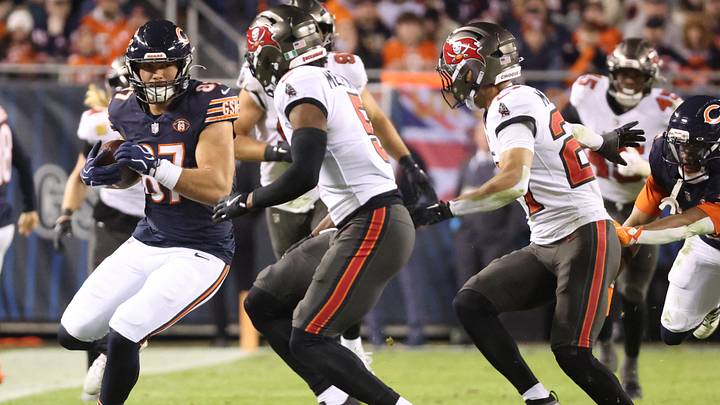
This was the injury to veteran tight end Cole Kmet.
Kmet's experience and leadership are huge and another thing he did was quickly accept and adapt to his function within the offense. This took him from the featured tight end to a secondary figure as Colston Loveland became the tight end target du jour.
The Bears have had two games to try to adapt to having Sam Roush playing the Kmet role and Stephen Carlson playing the third tight end role formerly filled by Roush. They haven't done terrible in terms of run blocking if you accept Pro Football Focus grades as legitimate. The tight end run blocking has been graded slightly lower the last two games but they were facing two difficult rush defenses in Seattle and Tampa Bay.
Caleb to Colston. Big gain. 💪
— Chicago Bears (@ChicagoBears) November 9, 2026
📺: NBC pic.twitter.com/5kQOveTpTI
They've probably done better as pass catchers than they have at blocking the run because Roush has two receptions for 23 yards in two games without Kmet and starter Colston Loveland has 11 for 119 yards. Between them, they've averaged 6.5 receptions and 71.5 yards in the two games.
This is good pass production for tight ends. In fact, in the first seven games with Kmet, they averaged 5.6 receptions for 52 yards from all of their tight ends including Roush. The main part of the increase has been Loveland kicking up his receiving to a higher level. He has come on strong through the current four-game winning streak.
Trey McBride, Year 2 (Age 24)
— Box Score Scout (@boxscorescout) November 11, 2026
- 8.3 fantasy points (8.3 expected)
- 6.2 targets
- 48.5 yards
Colston Loveland, Year 2 (Age 22), in the 5 full Caleb Williams games:
- 9.5 fantasy points (10.7 expected)
- 7.2 targets
- 50.6 yards
It would seem they're picking up the slack without Kmet, especially considering the two defenses were so strong.
"I wouldn't even say picking up," Loveland said. "I mean, it obviously still hurts and not having Cole out there is one thing, but I think we've done a great job and Sam and Steve have really done a great job in kind of mastering their role.
"And we all got a lot more to get better at for sure, but I think we've been doing pretty well."
Top 10 Tight Ends so far this season:
— Dayo (@DayoMotivated) November 16, 2026
1. Brock Bowers
2. Trey McBride
3. George Kittle
4. Dalton Kincaid
5. Colston Loveland
6. Dalton Schultz
7. Brenton Strange
8. Isaiah Likely
9. Kyle Pitts
10. Darnell Washington
HM: Jake Ferguson
Not so fast with multiple tight ends
Yet, it seems the Bears are not quite getting the type of overall production they need from a specific use of tight ends.
So much has been made of Johnson's belief in the EPA (expected points added) analytic as an indicator of offensive success, and one area the Bears offense hasn't achieved much success there involves their tight ends.
According to SumerSports Analysis, the Bears have not exactly smashed the record books with their production in 12-personnel and 13-personnel packages. That's two tight ends and three tight ends.
This shimmy by Colston Loveland at the top of his route helps him create this window for Williams to throw it to him, sick player pic.twitter.com/AwLDIvkvJx
— JP Acosta (@acosta32_jp) October 23, 2026
When the Bears are in 13-personnel, the three-tight end grouping, they rank 30th overall in EPA and are 22nd in rushing EPA and 22nd in passing EPA. And they're in this 17.7% of the time, or the fourth most of any team.
Also, when they are in two-tight end or 12-personnel — which is the third-most in the NFL at 32.13% — they are only 24th in EPA, 13th in the passing game and a disappointing 29th running the ball.
Essentially, when they are in two- and three-tight end packages their running game has struggled. They're in those multiple tight end packages almost half the time (49.8%).
Bears trotting out 13 personnel, but split all 3 TEs out in a bunch formation to run a screen to Colston Loveland. pic.twitter.com/wpixlNwEjQ
— Nate Tice (@Nate_Tice) October 19, 2026
However, when the Bears are in the basic three-receiver set with one running back and one tight end, they are second in the NFL in rushing EPA, 10th in passing EPA and seventh in overall EPA.
This isn't just an outgrowth of losing Kmet or losing Monangai as a runner for five weeks. The Bears were much better running in their one-tight end look throughout October, as well.
When Johnson did his self-scout over the break, hopefully it told him something they can do to be more effective when they go to multiple tight end packages. Before the break, he mentioned something about using extra offensive linemen at times. Maybe they'd better do it.
Considering how effective they've been when they don't use it and how ineffective they are when they do use it, maybe they just better stick with the three-receiver and four-receiver looks.
It can't make it any easier to operate in those looks when they don't have Kmet.
Ben Johnson loves using multiple tight ends, with the Bears running 12 or 13 personnel on an NFL-high 51.9% of plays, but Chicago has actually been more effective out of 11 personnel (3 WRs).
— Pete Collins (@Pete_Collins_) October 21, 2026
11 personnel:
• 6.8 yards per dropback (7th-most)
• 5.3 yards per carry (3rd-most)
•… pic.twitter.com/4LULb8scaQ
 Add us as a preferred source on Google

Gene Chamberlain has covered the Chicago Bears full time as a beat writer since 1994 and prior to this on a part-time basis for 10 years. He covered the Bears as a beat writer for Suburban Chicago Newspapers, the Daily Southtown, Copley News Service and has been a contributor for the Daily Herald, the Associated Press, Bear Report, CBS Sports.com and The Sporting News. He also has worked a prep sports writer for Tribune Newspapers and Sun-Times newspapers.