%20%20--%3E%0A%3Csvg%20version%3D%221.1%22%20id%3D%22Layer_1%22%20xmlns%3D%22http%3A%2F%2Fwww.w3.org%2F2000%2Fsvg%22%20xmlns%3Axlink%3D%22http%3A%2F%2Fwww.w3.org%2F1999%2Fxlink%22%20x%3D%220px%22%20y%3D%220px%22%0A%09%20width%3D%2239px%22%20height%3D%2240px%22%20viewBox%3D%220%200%2039%2040%22%20enable-background%3D%22new%200%200%2039%2040%22%20xml%3Aspace%3D%22preserve%22%3E%0A%3Cpath%20fill%3D%22%23FFFFFF%22%20d%3D%22M38.5%2C7H28.2v26h10.3V7z%22%2F%3E%0A%3Cpath%20fill-rule%3D%22evenodd%22%20clip-rule%3D%22evenodd%22%20fill%3D%22%23FFFFFF%22%20d%3D%22M26.1%2C25.5c0%2C5.8-4.1%2C7.5-12.9%2C7.5C3.9%2C33%2C0%2C31.2%2C0%2C25.2v-1.1h11.6%0A%09v2.4c0%2C0.7%2C0.1%2C1.4%2C1.2%2C1.4c1%2C0%2C1.2-0.4%2C1.2-1.3v-0.9c0-1.6-0.9-1.6-3.5-2.2C2.2%2C21.7%2C0%2C19.7%2C0%2C15.3v-0.9C0%2C9.3%2C5.5%2C7%2C12.9%2C7%0A%09c10.2%2C0%2C12.8%2C2.6%2C12.8%2C7.4v1.8h-11v-2.9c0-0.6-0.4-1.1-1.2-1.1c-0.6%2C0-1.2%2C0.4-1.2%2C1.1v0.9c0%2C1.5%2C0.9%2C2%2C3.3%2C2.5%0A%09c8%2C1.6%2C10.5%2C3.3%2C10.5%2C7.5V25.5z%22%2F%3E%0A%3C%2Fsvg%3E%0A)
Re-Grading Every 2026 NFL Head Coaching Hire: Why John Harbaugh Has Had the Greatest Impact
In this story:
I like the trend of re-grading grades. While you could argue it’s a natural evolution of the content cycle—creating content from content—I think it’s an important way to stop, raise our hands and say “my bad.” We don’t do enough of that in sports analysis, and we certainly don’t do enough of it in life. Not revisiting a grade, like we’re about to do on this season’s 10 first-year head coaches at the midway point, suggests infallibility. Far more interesting is digging back into what we thought at the time and why we think differently now.
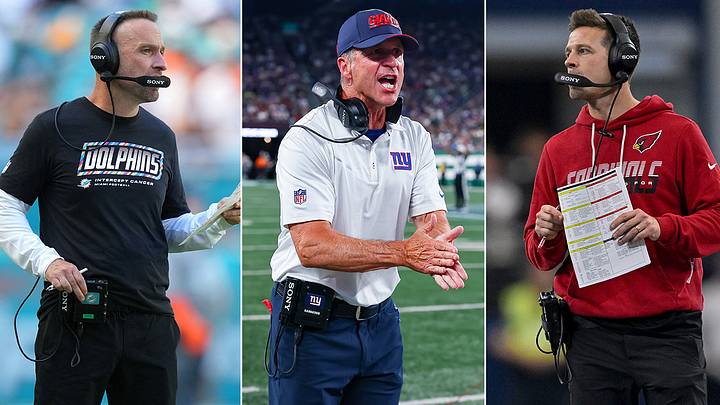
The relevance of the head coaching position is making a roaring comeback this season. John Harbaugh has the Giants in first place. Mike McCarthy has the Steelers in first place. Joe Brady has the Bills in first place. Todd Monken had the Browns in first place. Klint Kubiak won his first three games as head coach and has one of the NFL passing leaders in … Kirk Cousins. Most teams that changed head coaches this offseason have seen an immediate return on investment (quick, someone tell Jerry Jones).
With that in mind, I would like to present my re-grades, reflecting on why I got so many of them wrong and what, specifically, they did to earn so much extra credit. We’ll start with my lowest-graded coaches from the end of the hiring cycle in February and work our way down.
1. Mike LaFleur, Arizona Cardinals
Initial grade: D+
Why: I graded LaFleur low to reflect what I saw as the Cardinals misplaying the market. The Cardinals moved on from a coach and coordinator they didn’t totally hate—Jonathan Gannon and Drew Petzing—thinking they might be among the biggest fishes in a small pond. Arizona moved on from its head coach before the Ravens and Steelers blew up the coaching market and by the time all of the available jobs were laid out on the table, Arizona was among the least appetizing. LaFleur had a limited play-calling sample size and, given that he was making an intra-division move, it would have been especially hard for him to draw talent from the Rams’ coaching staff.
New grade: B-
Why: Arizona is perfectly middle of the road when it comes to offensive efficiency and, despite having one of the worst defenses in the NFL in both total points surrendered and points per drive surrendered, Arizona had a season-opening victory over the Chargers (which looks worse in hindsight but, at the time, was a quality victory) as well as wins over the Cowboys and Rams. This team, alongside Miami, was an odds-on favorite to have the No. 1 pick in the 2027 NFL draft. It’s also a team that has gotten almost nothing out of No. 3 pick Jeremiyah Love. LaFleur has had to deal with the Marvin Harrison Jr. trade midseason and, from the podium, adeptly defended Harrison without losing points in the locker room. His starting quarterback was traded and, in the Dallas game where LaFleur changed to Gardner Minshew II, he showed both heads-up clock management to force Brian Schottenheimer into an uncomfortable late-game decision before the two-minute warning and the feel to make a quarterback change.
Let’s be honest: Given the strength of this division, even though two of its top teams are performing far below expectations, we saw this Cardinals season as far worse. LaFleur’s team cannot be classified as in the mix, but it is not a glaring laughingstock.
2. Jeff Hafley, Miami Dolphins
Initial grade: C
Why: Long sigh. I thought the Dolphins should have kept Mike McDaniel. I wanted to see McDaniel with a GM like Jon-Eric Sullivan, given that Sullivan has spent years trying to find the types of players that Matt LaFleur, and by extension McDaniel, would excel at calling plays for. Given that the McDaniel-Chargers pairing is one of the absolute most depressing NFL occurrences of the 2026 regular season, I’ll happily take the loss and renounce some of my McDaniel shares. I also thought Hafley’s defense in Green Bay took too much of a step backward after the Micah Parsons trade, which concerned me since Hafley would have no star players in Miami and would be coaching the absolute worst roster in the NFL.
New grade: B+
Why: I think Hafley’s staff in Miami has done one of the best jobs in the NFL relative to new coaches, though when sitting at 1–7, winless at home and with a minus-74 point differential, it’s a hard argument to make. Of course, beyond the obvious examples that I have been given about the overall mood and the inroads Hafley is making with the players, it’s not something that a fan can take home with them on a day-to-day basis. Still, Miami came into Sunday’s game against the Lions with consecutive losses of one score or less. Holding the Lions to under 20 points is no small feat and on a weekly basis, rookies (like CB Chris Johnson against the Lions) are making game-altering plays. Had it not been for the rise of the Giants’ Arvel Reese, I think we would be talking about Dolphins LB Jacob Rodriguez as a Defensive Rookie of the Year candidate. Rarely can a 1–7 season feel this good, but I think that also says something about the snow globe Hafley has built around the Dolphins.
3. Todd Monken, Cleveland Browns
Initial grade: C+
Why: I mean, come on. Monken was a career NFL and college assistant who went 13–25 during his only stint as a head coach at Southern Miss. He had a reputation for being a little salty, and reviews are mixed on how his tenure in Baltimore ended and whether he forged a relationship with Lamar Jackson. The Browns seemed to be culling information for future coaching searches during the search that yielded Monken, and they hired Monken over Jim Schwartz, a coach with an actual track record at the position, who made the playoffs in 2011 with the Lions. To me, Monken was either going to be Bruce Arians 2.0 or David Culley with no real in between. Because the Browns have a scattershot history of hiring head coaches, I leaned closer to the latter. My main issue was firing Kevin Stefanski and whether Stefanski and a new quarterback of his choosing offered more upside than playing out the string on the Deshaun Watson contract and finding a coach who could attempt to legitimize the trade.
New grade: A-
Why: Monken has one of the five worst quarterback situations in the NFL. And not just worse in terms of talent. His starter is universally (and understandably) despised by the fan base and merely tolerated during periods of success. His backup, as we saw in the lead-up to Sunday’s game against the Saints, cannot seem to avoid the rake lying there for him to step on. In addition, the Jared Verse trade—interesting given the leaks out of Cleveland that Myles Garrett wasn’t really seen as one of the guys anymore, and then Verse comes out and criticizes his teammates for not defending him after getting body-slammed in the Steelers game—is proving more complicated than immediately helpful. Still, the Browns are in the mix and less calamitous than we would have imagined, given the circumstances. That’s the main reason for such a high grade change for Monken. When you think about all the unforced errors made by new first-time head coaches, so much of it comes down to an overcomplication or a desire to present themselves a certain way. Monken doesn’t care, which, in Cleveland, seems to be the secret sauce for surviving the daily soap opera.

4. Mike McCarthy, Pittsburgh Steelers
Initial grade: B-
Why: We all saw how Mike McCarthy–Aaron Rodgers ended the first time, and while people change, people don’t always change, right? My initial reservations were that the quarterback and coach would struggle to make it work and that McCarthy, at 62, wasn’t the right coach for this iteration of the Steelers. At some point, the Steelers have to stop investing in the oldest roster in the NFL. On the positive, I gave McCarthy a B-range grade to reflect that he’s not often spoken about in the same hushed tones as Sean Payton even though his record is incredibly similar. McCarthy doesn’t have the same floating PR department Payton does, but that shouldn’t change the pelts on his wall. I believe the Steelers had some younger candidates they liked who may not have been fully baked yet, and McCarthy was a win-now option, which we should admire to some degree.
New grade: B
Why: McCarthy has proved to be the perfect personality archetype for this locker room. While Mike Tomlin defined that mantle, McCarthy’s affability and rawness has been pitch perfect thus far for the Steelers. Again, I don’t know where this goes long term, or what McCarthy looks like breaking in a young player next season, but I do know that the Steelers are a win better than last year through eight games. Like last season, the meat of the schedule is yet to come, and so is the question of how this roster will deal with the ravages of time. There are moments when this offense is unwatchable and moments when Rodgers is in a kind of flow state where it’s downright beautiful, although the red zone play-calling remains stagnant. Pittsburgh is getting an incredible season out of the highly underrated defensive coordinator Patrick Graham.
5. John Harbaugh, New York Giants
Initial grade: B-
Why: At the moment, it’s fair to be skeptical of the Harbaugh effect when you’re removing the head coach from a Ravens machine that has defined how a franchise should operate in the modern NFL. The drafts, the compensatory picks, the roster—how much of that was the head coach encouraging a team to think that way, and how much of that was a team thinking that way that felt hampered by its head coach? Harbaugh wasn’t bringing Monken with him to New York, which I viewed at the time as a major disappointment, and he didn’t have the direct side-of-the-ball expertise to elevate both of the Giants’ underperforming units. Part of me was also concerned about the hype level, which was (at the time) ballooning to what felt like irresponsible proportions. The team was set to deal its defensive stalwart, and we had no idea what Malik Nabers could contribute offensively.
New grade: A+
Why: No coach has had a larger singular impact on his new franchise than Harbaugh. He’s been aggressive in free agency, pressed all the right buttons from a coaching standpoint and only reinforced his preexisting bona fides. The Giants have failed to have a coach that inspired any confidence with his hands on the steering wheel since peak Tom Coughlin. Of course, Harbaugh also motivated the Giants to back out of an organizational structure that, in many ways, held them back from reaching a point where they could recover from multiple failed regimes sandwiching together one bad roster after the next. I doubted Harbaugh at nearly every turn. I thought the Dexter Lawrence II trade was irresponsible and now D.J. Reader is playing incredibly well in his place. I thought the J.J. McCarthy trade was ridiculous and McCarthy nearly won the team a game in the fourth quarter and notched wins in two other games this season. I thought Matt Nagy and Greg Roman could not coexist schematically and he somehow made that happen, too. At this point, I have thrown all my negativity fastballs at Harbaugh, and he’s swatted them away.
6. Joe Brady, Buffalo Bills
Initial grade: B
Why: The promoted coordinator pivot is a tricky one. There are obvious issues with seeming to want to pacify the quarterback above all else, and there is always a risk of play falling off when you pivot from the notorious militaristic stickler to the coach promising to make work more enjoyable. I whacked Buffalo at the time because the process seemed entirely flawed. Joe Brady is great, don’t get me wrong, and was probably in play for other head coaching jobs down the line if the Bills didn’t promote him. But this was the golden goose opening. Every coach would want to coach Josh Allen and have the automatic problem solver as their quarterback. Part of the B grade (in a positive way) was the hiring of defensive coordinator Jim Leonhard, whom I’ve tabbed in multiple versions of my future head coaches list as a rising star. The 44-year-old has a unique pool of experience, and the upside was obvious after Leonhard was a key cog in a league-best Broncos unit in 2025.
New grade: B+
Why: Ultimately, Brady will be graded in the moments where his predecessor failed. A team built like this should be winning one of the more underwhelming divisions. Four games a year against Miami and the Jets are a springboard that teams outside the NFC South don’t get to enjoy. Still, through the first six games of the season, the Bills had one of the most explosive rushing offenses in modern NFL history. They still lead the league in EPA per play and trail just the Steelers and Chiefs in rushing efficiency. Brady’s play on the 13-personnel craze has upended football and given James Cook unbelievable opportunities to gash smaller corners and secondary players. On almost every carry, it seems like he can levitate to the second level based on how Brady can draw it up. This is the freedom a team achieves when the offense doesn’t have to marry an overarching defensive philosophy. I think Brady’s brilliance is going to shine especially during the waning months of the season, when tackling in cold weather is an ugly proposition.
7. Klint Kubiak, Las Vegas Raiders
Initial grade: B+
Why: Play-calling head coaches are the rarest commodity in the space, and the Raiders, after missing out on Ben Johnson the year before, got what I believe to be the next-best available option after Pete Carroll’s gap year. I loved the hire initially because it combined two of my favorite moves: One, not falling for the trope (in this case, that Kubiak is very soft-spoken in interviews, believing that it will somehow hamper his ability to motivate the team) and two, waiting out the Super Bowl champions and refusing to rush your process. Super Bowl teams often have the best coaching staffs for a reason, yet too many teams try to fly through the carpool lane to get a coach to his introductory press conference as a means of pacifying the fans. They leave on the table the opportunity to get the best available coach. Kubaik has quarterback development bona fides, comes armed with a proven system that he has a mastery of and plays a brand of football that is fun to watch and will sell tickets. Sometimes, it doesn’t have to be complicated.
New grade: B+
Why: Ultimately, we have to see what this Raiders offense looks like with Fernando Mendoza to solidify a long-term grade for Kubiak. In the meantime, Kirk Cousins is one of the leading passers in the NFL, the Raiders won three consecutive games to start the season and Kubiak has not for a moment been bogged down with b.s. Benching Ashton Jeanty was quick and a relative nonstory while also proving the point that he needed to prove. Another draft and free-agency year are needed to build up the pieces Kubiak needs to run the football the way he wants, which may or may not be the holdup in getting Mendoza out on the field. I loved Kubiak’s confidence at halftime of the Chiefs game, when he suggested the Raiders would win the game, and his stoic demeanor is perfect for a franchise that has been shopping for ideas for decades under the Davis ownership. What excites me most about this offense is that it’s building a universe for Mendoza that will have so many options. Even one of the smallest concepts, like how he takes turns delay-leaking weapons out of the backfield, shows how many sensible options Mendoza will have once he takes over.

8. Robert Saleh, Tennessee Titans
Initial grade: A-
Why: The Titans concluded a frenzied search for their next head coach by choosing Saleh, who ultimately filled the personality gap ownership thought it was missing after Mike Vrabel’s firing (and Vrabel’s subsequent eff-you run to the Super Bowl in his first season helming the Patriots). I liked the Saleh hire at the time because of his connections with a slew of good offensive coordinators and a simplistic, yet effective defensive scheme that could be taught easily and quickly. Saleh has a zen to him that made him an ideal candidate to lead another rebuild atop an organization with a history of mismanagement and untimely hiring and firings. I maintain that his work with the Jets is underrated to this day, and the mood in the building when Woody Johnson fired Saleh after just a handful of games in 2024 reflected as much. Saleh was as much of a “culture creator” as any available head coach last year. With a Titans team hoping to invigorate a fan base leading into the opening of its new stadium, the choice felt obvious.
New grade: B-
Why: We’re just now seeing Cam Ward’s best game as a Titan. Frustratingly, Tennessee had two winnable games early in the season, one against the Giants and another against the Eagles, that would have rapidly changed the tenor of the early Saleh era and possibly prevented the team from selling on Jeffery Simmons. I think Saleh has done an underrated job at supporting Ward and not committing a valuable asset to the deflating “soft benching” process that wouldn’t necessarily work for a player like Ward. The Titans’ offense, especially in the past few weeks, has been pulling out all the stops to find a pace and style that can make Ward a sustainable entity in Tennessee. At the big-picture level, the Titans had their best display of fight after Simmons was traded, and Saleh has handled some heady issues, like the Jordan Elliott situation in which Elliott got into a practice feud and fled to his car to retrieve a gun, with grace. As of now, coaching industry veterans don’t see a one-and-done scenario in Nashville … yet.
9. Kevin Stefanski, Atlanta Falcons
Initial grade: A+
Why: At the time of Stefanski’s hire, we called it a down-the-middle fairway shot. Stefanski had playoff success in his past and a history of turning around an organization rife with dysfunction. Out of the heat lamp that is Cleveland, coaching the Falcons would probably unlock more possibilities for the longtime offensive coordinator and quarterbacks coach. Stefanski had the cachet to draw a great position coach in Bill Callahan and the good sense to bring Tommy Rees with him from Cleveland (Rees, had Josh McDaniels not gotten the Patriots’ offensive coordinator job, would have very likely been New England’s OC under Mike Vrabel) as well as keeping DC Jeff Ulbrich.
New grade: B
Why: Atlanta is one of the least-penalized presnap teams in the NFL and middle of the road in terms of overall penalties committed. I think week to week, we can see tangible evidence of Rees evolving the game plan to suit Michael Penix Jr., making sure he’s not in a situation where he’s constantly on the run and placing himself in the crosshairs for another injury. While the Falcons are a middle-of-the-road offense, Atlanta is top-10 in running back carries and top-five in rushing yards per attempt. Drake London is top-13 in total targets and top-10 in success percentage per target. It may not feel like it, but Stefanski is putting the ball in his playmakers’ hands. The deficiencies on defense (and Atlanta’s subsequent Jessie Bates III trade) aren’t helping, though the Falcons are in the mix in the woeful NFC South.
10. Jesse Minter, Baltimore Ravens
Initial grade: A+
Why: I think I did what I caution most teams against: making a coach into an archetype and assuming that success will carry over from one team to another. In this case, we were riding the heels of a Seattle Super Bowl victory spearheaded by the brilliant Mike Macdonald. Defense was having a moment in the NFL, and it looked like the right scheme could keep the league’s best offenses in a chokehold until the next big evolution. Minter’s credentials were impeccable, and his history with the organization suggested a thoughtful process with fewer surprises for the new head coach. Minter was the only coach universally requested for interviews by every team last offseason and was held out as the prize of the offseason. I tend to award extra points for hires in those situations because, as with the Ben Johnson hire in Chicago, it’s an organizational feat to appear competent enough that a coach with options chooses you.
New grade: B-
Why: The Ravens lead the league in both penalties and presnap penalties, and Baltimore’s defense is a middle-of-the-road team in terms of EPA per play allowed. The Ravens rank 25th in net passing yards per attempt allowed, and eighth in percentage of opponent drives that end in a score. Again, a lot of issues stem from Lamar Jackson barely playing for this team, but nearly all of the coaches on this list have dealt with some degree of uncertainty at quarterback. The mini-bye heading into a game against Minter’s former team, the Chargers, should let the Ravens to claw back to .500 before a winnable game against the Panthers. Ultimately, we will judge Minter on his ability to keep Baltimore relevant over the time period where Jackson is out recovering from thumb surgery.
 Add us as a preferred source on Google

Conor Orr is a Senior Writer for Sports Illustrated with more than 15 years of experience covering the NFL. His work has been cited in Best American Sportswriting and has won a PFWAA award. Prior to Sports Illustrated, he covered both the Giants and Jets for The Star-Ledger. Conor lives in New Jersey with his amazing wife and three children.
Follow author