%20%20--%3E%0A%3Csvg%20version%3D%221.1%22%20id%3D%22Layer_1%22%20xmlns%3D%22http%3A%2F%2Fwww.w3.org%2F2000%2Fsvg%22%20xmlns%3Axlink%3D%22http%3A%2F%2Fwww.w3.org%2F1999%2Fxlink%22%20x%3D%220px%22%20y%3D%220px%22%0A%09%20width%3D%2239px%22%20height%3D%2240px%22%20viewBox%3D%220%200%2039%2040%22%20enable-background%3D%22new%200%200%2039%2040%22%20xml%3Aspace%3D%22preserve%22%3E%0A%3Cpath%20fill%3D%22%23FFFFFF%22%20d%3D%22M38.5%2C7H28.2v26h10.3V7z%22%2F%3E%0A%3Cpath%20fill-rule%3D%22evenodd%22%20clip-rule%3D%22evenodd%22%20fill%3D%22%23FFFFFF%22%20d%3D%22M26.1%2C25.5c0%2C5.8-4.1%2C7.5-12.9%2C7.5C3.9%2C33%2C0%2C31.2%2C0%2C25.2v-1.1h11.6%0A%09v2.4c0%2C0.7%2C0.1%2C1.4%2C1.2%2C1.4c1%2C0%2C1.2-0.4%2C1.2-1.3v-0.9c0-1.6-0.9-1.6-3.5-2.2C2.2%2C21.7%2C0%2C19.7%2C0%2C15.3v-0.9C0%2C9.3%2C5.5%2C7%2C12.9%2C7%0A%09c10.2%2C0%2C12.8%2C2.6%2C12.8%2C7.4v1.8h-11v-2.9c0-0.6-0.4-1.1-1.2-1.1c-0.6%2C0-1.2%2C0.4-1.2%2C1.1v0.9c0%2C1.5%2C0.9%2C2%2C3.3%2C2.5%0A%09c8%2C1.6%2C10.5%2C3.3%2C10.5%2C7.5V25.5z%22%2F%3E%0A%3C%2Fsvg%3E%0A)
Ranking the 25 Greatest Coaches in College Football History
In this story:
“It’s not the X’s and the O’s but the Jimmys and the Joes.”
The classic quote, often attributed to legendary Texas quote Darrell K. Royal, certainly has merit. The best teams are comprised of great players, and as we often see on Saturdays, it is very difficult to overcome significant talent disparities.
The quote serves to deflect praise from coaches, though in college football, it is also a roundabout way to credit them. Historically, college football coaches have had near-total control over their rosters, recruiting players and then coaching them up, unlike the NFL, in which general managers, team presidents and various others have hands in roster construction.
And in the transient world of college football, where the greatest players may spend only three seasons before jumping to the NFL—and now may play for a new school every year via the transfer portal—coaches have long been the pillars of the sport.
Entire eras are marked by the rivalries formed between programs and their leading men. The battle lines drawn by Michigan’s Fielding Yost and Notre Dame’s Knute Rockne still reverberate, as the Fighting Irish relish their independence that has roots in Yost blocking the school from their most logical conference home, the Big Ten. Annual showdowns between Woody Hayes’s Ohio State and his former mentee Bo Schembechler’s Michigan turned the heat up on the sport’s most historic rivalry. A similar dynamic played out in more recent years, as Georgia’s Kirby Smart became the closest thing to his former boss at Alabama, Nick Saban, that we’ve seen aside from Saban himself.
The entire history of the sport can be tracked through the titanic figures who’ve led its top programs, driven innovation on the field and stacked wins and titles through the shifting conferences and postseason formats that give college football its ever-evolving structure. Sports Illustrated’s college football staff combed through the sport’s entire history to rank the 25 coaches who stand above the rest. Here are our 25 greatest coaches in college football history. —Dan Lyons
Editor’s note: SI writers Pat Forde and Bryan Fischer contributed to these rankings.
25. Curt Cignetti
150–37 (.802); 2025 national championship; five conference championships
Indiana (2024–current)
James Madison (2019–23)
Elon (2017–18)
IUP (2011–17)

Is it too early to anoint Cignetti as one of the 25 greatest college coaches of all time? Perhaps, but his accomplishments long predate the Hoosiers’ miraculous run to the national title in 2025. You can google him, remember, something he implored critics and skeptics to do before he coached a single game with the Hoosiers.
Cignetti is a 21st century rebuild artist. He took over a struggling IUP program and immediately led it to a 7–3 season, and made three trips to the Division II playoffs. Elon had six straight losing seasons before he arrived in 2017; the Phoenix would go to the FCS playoffs in both of his seasons with the program. He reached the FCS semifinals (with one national title trip) in each of his three seasons at JMU before the Dukes jumped to the FBS. They found immediate success, vaulting him to the Big Ten, where he went 31–2 in his first two seasons with a historically moribund Indiana program. Now, Cignetti is the model that most programs are looking to emulate in the NIL/revenue-sharing era—a true ball coach who knows how to identify talent and manage a roster with a budget.
Of the 137 other FBS programs, there are probably 136 that would trade coaches with Indiana right now, with one potential exception … —D.L.
24. Kirby Smart
112–18 (.862); 2021, ’22 national championships; four conference championships
Georgia (2016–current)

The one program that might pass: the Bulldogs, with native son Smart at the reins. It took about a year for the former Saban coordinator to get things revved all the way up in Athens, Ga. After an 8–5 debut season in 2016, Smart has won at least 11 games every year (outside of an 8–2 COVID-19-shortened ’20 season), and has averaged 12.6 wins and just 1.8 losses per year in those full seasons since his first. He fielded the decade’s most dominant two-season run, with back-to-back national titles in ’21 and ’22, a remarkably difficult thing to accomplish in the modern game. And he is finding serious success later in the decade while bucking many of the trends of the transfer portal era, focusing more on homegrown talent. Where Clemson’s Dabo Swinney has failed to keep positive momentum in the modern game, Smart is winning about as much as ever, even as talent across the sport spreads thinner than ever before. —D.L.
23. Pete Carroll
97–19 (.836); 2003, ’04 national championships; seven conference championships
USC (2001–09)

Carroll, a failed NFL coach—at the time—who had been away from the college game since the 1980s, was certainly not the first choice of USC’s brass, which desired a proven winner coming off of Paul Hackett’s middling tenure. At first glance, Carroll’s sunny demeanor and outside-the-box psychological thinking seemed like a square peg/round hole fit for a Trojans fan base that had become accustomed to a hard-nosed mentality and longed for the glory days of the 1960s and ’70s.
But Carroll, with a shrewd eye for talent on the recruiting trail and a rock-star coaching staff that included names like Ed Orgeron, Lane Kiffin and Steve Sarkisian, eventually won over the fan base. There was early turbulence—a 6–6 first year and bowl game loss—but by Year 2, the players had bought in.
By Year 3, Carroll had what would become the best backfield in the country, the Matt Leinart–Reggie Bush duo, and what ensued is one of the greatest stretches in college football history. The Trojans lost two games in three years, culminating with the legendary 2004 team’s dominance. While the eventual recruiting violations tied to Bush, a bit hypocritical by today’s standards, left a stain on the Carroll tenure, one has to simply look at today’s USC football program to see Carroll’s true impact. Four coaches later, the Trojans still haven’t reached the same heights. —Tim Capurso
22. Bo Schembechler
234-65-8 (.775); 15 conference championships
Michigan (1969–89)
Miami (Ohio) (1963–68)

In the ultimate twist of irony, Schembechler got his first taste of college football coaching as a graduate assistant on Hayes’s Ohio State staff in 1951. But make no mistake: Schembechler was a Michigan man through and through. A Michigan man who later in his life turned down what at the time was the richest contract in college athletics to leave the Wolverines to become Texas A&M’s coach and athletic director because he believed “there are things more important in this world than money. And one of them is Michigan.”
Schembechler cut his teeth as a head coach at Miami (Ohio) in the 1960s, earning MAC Coach of the Year honors in 1965 while leading the program to a 40-17-3 record in six seasons. Meanwhile the Wolverines, 200-plus miles away in Ann Arbor, Mich., toiled through five losing seasons in 10 years, needed a change at head coach. Then-athletic director Don Canham said he needed just 15 minutes to know that Schembechler was the man to turn Michigan around.
Schembechler turned the Wolverines into perennial winners, leading the program to double-digit wins 11 times in his 21 seasons, five bowl game victories, a winning record against his former employer Hayes’s Buckeyes, and a remarkable 143-24-3 record in Big Ten play. Finishing out his coaching career as the Wolverines’ athletic director, Schembechler oversaw the creation of a $12 million football training center and athletic administration building, further leaving his imprint on Michigan. And Michigan left their imprint on him, naming the building Schembechler Hall. —T.C.
21. Lou Holtz
249-132-7 (.651); 1988 national championship; three conference championships
South Carolina (1999–2004)
Notre Dame (1986–96)
Minnesota (1984–85)
Arkansas (1977–83)
NC State (1972–75)
William & Mary (1969–71)

Before Saban left his native West Virginia to play at Kent State and then embark on a legendary college coaching career, Holtz took a very similar path. And while Holtz’s Notre Dame tenure became the defining run of his career (much like Saban at Alabama), he was far more well-traveled than most coaches of his era.
Holtz loved a rebuild, and a quick one. At NC State, he turned a three-win team into an eight-win ACC contender, leading a Wolfpack program that had never been to consecutive bowl games to four straight. After an ill-conceived one-year dalliance with the NFL, he returned to college to lead Arkansas, taking over for program legend Frank Broyles, who went 5-5-1 in his final season. Holtz’s record in Year 1? 11–1.
He never quite got Minnesota off the ground when he left to take over Notre Dame after the mediocre Gerry Faust years. He returned the Fighting Irish to the postseason in Year 2 and captured the national title in his third season in South Bend. He’d argue that he should’ve had a second added to his résumé in 1993, after going 11–1 and beating national champion Florida State during the season.
Holtz stepped down from Notre Dame in 1996, but couldn’t stay away for long, taking over a one-win South Carolina squad in 1999. Holtz would go winless in his first season, but jumped to 8–4 in his second Gamecocks season, leading the program to the first of back-to-back Outback Bowls and returning it to respectability in the SEC. On- and off-field controversy followed Holtz throughout his career, from NCAA violations at multiple stops to the outward support for the racist politician Jesse Helms that coincided with his abrupt exit at Arkansas. Even so, through his work at Notre Dame and on ESPN after his coaching career, he became one of college football’s unlikely faces through the 1990s and 2000s. —D.L.
20. Fielding H. Yost
198-35-12 (.833); 1901, 1902, 1903, 1904, 1918, 1923 national championships; 10 conference championships
Michigan (1901–23, 1925–26)
San Jose Normal (1900)
Stanford (1900)
Kansas (1899)
Nebraska (1898)
Ohio Wesleyan (1897)
Yost put in work with six different schools but remains first and foremost associated with the Wolverines, whom he molded into a national power almost immediately upon arrival in 1901. Playing a schedule that mixed nearby also-rans and the burgeoning Big Ten, Michigan reeled off 55 wins against one loss and one tie in Yost’s first five seasons. On four different occasions in that time frame, the Wolverines scored 100 points in a game, and all four of those wins came over teams currently in FBS (Buffalo, Iowa, Michigan State and West Virginia—where Yost played from 1894 to 1896). Only a loss to Chicago in the 1905 finale prevented Michigan from five consecutive unbeaten seasons.
Those were the best of times for Yost, but he remained a consistent winner, garnering national championship acclaim in 1918 and 1923 while forging a 25-year career with the Wolverines. He coached a consensus All-American (end Neil Snow) in his first year in Ann Arbor, and two in his last year (quarterback Benny Friedman and end Bennie Oosterbaan). All the while, like perennial foe Rockne of Notre Dame (who accused Yost of anti-Catholic prejudice in his personal writings), Yost lent a new legitimacy to college football coaching as a profession. —Patrick Andres
19. LaVell Edwards
257-101-3 (.716); 1984 national championship; 19 conference championships
BYU (1972–2000)
Turning a religious institution with a fairly restrictive honor code into both a national brand and a title-winning football program has to be one of the most impressive accomplishments of any college football coach. That is exactly what Edwards did with the Cougars.
Edwards was a pioneer of the modern passing game, and under his tutelage, BYU became known for elite quarterback play. Four of Edwards’s signal-callers are among the program’s 11 consensus All-American selections during his tenure: Marc Wilson (1979), Jim McMahon (’81), Steve Young (’83) and Ty Detmer (’90, ’91). Detmer also became the program’s first (and only) Heisman winner in ’90, throwing for 5,188 yards and 41 touchdowns to 28 interceptions in Edwards’s wide-open attack. He remains eighth in all-time FBS passing yardage.
Edwards’s Cougars dominated the Western Athletic Conference during most of his run, winning 18 conference crowns, including a remarkable streak of titles from 1976 to ’85. He’d help the team transition into the Mountain West in 1999, his second-to-last season as head coach, and won that league in his first year. BYU has had many homes over the years, settling in the Big 12 in 2023 after more than a decade as an FBS independent. It is very unlikely that the school would be a Power 4 program today if not for the groundwork laid by Edwards over nearly three decades. —D.L.
18. Darrell K. Royal
184-60-5 (.749); 1963, ’69, ’70 national championships; 11 conference championships
Texas (1957–76)
Washington (1956)
Mississippi State (1954–55)

Royal could make this list twice, once for his incredible run with the Longhorns from 1957 to ’76, and again for his revolutionary wishbone offense, which forever changed the game and sparked multiple imitators.
It feels hard to believe, but the Longhorns nearly didn’t hire Royal, as the struggling program, on the heels of its worst season in nearly 20 years, looked to established names, such as Bobby Dodd and Duffy Daugherty, instead of the 32-year-old Royal, whose head coaching experience consisted of stints with the Edmonton Eskimos of the Western Interprovincial Football Union, as well as Mississippi State and Washington.
Royal quickly injected life into a Longhorns program that had fallen on hard times, authoring a five-win year-over-year improvement in his first season at the helm. An excellent communicator and smart coach, Royal’s teams became known for their toughness and propensity to rarely beat themselves.
Royal’s innovation knew no bounds. First came the “Flip-Flop” offense, a scheme catered to the strengths of his offensive linemen that helped the Longhorns to the first of three national titles under Royal. There was the “brain coach,” effectively a tutor who was hired by Royal to help the Longhorns, some of whom were losing eligibility due to poor grades, hit the books as hard as they did opponents on the field.
And then there was the legendary wishbone offense, installed by offensive coordinator Emory Bellard, which featured a fullback between the two halfbacks, creating a running game that became the envy of rival coaches—even the great Bear Bryant—and was so potent that opposing defenses had no answer for it.
From 1968 through ’70, Texas won 30 straight games, and was named consensus national champion in ’69. From 1957 to ’76, Royal led the Longhorns to a 167-47-5 record, the best mark in the nation during that time.
While critics of Royal point to Texas’s gradual integration—the Longhorns had the last all-white national championship team in 1969—there’s little doubt that the legendary coach left an indelible mark on that game, both for his dominant teams and innovative schemes. —T.C.
17. Ara Parseghian
170-58-6 (.739); 1966, ’73 national championships; two conference championships
Notre Dame (1964–74)
Northwestern (1956–63)
Miami (Ohio) (1951–55)
When Parseghian moved from Northwestern to Notre Dame before the 1964 season, the Fighting Irish had a type and he wasn’t it. The platonic idea of the Notre Dame football coach was a Catholic who had played his college ball in South Bend; Parseghian was an Armenian Presbyterian who suited up for Miami (Ohio) after a stint in the U.S. Navy.
Nonetheless, Notre Dame vice president and sports power broker Edmund Joyce took a chance, and Parseghian rewarded him handsomely. Following a 39-6-1 stint with his alma mater and four winning seasons with the Wildcats, Parseghian shocked the Fighting Irish out of their early-1960s doldrums. A 2–7 record in 1963 under Hugh Devore morphed into a 9–1 campaign in ’64, and two years later Notre Dame won its first AP national title in 17 years.
Relatively speaking, Parseghian didn't stay long, retiring at 51 and entering television shortly thereafter. His 95-17-4 record with the Fighting Irish spoke for itself, as he bridged Notre Dame's glorious past with its stately future. —P.A.
16. Eddie Robinson
408-165-15 (.706); 1955, ’67, ’72, ’74, ’75, ’77, ’80, ’83, ’92 Black college national championships; 17 conference championships
Grambling State (1941–97)
Robinson was neither the first nor last great HBCU coach, but through his incredible longevity he became more closely associated with Black college football than any other figure. When he won his record-breaking 324th game in 1985—passing Alabama great Bear Bryant’s all-division mark—the feat was widely celebrated, showing the gulf between the college football world he entered and the one he would soon leave.
Grambling—then known as the Louisiana Negro Normal and Industrial Institute—hired Robinson, 22, in 1941, and the Tigers reeled off an unbeaten season in ’42. That’d soon become routine—Robinson won nine Black national championships spread over five different decades, and 17 SWAC titles after Grambling joined that league in ’58. With Southern football remaining segregated deep into the 1960s, Robinson’s Tigers specifically and HBCU football more broadly became a fount of pro-caliber talent—as late as ’76, NFL teams took six Grambling players in their draft’s first six rounds.
“I did what I could within the system,” Robinson said in 1985, and by the time he retired a national treasure in ’97 he’d helped change it. However, inequity has persisted within the coaching ranks—entering the 2026 season, just 14 of the 138 FBS programs were led by Black coaches, a generation after Robinson’s death at 88. —P.A.
15. Steve Spurrier
228-89-2 (.718); 1996 national championship; seven conference championships
South Carolina (2005–15)
Florida (1990–2001)
Duke (1987–89)

The ol’ Ball Coach first burst onto the scene as a star quarterback at Florida, winning the program’s first Heisman Trophy in 1966. It wasn’t until he returned to his alma mater as coach after a successful run at Duke that the Gators reached their potential as a program. He found immediate success in Gainesville, Fla., going 9–2 in Year 1, the SEC in Year 2 and again in 1993, ’94, ’95 and ’96, breaking through for the national championship that season with a 12–1 record and a Sugar Bowl win over Florida State. The rival Seminoles got the best of Spurrier’s Florida on Nov. 30, 24–21. On Jan. 2 in New Orleans, the Gators bit back with a 52–20 to earn the consensus national title.
Spurrier left Gainesville for an ill-fated NFL stint in Washington after the 2001 season, returning to the college game to take over a South Carolina program from Holtz, whose retirement was marred by an ugly brawl with Clemson. Spurrier would prove to be the greatest coach in program history for a second SEC program, going 86–49 for the historic also-ran, topping out with three consecutive 11–2 campaigns from 2011 to ’13, and the program’s only division title in ’10. —D.L.
14. Amos Alonzo Stagg
314-99-35 (.740); 1905, ’13 national championships; 12 conference championships
Pacific (1933–46)
Chicago (1892–1932)
Springfield YMCA (1890–91)
Stagg, born in West Orange, N.J., in the midst of the Civil War, lived to be 102 years old and saw a lot of life. He originally studied to be a preacher at Yale but found that public speaking wasn’t for him. That’s when he turned to coaching, specifically baseball and football, making many significant contributions to the latter.
Stagg’s accomplishments in college football are staggering: After being named to the first All-America team as a player in 1889, Stagg went on to enjoy a 71-year coaching career, 57 years of which were spent as the head coach for Springfield College, Chicago and College of the Pacific. Stagg won a then-record 314 games, the fifth-most of any coach in major college football history.
But even more so than regular-season wins or the two national championships he claimed, Stagg left a lasting impact on the game of football with his many innovations: the tackling dummy, the huddle, the end-around, the fake punt, the man in motion, the lateral pass, the Statue of Liberty play and uniform numbers, among others. Stagg also scored a basket in the very first public game of basketball at the YMCA in Springfield, Mass., earning him a spot in the Naismith Basketball Hall of Fame, as well as inductions in the College Football Hall of Fame as both a player and a coach. —T.C.
13. Pop Warner
319-106-32 (.738); 1915, ’16, ’18, ’26 national championships; five conference championships
Temple (1933–38)
Stanford (1924–32)
Pittsburgh (1915–23)
Carlisle (1899–1903, 1907–14)
Cornell (1897–98, 1904–06)
Iowa State (1895–99)
Georgia (1895–96)
Many of the aspects that define modern football have their roots in Warner’s myriad innovations: the single-wing offense (which is still the building block for many of the wide-open formations that took root in the 2000s), the three-point stance and the developmental youth football league that now bears his name. Well-traveled modern coaches also descend from Warner, who began his career coaching Iowa State for over a month before leaving to start a gig at Georgia during the same fall season, sending telegraphs back to Ames, Iowa, to keep tabs and give advice to his other program. He eventually moved on from Georgia to take over at his alma mater Cornell but continued his remote work with Iowa State.
Warner would go on to coach the legendary Jim Thorpe at Carlisle Indian Industrial School, before longer terms at Pitt and Stanford, where he would claim national titles, as well as Temple. —D.L.
12. Joe Paterno
409-136-3 (.749); 1982, ’86 national championships, three conference championships
Penn State (1966–2011)

Paterno, a Brooklyn native and Brown alumnus, took a job as an assistant to his college coach Rip Engle at Penn State in 1950, eschewing law school to make the move to Happy Valley. He’d never leave.
Paterno was elevated to head coach upon Engle’s retirement in 1966, taking over a program that had experienced its most consistent success from 1959 to ’62, with four straight bowl trips and a No. 9 finish in the last year of the run—the second-highest ranking that the Nittany Lions had ever achieved in the final AP poll. He’d return Penn State to the Gator Bowl in his second season leading the program, and never looked back, ripping off a multi-decade run that installed the Nittany Lions as the Northeast’s dominant college football program.
Paterno’s program finished undefeated five times during his tenure, with a pair of claimed national titles and a Rose Bowl win in 1994—his final perfect season. He successfully transitioned the proud independent program into the Big Ten in ’93, winning the conference three times during his tenure. The Nittany Lions went through a lean stretch at the start of the new millennium, going 26–33 from 2000 to ’04, but bounced back with seven consecutive winning seasons, including three 11-win campaigns, to end his career.
Legacy is a messy concept with so many legendary college football figures, perhaps none more so than Paterno. He was fired midway through the 2011 season at the age of 84, in connection to the Jerry Sandusky child sexual abuse scandal that played out within the Penn State community, after a report conducted by former FBI director Louis Freeh determined that Paterno was among the prominent school officials who “failed to protect against a child sexual predator harming children for over a decade.” As part of the NCAA penalties handed down, Paterno and the Nittany Lions had 111 of his FBS-record 409 wins vacated. In 2015, the organization reversed course, reinstating Paterno as the winningest coach in the history of the sport’s highest level. —D.L.
11. John McKay
127-40-8 (.749); 1962, ’67, ’72, ’74 national championships; nine conference championships
USC (1960–75)
In one of life’s many twists of fate, the greatest coach in USC football history started his coaching career at Oregon. McKay was born in the town of Everettville, W.Va., a former coal mining community, where he began working at a young age after his father died when he was 13 years old.
As such, McKay early on learned the value of hard work, a lesson that would show up time and time again in his coaching career, whether it was his eye for talent and relentlessly excellent recruiting that eventually reeled in two Heisman Trophy winners and as many as 40 All-Americans, or his shrewd eye and fine-tuning of the I formation into the highly productive offenses he so often fielded.
His undefeated 1972 squad is widely regarded as one of the greatest ever and was one of four national title–winning teams he coached at USC. Among many other impressive achievements, McKay’s Trojans lost just three times in 11 games against Parseghian’s talented Notre Dame teams, and USC lost only 17 conference games in 16 seasons with McKay pacing the sideline. —T.C.
10. Urban Meyer
182–32 (.854); 2006, ’08, ’14 national championships; seven conference championships
Ohio State (2012–18)
Florida (2005–10)
Utah (2003–04)
Bowling Green (2001–02)

At the collegiate level, Meyer was an incredible bet to win and win big. He set the stage for Utah’s ascension into power-conference football, going 22–2 in two years, finishing with a 12–0 campaign, a Fiesta Bowl win and a finish in the top five of both major polls. At Florida, he won two national titles in his first four years, and while first-year coach Jon Sumrall has had solid early returns in 2026, the Gators have never truly bounced back from Meyer’s departure, with four failed head coaching stints since.
He’s most closely associated now with Ohio State, which he immediately revived from the ashes of the tattoo scandal that pushed out Jim Tressel. The Buckeyes went 12–0 in his first season, captured the first-ever College Football Playoff in his third and never won fewer than 11 games.
He didn’t have quite the longevity of many of the other coaches on this list, his tenure was marred by scandal at his two most high-profile stops and his coaching career appears to be over after an embarrassing 13-game NFL stint with the Jaguars—a brief dip into the pros that also featured its fair share of public shame. But only two coaches who coached at least 10 seasons have a higher career win percentage in top-flight college football than Meyer, the only true rival to Saban in the late 2000s and 2010s. —D.L.
9. Woody Hayes
238-72-10 (.753); 1954, ’57, ’61, ’68, ’70 national championships; 15 conference championships
Ohio State (1951–78)
Miami (Ohio) (1949–50)
Denison (1946–48)

One would never know it given the stability the Buckeyes have enjoyed at head coach over the last two decades, but Ohio State was once known as the graveyard of coaches due to constant turnover at the position. Hayes changed that.
Hayes, who enlisted in the United States Navy and saw combat duty in World War II before stops at Denison and Miami (Ohio) led him to Ohio State, instilled a resolve that the Buckeyes program had been lacking. Just as unyielding as the man was his offensive philosophy. “There are three things that can happen when you pass, and two of them ain’t good,” Hayes said. His best teams lived by the “three yards and a cloud of dust” mantra; his Ohio State teams averaged over 200 rushing yards per game 20 times.
Unfortunately, Hayes had a temper as long as his list of impressive accolades—13 Big Ten championships, three national titles and three Heisman Trophy winners coached. Footage of his broken yardstick tirade lives on in infamy, but it was another time that Hayes’s temper got the best of him that also resulted in the end of his coaching career. During the 1978 Gator Bowl, Clemson’s Charlie Bauman picked off Ohio State quarterback Art Schlichter, essentially sealing the win for the Tigers and drawing the ire of Hayes, who punched Bauman.
That was the final straw for Hayes, who was fired the next morning, ending an unforgettable tenure that produced 205 wins, 61 losses and 10 ties. —T.C.
8. Frank Leahy
107-13-9 (.864); 1943, ’46, ’47, ’49 national championships
Notre Dame (1941–43, 1946–53)
Boston College (1939–40)
After Rockne died in 1931, Notre Dame hired three of his players in a row to succeed him: Hunk Anderson, Elmer Layden and Leahy. It was Leahy—the coach with the least distinguished playing career—that stuck.
Born in Nebraska, Leahy made his name coaching one of the most famous units in the history of college football: Fordham’s Seven Blocks of Granite offensive line. Boston College hired him as its head coach and promptly reaped the benefits, going 9–2 in 1939 and 11–0 in ’40. After weaseling his way out of his Eagles contract, Leahy returned to his alma mater, where he coached some of the most talented teams his sport has ever seen. From 1946 to ’49, Leahy went 36-0-2 and won three national championships.
Like Rockne, however, Leahy saw his career cut short by circumstances beyond his control. Long afflicted by severe mental stress, he collapsed during a game against Georgia Tech in 1953 and resigned after the season. His direct involvement in football late in life was scant—he was the Chargers’ first general manager, but that was about it—and he died at 64 in 1973, his legacy as an effective steward of the program that Rockne built into a powerhouse secure. —P.A.
7. Bobby Bowden
377-129-4 (.734); 1993, ’99 national championships; 12 conference championships
Florida State (1976–2009)
West Virginia (1970–75)
Samford (1959–62)
South Georgia (1955–58)

How many coaches can say they built a powerhouse program from the ground up? That list is extremely small, and Bowden is right at the top.
Tallahassee was a relative college football backwater through their first 22 years of the Seminoles’ existence as a program, reaching seven bowl games during that stretch. There were high points, Bill Peterson’s 9-1-1 1964 season that ended with the program’s first postseason victory at the Gator Bowl against Oklahoma, for instance. But it was Bowden who transformed a regional concern into a national brand.
Inheriting a program that posted a 4–29 record over three seasons, Bowden led Florida State to its first 10-win campaign in Year 2, finishing in the AP Top 25 for the first time at No. 14. The 1982 season kicked off an FBS-record 36-year bowl game streak, which continued through Jimbo Fisher’s final year with the program in 2017. Bowden went 14-0-1 in the first 15 games of the streak, capturing the 1993 national championship along the way with a second consecutive Orange Bowl win over mighty Nebraska.
Bowden’s run from 1987 through the turn of the millennium is one of the all-time great stretches in college football history. Starting with an 11–1 campaign and Fiesta Bowl win, Bowden’s Noles went 152-19-1, winning at least 10 games every year, never losing more than two, capturing a pair of national titles and capturing the ACC crown in each of the program’s first nine seasons in the league, beginning in ’92. —D.L.
6. Barry Switzer
157-29-4 (.837); 1974, ’75, ’85 national championships; 12 conference championships
Oklahoma (1973–88)

Second on Oklahoma’s all-time wins list, Switzer’s Sooners excellence began as the program’s offensive coordinator, when he put his own spin on Royal’s wishbone offense, helping Oklahoma author one of the greatest one-loss seasons in the sport’s history in 1971.
And Switzer was just getting started in Norman, Okla. He took over as head coach in 1973 after Chuck Fairbanks left for the NFL, and immediately returned Oklahoma to glory.
Switzer’s Sooners won 32 of the first 34 games he coached, including 15 straight home victories to kick-start his tenure. His wishbone offense, built on simplicity, strength in numbers and the constant threat of four rushing options—and even the pass—tied defenses into knots trying to stop it and produced an average of 32.1 points per game during Switzer’s 16 seasons at the helm. His teams won 12 Big Eight conference titles and three national championships. After moving on to the NFL, he became just the third coach to win both a Division I national championship and a Super Bowl.
But even more than his accolades, Switzer stood out for his larger-than-life personality, extravagant fur coats and for his embrace of Black players at a time when many peer programs remained largely segregated. —T.C.
5. Bud Wilkinson
145-29-4 (.826); 1950, ’55, ’56 national championships; 14 conference championships
Oklahoma (1947–63)

Decades before wunderkind offensive coaches became all the rage across both college football and the NFL, the greatest coach in Sooners history took over the program at 31 years old, just one year after joining Jim Tatum’s Oklahoma staff. The former Minnesota quarterback hit the ground running, leading the Sooners to their first of 13 straight conference titles in what would become the Big Eight conference—a precursor to the Big 12.
Wilkinson led Oklahoma to its first national title in 1950, a consensus champion crowned ahead of a Sugar Bowl loss to No. 7 Kentucky. Three years later, Wilkinson’s Sooners embarked on the greatest winning streak in college football history. After opening the 1953 season with a one-touchdown loss against Notre Dame and a tie against Pitt, Oklahoma rattled off nine straight wins, beginning with a Red River Rivalry win over Texas and ending with a 7–0 victory in a slugfest against No. 1 Maryland in the Orange Bowl. The Sooners ran the table the following year, but finished at No. 3 in the polls behind fellow undefeated Ohio State and UCLA squads as a result of a relatively weak schedule.
They could not be denied in 1955 or ’56, however. Wilkinson’s teams rattled off two more undefeated seasons, pitching 11 shutouts across the two seasons, claiming a pair of national championships with No. 1 finishes. It wasn’t until Nov. 16, 1957—1,512 days after their previous loss to Notre Dame—that Oklahoma lost another game, once again to the Fighting Irish, after 47 straight victories.
Wilkinson retired after 17 seasons, and at just 47 years old. No team has come close to snapping his streak, especially at college football’s top level. North Dakota State came closest in the FCS at 39 consecutive wins from 2017 to ’21. With talent across college football getting flatter across the board, it is very likely that we’ll never see any team ever approach this level of multiyear dominance again. —D.L.
4. Tom Osborne
255-49-3 (.836); 1994, ’95, ’97 national championships; 12 conference championships
Nebraska (1979–98)

After a brief NFL career, Osborne joined then-Nebraska coach Bob Devaney’s staff as a graduate assistant in 1962, after which he went on to obtain a master’s and doctorate in educational psychology while also working as a receiver’s coach and eventually, the Cornhuskers offensive coordinator.
What does his psychology degree have to do with his early coaching experience? Together, they became the nexus of his prowess on the sideline. Where other coaches ruled with an iron fist, Osborne was a player’s coach who looked to the process and valued positivity in his evaluation of his teams. Where other coaches were set in their ways, Osborne welcomed innovation, whether it was overhauling the Nebraska offense into an I formation–based triple option attack as offensive coordinator, or pioneering the first strength and conditioning program as Huskers head coach.
Osborne believed success was measured by more than just wins, but he certainly had plenty of those—255 against just 49 losses—in his 25 seasons. Remarkably, Osborne’s Cornhuskers won nine or more games and finished in the AP Top 25 poll in every season he paced the sideline. Yes, there was heartbreak—the 1984 Orange Bowl loss, for example—but more often than not, there was glory. Osborne won three national championships in his coaching career, coached one of the greatest teams in the history of the sport, 1995 Nebraska, and went on to serve three terms in Congress after his coaching career. —T.C.
3. Knute Rockne
105-12-5 (.881); 1924, ’29, ’30 national championships
Notre Dame (1918–30)
The story of mass-market college football begins with Rockne, an immigrant from the rural town of Voss on Norway’s west coast who went on to live one of America’s richest sports lives.
Raised in Chicago, Rockne enjoyed a productive playing career at Notre Dame and played early professional football before succeeding his own college coach—Hall of Famer Jesse Harper. By the third year of his career, he’d ripped off back-to-back 9–0 seasons in 1919 and ’20 and put the Fighting Irish on the national radar—but what he did after that was far more interesting.
Like no college football figure before him, Rockne intuited what a technologically advanced, postwar society was doing to Americans’ leisure habits, and structured Notre Dame as a capital-B Brand accordingly. Intelligent on the field (duh) and off it (he had a pharmaceutical degree), Rockne took his team to New York to play Army and Los Angeles to play USC—expanding the sport’s media map in the process.
With a career record of 105-12-5 and three widely recognized national championships, Rockne died in a plane crash at the age of 43. The game he created outlived him. —P.A.
2. Paul “Bear” Bryant
323-85-17 (.780); 1961, ’64, ’65, ’73, ’78, ’79 national championships; 15 conference championships
Alabama (1958–82)
Texas A&M (1954–57)
Kentucky (1946–53)
Maryland (1945)

At 13 years old, Bryant wrestled a carnival bear, earning a bite to the ear and the nickname that would become synonymous with the man. In many ways, it’s where the legend of Bear Bryant began, for the fearlessness, aggression and tenacious edge needed to wrestle a ferocious animal became the very traits Bryant displayed as an all-state high school football player in Fordyce, Ark., a standout two-way player at Alabama and then the chip-on-his-shoulder football coach at Kentucky, living in the shadows of basketball great Adolph Rupp.
But when Bryant in 1954 was hired to reinvigorate a stagnant Texas A&M football program, he began to slowly cast his own shadow that hovers over the sport to this day. His hellacious first training camp in Junction, Texas, became the stuff of legend. Training camp survivor and former Junction Boy Gene Stallings said it best: “We went in two buses and we came back in one.”
After a one-win campaign in his first season, Bryant’s hardened Aggies went 24-5-2 the next three years, catapulting him into national prominence and eventually landing him back at his alma mater as the coach.
It was in Tuscaloosa, Ala., where Bryant forged his timeless legacy. His blue-collar upbringing and his Southern charm endeared him to many families across the country and helped make him a master recruiter. He was iconic, rarely seen without his trademark houndstooth hat. He was innovative. A defensive-minded coach at heart, Bryant prioritized speed and agility over other traits. He wasn’t afraid of change, even adopting Royal’s wishbone offense in 1971 to ignite what had become a stagnant unit.
Bryant struck an intimidating and imposing figure atop his 25-foot coaching tower at Alabama practices, like a hungry owl surveying a field in search of mice. But he deeply cared for and loved his players, even helping them and their families long after they departed his program.
Bryant’s accomplishments are etched in stone: 232 wins at Alabama, 323 wins in his collegiate career and six national championships. He gave his life to football, working as a head coach for 25 years even as he experienced health issues in his later years. Bryant died of a heart attack just 28 days after coaching his final game. Hundreds of thousands across the state—and the nation—mourned his loss, speaking to how impactful he truly was both on and off the field. —T.C.
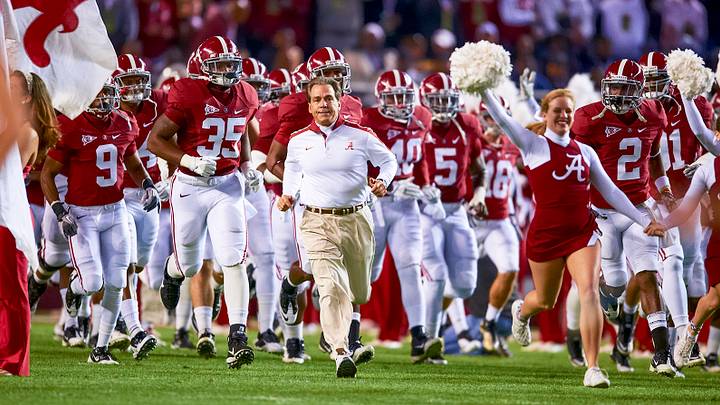
1. Nick Saban
297-71-1 (.806); 2003, ’09, ’11, ’12, ’15, ’17, ’20 national championships; 12 conference championships
Alabama (2007–23)
LSU (2000–04)
Michigan State (1995–99)
Toledo (1990)

There are great coaches, and there are coaches who defined their generations, but there is only one coach who turned the game of college football into his personal fiefdom for a decade and a half.
Saban—the Fairmont, W.Va.–born son of service station owners and a former Kent State defensive back—was, like many coaches on this list, an unlikely candidate to become the greatest college football coach in history. As late as 2006, Saban’s post-2003 LSU national championship reputation was smarting from a sub-.500 NFL tenure with the Miami Dolphins, and the coach was backing into an unenviable gig resurrecting an inconsistent Alabama program.
After a feeling-out year in 2007, Saban was off and running. The Crimson Tide finished No. 6 in the country in 2008, the first of 16 consecutive AP top 10 finishes to close the coach’s career (he also had two with the Tigers and one with Michigan State). He retired after the 2023 season the winner of seven national championships under all kinds of circumstances: a split with USC (’03), as an unbeaten juggernaut (’09), in a rematch (’11), after shaking off a regular-season loss (’12 and ’15), behind North American sports’ most famous in-game decision (’17), and during a global pandemic (’20). It’s his versatility that sets him head and shoulders above his peers, and earns him the No. 1 spot on this list. —P.A.
PODCAST: Listen to Sports Illustrated’s college sports podcast, Others Receiving Votes, hosted by Pat Forde, on Apple and Spotify. Watch the show on SI’s college YouTube channel or on SI TV.
 Add us as a preferred source on Google

Dan Lyons is a staff writer and editor at Sports Illustrated. He joined SI for his second stint in November 2024 after a season as senior college football writer at Athlon Sports and previous three-year run at SI as a writer and editor for the Breaking and Trending News team. When he’s not watching a game, you can find Dan at an indie concert venue or movie theater. Dan has a bachelor’s degree in writing and rhetoric from Syracuse.
Follow dan_lyons76
Patrick Andres is a staff writer on the Breaking and Trending News team at Sports Illustrated. He joined SI in December 2022, having worked for The Blade, Athlon Sports, Fear the Sword and Diamond Digest. Andres has covered everything from zero-attendance Big Ten basketball to a seven-overtime college football game. He is a graduate of Northwestern University's Medill School of Journalism with a double major in history .
Follow PAndres2001
Tim Capurso is a staff writer for Sports Illustrated, primarily covering MLB, college football and college basketball. Before joining SI in November 2023, Capurso worked at RotoBaller and ClutchPoints and is a graduate of Assumption University. When he's not working, he can be found at the gym, reading a book or enjoying a good hike. A resident of New York, Capurso openly wonders if the Giants will ever be a winning football team again.
Follow TimCapurso