%22%3E%0A%3Cpath%20d%3D%22M0%205.37646H8.15061L17.4195%2016.8819V5.37646H26.0647V31.4412H18.3227L8.64523%2019.4196V31.4412H0V5.37646Z%22%20fill%3D%22white%22%2F%3E%0A%3Cpath%20d%3D%22M29.2041%205.37649H43.8064C47.4193%205.37649%2049.6989%206.1937%2051.2258%207.72059C52.1505%208.64533%2052.8172%2010.0002%2052.8172%2011.7851V11.8497C52.8172%2014.9465%2050.9462%2016.8389%2048.172%2017.8067C51.5269%2018.7744%2053.6774%2020.5594%2053.6774%2024.1293V24.1938C53.6774%2028.3659%2050.258%2031.4197%2043.6558%2031.4197H29.2041V5.35498V5.37649ZM44.258%2013.7637C44.258%2012.6024%2043.3333%2011.9787%2041.4623%2011.9787H37.6988V15.6346H41.5053C43.3763%2015.6346%2044.258%2015.011%2044.258%2013.8497V13.7852V13.7637ZM42.0859%2020.9895H37.6988V24.8605H42.0644C43.9569%2024.8605%2044.9247%2024.0863%2044.9247%2022.968V22.9035C44.9247%2021.7852%2043.9999%2021.011%2042.0859%2021.011V20.9895Z%22%20fill%3D%22white%22%2F%3E%0A%3Cpath%20d%3D%22M64.8174%205.18286H73.4627L84.452%2031.4411H74.9896L73.6132%2027.9357H64.4949L63.1615%2031.4411H53.8496L64.8389%205.18286H64.8174ZM71.4412%2021.7636L69.054%2015.441L66.6669%2021.7636H71.4412Z%22%20fill%3D%22white%22%2F%3E%0A%3Cpath%20d%3D%22M95.2695%205.37646H105.248C115.592%205.37646%20120.775%2010.4733%20120.775%2018.1938V18.2583C120.775%2025.9788%20115.485%2031.4412%20104.947%2031.4412H95.2695V5.37646ZM104.001%2012.9679V23.8497H105.463C109.442%2023.8497%20112.022%2022.2153%20112.022%2018.4518V18.3873C112.022%2014.6239%20109.463%2012.9894%20105.463%2012.9894H104.001V12.9679Z%22%20fill%3D%22white%22%2F%3E%0A%3Cpath%20d%3D%22M123.098%2011.1182H131.549V15.2258C132.711%2012.4731%20134.56%2010.6881%20137.915%2010.8387V19.8065H137.012C133.442%2019.8065%20131.528%2021.785%20131.528%2026.2797V31.4625H123.076V11.1182H123.098Z%22%20fill%3D%22white%22%2F%3E%0A%3Cpath%20d%3D%22M137.808%2025.6772V25.6127C137.808%2021.5482%20140.818%2019.2901%20145.55%2019.2901C147.27%2019.2901%20149.464%2019.6557%20150.345%2020.0428V19.6987C150.345%2017.8277%20149.184%2016.7524%20146.582%2016.7524C144.496%2016.7524%20142.754%2017.204%20140.969%2017.9137L139.485%2012.3008C141.829%2011.3975%20144.517%2010.8169%20148.044%2010.8169C152.173%2010.8169%20154.862%2011.6771%20156.646%2013.4621C158.173%2014.989%20158.776%2016.9675%20158.776%2019.9137V31.5052H150.324V29.4622C148.904%2030.9891%20147.012%2031.9999%20144.474%2031.9999C140.56%2031.9999%20137.808%2029.7633%20137.808%2025.7417V25.6772ZM150.431%2023.9138V23.0536C149.937%2022.86%20149.206%2022.7095%20148.496%2022.7095C146.818%2022.7095%20145.894%2023.7202%20145.894%2024.9891V25.0536C145.894%2026.2364%20146.754%2027.0321%20147.829%2027.0321C149.313%2027.0321%20150.431%2025.8493%20150.431%2023.9138Z%22%20fill%3D%22white%22%2F%3E%0A%3Cpath%20d%3D%22M162.883%2017.6345H160.496V11.1183H162.883C162.926%208.96778%20163.442%207.20433%20164.711%205.9355C166.088%204.55915%20167.872%204%20170.668%204C173.163%204%20174.69%204.21506%20175.851%204.55914V9.84951C175.034%209.65596%20174.217%209.54843%20173.141%209.54843C171.83%209.54843%20171.163%2010.0646%20171.163%2011.1829V11.3334H175.851V17.6345H171.335V31.4411H162.883V17.6345Z%22%20fill%3D%22white%22%2F%3E%0A%3Cpath%20d%3D%22M178.883%2024.6238V17.613H176.496V11.0968H178.883V6H187.335V11.0968H192.023V17.613H187.335V22.7528C187.335%2024.2797%20188.045%2024.8389%20189.378%2024.8389C190.152%2024.8389%20191.055%2024.6238%20191.937%2024.2152V30.7314C190.604%2031.4411%20188.582%2031.8927%20186.539%2031.8927C181.55%2031.8927%20178.862%2029.5916%20178.862%2024.6238H178.883Z%22%20fill%3D%22white%22%2F%3E%0A%3Cpath%20fill-rule%3D%22evenodd%22%20clip-rule%3D%22evenodd%22%20d%3D%22M201.368%204.36764C207.191%20-1.45588%20216.632%20-1.45588%20222.456%204.36764C228.279%2010.1912%20228.279%2019.6324%20222.456%2025.4559L211.912%2036L201.368%2025.4559C195.544%2019.6324%20195.544%2010.1912%20201.368%204.36764ZM204.009%207.55761C203.948%207.86849%20203.916%208.39718%20203.916%209.14566V10.4189C203.916%2011.1832%20203.948%2011.7198%20204.013%2012.0267C204.078%2012.3317%20204.278%2012.6168%20204.617%2012.8762C204.956%2013.1376%20205.403%2013.3316%20205.958%2013.4623C206.512%2013.593%20207.1%2013.6583%20207.837%2013.6583C208.573%2013.6583%20209.217%2013.591%20209.769%2013.4524C210.322%2013.3158%20210.761%2013.1178%20211.086%2012.8604C211.411%2012.6029%20211.605%2012.3178%20211.666%2012.0069C211.728%2011.6961%20211.759%2011.1674%20211.759%2010.4189V9.14566C211.759%208.38134%20211.728%207.84473%20211.662%207.53781C211.597%207.23287%20211.397%206.94972%20211.058%206.68834C210.72%206.42696%20210.272%206.23291%20209.718%206.10223C209.163%205.97154%20208.536%205.90619%20207.839%205.90619C207.102%205.90619%20206.459%205.97352%20205.906%206.11213C205.352%206.24875%20204.914%206.44677%20204.589%206.70418C204.265%206.9616%20204.071%207.24673%20204.009%207.55761ZM209.276%2024.8638C212.876%2024.8638%20214.557%2024.2064%20214.557%2021.862V21.858V21.3155C214.557%2019.6581%20213.516%2018.971%20210.252%2018.3136C209.278%2018.1136%20208.908%2017.9136%20208.908%2017.3136V16.9414C208.908%2016.6543%20209.177%2016.5117%20209.413%2016.5117C209.749%2016.5117%20209.918%2016.7137%20209.918%2016.9414V18.1136H214.391V17.3988C214.391%2015.4563%20213.347%2014.4266%20209.177%2014.4266C206.15%2014.4266%20203.896%2015.3414%20203.896%2017.3711V17.7433C203.896%2019.5155%20204.805%2020.3155%20208.201%2021.0303C208.28%2021.0472%20208.355%2021.063%20208.427%2021.0781C209.329%2021.2674%20209.647%2021.3341%20209.647%2021.9174V22.2897C209.647%2022.6619%20209.546%2022.8045%20209.142%2022.8045C208.67%2022.8045%20208.637%2022.5471%20208.637%2022.262V21.2897H203.894V21.7471C203.894%2024.149%20205.476%2024.8638%20209.276%2024.8638ZM215.424%2024.5569H219.925V14.7355H215.424V24.5569ZM216.955%2013.5019H219.925V6.06064H217.092V9.411L215.193%206.06064H212.359V13.5019H215.193V10.1199L216.955%2013.5019ZM208.269%2012.152C208.204%2012.2688%20208.055%2012.3262%20207.825%2012.3262L207.827%2012.3282C207.604%2012.3282%20207.459%2012.2767%20207.398%2012.1757C207.336%2012.0748%20207.305%2011.8074%20207.305%2011.3758V7.90068C207.305%207.51852%20207.352%207.28684%20207.445%207.20962C207.538%207.13239%20207.675%207.09279%20207.851%207.09279C208.059%207.09279%20208.198%207.14031%20208.265%207.23734C208.332%207.33239%20208.366%207.55416%20208.366%207.90068V11.3203C208.366%2011.7579%20208.334%2012.0352%20208.269%2012.152Z%22%20fill%3D%22white%22%2F%3E%0A%3C%2Fg%3E%0A%3Cdefs%3E%0A%3CclipPath%20id%3D%22clip0_15247_3640%22%3E%0A%3Crect%20width%3D%22227%22%20height%3D%2236%22%20fill%3D%22white%22%2F%3E%0A%3C%2FclipPath%3E%0A%3C%2Fdefs%3E%0A%3C%2Fsvg%3E%0A)
2026 NBA Mock Draft: First-Round Projections One Month Out
In this story:
The 2026 NBA Draft is less than a month away, with prospects already done with combine testing and scrimmages.
Information continues to swirl about who will be selected where, especially in the top-four, which is certain to set the tone for the ’26 draft. The Wizards will ultimately have the honors. There’s been a consensus among pundits that BYU’s AJ Dybansta will be the first to hear his name on draft night, though that was far from the case through the season, with both Darryn Peterson and Cameron Boozer having claim to the top spot as well.
Which direction the Wizards go, and in turn the Utah Jazz, will cause a domino effect.
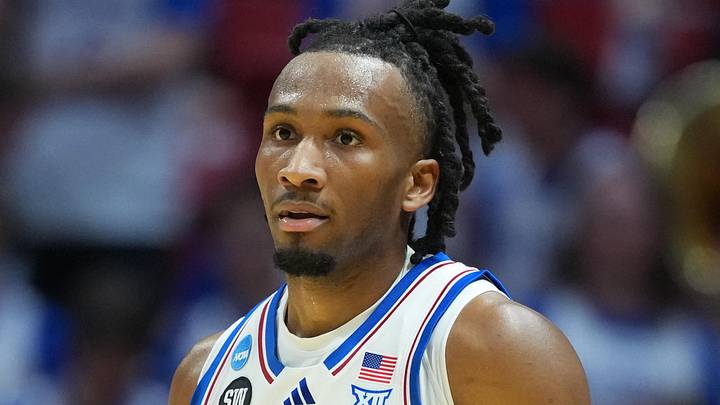
1. Washington Wizards: Darryn Peterson, Kansas
At this point, the Wizards selecting Kansas’ guard Darryn Peterson would be a zag from consensus opinion, though it shouldn’t be given Peterson’s talent-level, and the Wizards’ need for an infusion in the backcourt.
Peterson’s case will be built around his positional size as a guard, his blistering shooting and shot-making season with Kansas, in addition to him being the best defender of the three top options. Injuries and inconsistency raised odd questions at the college level, though if Washington is sure that’s behind him, they’d have no issue adding him to a young core of Alex Sarr, Kyshawn George, Bilal Couliybaly, Tre Johnson and more.
Peterson has alluded to the fact he believes he can play on the ball more, potentially making him an even higher upside prospect than it seems.
Peterson’s year at Kansas raised questions, though the Wizards will be picking with the next decade-plus in mind.
2. Utah Jazz: AJ Dybantsa, BYU
At this point, Jazz fans are likely coming around on the idea of adding Peterson to the backcourt with Keyonte George, who can toggle between on and off-ball play, and needs a strong defensive parter. Despite that, if Dybantsa is on the board, the team likely runs to the podium.
Utah has done more with less in terms of draft picks in recent years, and Dybantsa would immediately be the most talented prospect to join Utah in decades. At 6-foot-9 with a 7-foot wingspan, he has all the tools available to become a superstar scorer.
He’s lengthy, fluid, can get downhill and rise up in the mid-range. He’s the only player in the top group to have shown in-season improvement, having gradually shored up his shooting, defense and passing as the season wore on.
The Jazz backcourt could use an infusion, but they’d make a star wing work in a core of Lauri Markkanen, Jaren Jackson Jr., Ace Bailey and George.
3. Memphis Grizzlies: Cameron Boozer, Duke
There’s buzz that Boozer could be taken earlier than expected, and that makes sense given his collegiate dominance and analytically-slated profile. Still, his pairing with the Memphis Grizzlies continues to be one of the more popular on the board.
The Grizzlies have won 25 or less games only twice in the last 17 years, and aren’t a lock to repeat at the top of the draft next season, even accounting for how strong the Western Conference is. Additionally, they’ve long valued analytics, and Boozer offers likely the best ever in that regard.
Some will look at his 22.5 points, 10.2 rebounds and 4.1 assists as the college level and wonder how he’s not the top pick. Others will have a hard time getting there due to athletic translation concerns.
For now, the latter makes it easier for him to go after Peterson and Dybatnsa, though you can’t rule out draft-night surprises.
4. Chicago Bulls: Caleb Wilson, North Carolina
If the Boozer-Grizzlies pairing stands atop the board, Wilson to the Bulls isn’t far behind.
New decision-maker Bryson Graham recently alluded to early draft and team-building philosophy, noting SLAP (size, length, athleticism and physicality). That’s largely what Wilson dominated with at North Carolina, coming back 6-foot-9 barefoot with a 7-foot wingspan at the combine.
It does feel to this point he stands behind the top-three due to 3-point shooting, which is further away on all mechanical, volume and efficiency fronts. Though the Bulls have no issue grabbing their best and toolsiest prospect added to the roster in decades.
Should there be surprises and another prospect fall here, they won’t be choosy.
5. LA Clippers (via Pacers): Keaton Wagler, Illinois
The LA Clippers were sneakily one of the biggest winners of lottery night, grabbing a top-five pick in simply offloading Ivica Zubac, a major organizational win after several losses. Now, they’ll be tasked with kicking off the draft following the top-four.
LA will have several options, not necessarily beholden to the current core. Illinois’ Keaton Wagler seems to have the most buzz, in addition to potentially being the best player available on the board.
Meteoric barely does justice to Wagler’s rise through the draft ranks this season. He went from off draft radars completely to a bonafide top-seven prospect for most in just one season, leading his team to the Final Four while showing positional size, feel for the game and offensive versatility.
He’ll have competition here in Darius Acuff Jr., Mikel Brown Jr. and potentially a few others, though he feels the cleanest fit in addition to offering long-term upside as a guard-slash-wing that the Clippers desperately need.
6. Brooklyn Nets: Mikel Brown Jr., Louisville
The Nets were one of a few teams desperately needing to leave with a top selection, and instead find themselves picking up the pieces of a 20-win season at No. 6. Still, they’ll have their choice between several solid high-upside options, Brown notwithstanding.
Brown has expectedly been one of the biggest winners of the post-season cycle, measuring well as a big guard while showing off his high-end athleticism following a back injury. His season at Louisville was up and down, but he offers some of the top upside in the class if things swing his way developmentally.
Brooklyn grabbed as many as four handlers with five first-round selections in 2025, obviously looking to land multiple useable contributors on the wing. Brown offers a blue-chip combination of several things they looked for: positional size, shooting ability, handing, play-making and more.
If Brooklyn’s confident the back injury is behind him, and head coach Jordi Fernandez can help him to level out defensively, it would be an exciting selection.
7. Sacramento Kings: Darius Acuff Jr., Arkansas
The Kings missed out on a transformational top-four, perhaps needing to be transformed more than any other team in the league.
While they ultimately didn’t land the Dybantsa, Peterson or Boozer’s of the world, the order has shaken out well for them to potentially land a target they’ve been associated with: Darius Acuff Jr.
Acuff is one of the best basketball players in the draft, full stop. His control and assertion for Arkansas over the last year are rarely seen, leading to 23.5 points, 6.4 assists and an SEC title and Sweet 16 appearance for the Razorbacks.
Despite that, there’s some overthinking to be done in terms of his defensive ability, and higher-end upside due to his size (correct or not). It’s easy to envision both the Clippers and Nets, seemingly interested in versatility and positional size, both passing him up.
The Kings would rejoice in that scenario, grabbing a floor general geared for simply putting the ball through the hoop and winning basketball.
8. Atlanta Hawks (via Pelicans): Kingston Flemings, Houston
The Hawks would’ve preferred their house money to yield a higher return, though they’ll still be happy with a top-eight selection. This spot could sneakily be set to add some real talent to Atlanta, who is primed to make noise in the East next season.
A center 7-foot-3 center has become a popular option here for Atlanta, though landing this high should lend itself to swinging for guard help that won’t come around often. Houston’s Kingston Flemings is the natural progression.
The first day of the NBA Draft combine wasn’t kind to Flemings from a height and length perspective, but he quickly course-corrected with some of the best athletic testing available. He’s still likely the most naturally talented defender among the top group, having led a defensive-minded Houston group in scoring and passing at 16.1 points and 5.2 assists per game.
Flemings needs to refine his scoring process, but would be able to in a spaced-out Hawks system, while thriving as a passer, defender and more.
9. Dallas Mavericks: Brayden Burries, Arizona
The Dallas Mavericks saw a short fall at the draft lottery, still in striking distance of landing one of the top guards in the class, or a high upside swing elsewhere.
In speaking on last year’s No. 1 pick in Cooper Flagg, new Mavericks’ decision-maker Mike Schmitz said that his feel, IQ versatility are things that Dallas’ values. In looking at available options and fits for Dallas, Arizona guard Brayden Burries stands out as a backcourt piece with those qualities as well.
“The reality is there are players who end up being All-Star caliber guys or even better that don’t go in the top two, three, four, five.” Schmitz said.
Burries, having led a buzzsaw Wildcat team in scoring without completely dominating on-ball reps, feels like he could fit into that in the right landing spot. He wouldn’t be the most Masai Ujiri selection, potentially shedding light on how things will be run in Dallas.
10. Milwaukee Bucks: Nate Ament, Tennessee
Nate Ament to the Milwaukee Bucks has been a popular selection, but makes sense on several different levels.
It seems the Bucks are finally careening toward a future without superstar Giannis Antetokounmpo, potentially as soon as draft-night itself. That would mean it has ample time to develop a new, young core of players, and Ament would be a great starting point.
Ament saw a topsy-turvy season with Tennessee, and has his flaws, but also has a rare blend of size, fluidity and shot-making at 6-foot-10 that doesn’t pass through the draft ranks often. The Bucks wouldn’t need an immediate superstar, with some low-leverage, developmental seasons coming up that could see Ament develop across the board.
Milwaukee will have options, but with all the time in the world should feel comfortable taking some swings.
11. Golden State Warriors: Yaxel Lendeborg, Michigan
The Warriors are preparing for one final run with all-time guard Stephen Curry. They’ve seen a few disappointing seasons, but in sticking with Steve Kerr and seemingly being aggressive on the trade market, they’ve chosen their path for the next two seasons minimum.
With that being the case, it makes little sense to take a half-in, half-out approach at the draft, instead grabbing the most readily available player in Michigan’s Yaxel Lendeborg.
Lendeborg re-invented himself a few times at the college level, starting out as a board-grabbing big man before morphing into a positionally versatile wing in a title-winning season with Michigan. He can shoot, dribble, pass, defend, rebound and more, all at 6-foot-9 with a 7-foot-3 wingspan.
One of the only downsides to Lendeborg’s case is his being 24-years-old shortly after draft night, which the Warriors wouldn’t care about in the spirit of competing now.
12. OKC Thunder (via Clippers): Morez Johnson Jr., Michigan
In speaking on Michigan standouts, Morez Johnson Jr. pops as a player that could be in Oklahoma City’s sights as they continue to backfill their roster with cost-controlled role players around Shai Gilgeous-Alexander, Jalen Williams, Chet Holmgren and more.
Johnson transferred from Illinois to Michigan, eventually sliding in alongside both Lendeborg and Aday Mara. At 6-foot-10 with his own 7-foot-3 wingspan, he continued to showcase nice play-finishing and interior prowess, while also showing some of the best perimeter defense seen in a player of his size.
The Thunder lack true wings, which Johnson isn’t, but he may be able to replicate that level of defense while adding some of the rolling, cutting and rebounding that they need alongside Holmgren long-term.
Additionally, Johnson feels one of the more projectable shooting projects, which the Thunder have had no issue gambling on.
13. Miami Heat: Labaron Philon, Alabama
The Heat can go a number of directions with their late-lottery selection, per usual looking to squeeze every ounce of talent possible out of a non-top-10 pick. Here they’ll go with Labaron Philon, adding a true point guard to the roster.
Philon has flown under the radar of the top group due to his being a sophomore, but saw one of the better seasons in the country for Alabama. He improved across the board, raising his volume, efficiency and more while averaging 22.0 points and 5.0 assists.
The Heat have been rolling out a somewhat patch-worked point guard group, made up of players who are suited more for off-ball roles or simply aren’t tenable starting lead guards long-term.
Philon will need to bulk up and add strength to reach his potential, but otherwise offers a foolproof handler that fits in Miami’s core.
14. Charlotte Hornets: Aday Mara, Michigan
The Hornets round out the lottery, looking to continue an unexpected ascension in the Eastern Conference behind its star trio of LaMelo Ball, Brandon Miller and Kon Knueppel. Aday Mara offers a great frontcourt fit, if available.
Mara saw a breakout campaign with Michigan, showing off his immense size, touch all over the floor, unthinkable rim-protection and even some interesting, high-end passing ability. His 12.1 points, 6.8 rebounds, 2.4 assists and 2.6 blocks were vital in helping the Wolverines cut down the final nets.
The Hornets will rightfully be content to bomb triples with their young core for the foreseeable future, making a gargantuan possession-winner on the interior a viable option.
There’s no guarantee Mara will slip all the way to No. 14 given his unteachable size, which could be coveted as high as No. 8.
15. Chicago Bulls (via Trail Blazers): Hannes Steinbach, Washington
The Bulls have already left with a big in taking Wilson fourth, but that shouldn’t deter them from simply taking the best player available at No. 15 as they gear up for the future, which could very well be Washington big Hannes Steinbach.
Steinbach’s range is certain to be wide, having been massively productive for the Huskies in his lone season without the pure flash of other prospects. He led the NCAA in rebounding at 11.8 per game, and shot 58% from the floor while making his money largely on the interior.
Steinbach may not check the pure athleticism box, but Wilson does that enough for the both of them, and he certainly exceeds from a size, length and physicality standpoint at 6-foot-10 barefoot with a 7-foot-2 wingspan.
With these two selections, Chicago could very well shore up its frontcourt for years.
16. Memphis Grizzlies (via Suns): Cameron Carr, Baylor
After grabbing potentially the best natural play-maker in the draft third overall, the Grizzlies grab supplemental fire-power mid-way through the draft, taking Baylor’s Cameron Carr.
Carr was one of the biggest winners at the NBA draft combine, not only measuring well with his 7-foot wingspan, but adding 30 points and seven rebounds while hitting six threes in his lone scrimmage. He’s long been a potential breakout star at the college level, and was finally able to unlock that with Baylor in his redshirt sophomore season.
Carr doesn’t profile exactly as Grizzlies of draft’s past, but does have the combination of length, athleticism and shooting ability that they could make work.
17. OKC Thunder (via 76ers): Dailyn Swain, Texas
As previously mentioned, the Thunder lack true wings, instead playing guard-sized wing defenders in Luguentz Dort, Cason Wallace, Alex Caruso and more. With their second first-round pick they’ll be able to add a true wing in Texas’s Dailyn Swain.
Swain stands at 6-foot-6-and-a-half with a 6-foot-10 wingspan, having fully broken out in his season with the Longhorns. He’s an adept slasher, able to get to the rim both off the ball and in creating himself, with the necessary defense, rebounding and passing to thrive as a role player.
Swain’s 3-pointer is one of the biggest swing skills in the draft, either sending him to the stratosphere or relegating him to a more seldomly used wing creator.
Oklahoma City would take either version given its current roster construction.
18. Charlotte Hornets (via Magic): Jayden Quaintance, Kentucky
The Hornets take another bite at the big man apple at No. 18, chancing Kentucky’s Jayden Quaintance.
Quaintance has the most mysterious stock in the class presently, fresh off a major knee injury but with sky-high upside long-term. He came back with an enormous 7-foot-5 wingspan, which makes his 2.6 blocks and 1.1 steals per game with Arizona State in his freshman season more explainable.
Having already made a pick, the Hornets have no qualms adding a potential star defender to their ranks, even if he’ll need time to simmer. His defense could be game-changing for a Hornets’ group that already seems to have offense figured out.
19. Toronto Raptors: Ebuka Okorie, Stanford
The Raptors are entering what seems to be a crucial period, needing to upgrade alongside others teams in the East to keep up. They desperately need guard help, and Stanford’s Ebuka Okorie checks several boxes.
Okorie was a breakout star for the Cardinal to the tune of a blistering 23.2 points per game on 47% shooting. He also saw a combine win, coming back with a near-6-foot-8 wingspan despite being undersized in the height department at 6-foot-1.
Okorie won’t be the all encompassing play-maker that some teams covet, though his rim pressure, shot-making and defensive competitiveness should jump out to a team like Toronto.
20. San Antonio Spurs (via Hawks): Allen Graves, Santa Clara
Even amid a potential title run, the Spurs’ needs are obvious: a backup big capable of winning minutes alongside or in reserve of Victor Wembanyama. Luke Kornet is a solid player in his own right, but is massively losing minutes against the deeper OKC Thunder.
Allen Graves won’t be capable of fully putting a lid on the rim, but offers too interesting a fit next to Wembanyama to pass up in the twenties. At 6-foot-9 with a 7-foot wingspan, he’s not the most traditionally athletic players, but put together a nearly unbelievable defensive play-making season with 1.9 steals and 0.9 blocks per game across just 22.6 minutes for Santa Clara.
That level of disruption could at least offer San Antonio some solace on the back-end.
Even more, Graves’ outside mark of 41%, even on low volume, could point to a future hitting triples alongside Wembanyama.
21. Detroit Pistons (via Timberwolves): Bennett Stirtz, Iowa
The Pistons’ fell out of the NBA postseason in disappointing fashion: a game 7 blowout to the now-floundering Cleveland Cavaliers. One of their needs is apparent in that they need secondary handling and play-making alongside Cade Cunningham, who simply can’t do everything.
Luckily, the Pistons’ trade-deadline move to grab the Wolves’ swap places them in a great range to do so, with several point guard options hovering around. One of the best available is Iowa’s Bennett Stirtz, a solid fit in Detroit.
Stirtz has figured out every level of basketball dating back to Division II play, and the NBA is next on his checklist. He’s one of the more prolific pick-and-roll players seen — a nice fit for Jalen Duren — and can play off the ball with white-hot 3-point shooting.
22. Philadelphia 76ers (via Rockets): Karim Lopez, NZ Breakers
The Philadelphia 76ers surprisingly earned themselves a Playoffs series win, but still feel several pieces away from competing. Breakers’ forward Karim Lopez is a bet on a positionally malleable player able to spread production across several areas.
Lopez has a wide range as a player that produced at a high level in a pro league, but doesn’t offer the neon light flashiness that others do. He scored 11.9 points per game in the NBL, upping his points, rebounds, assists, steals, blocks and efficiency across the board.
Lopez is tall, lengthy, strong, competitive and can slide in as a jumbo wing or nice-sized four, able to put his fingerprints on several areas of the game. All things the 76ers need out of a late-first pick.
23. Atlanta Hawks (via Cavaliers): Zuby Ejiofor, St. John’s
The Hawks continue to zag in this mock draft, grabbing St. John’s big Zuby Ejiofor here at No. 23.
Flemings and Ejiofor don’t necessarily compound the Hawks’ current skills, but instead add some of what they don’t have in terms of defense, play-making and more. Ejiofor was among the best and most impactful players in college basketball, leading the Red Storm in points, rebounds, assists and blocks.
He’s one of the best switchable big defenders in the class, with rangy arms, competitiveness an instincts.
The Hawks ranked No. 11 in defensive rating through the regular season and fifteenth out of sixteen teams in the postseason. Their selections here would certainly help those rankings, in the least.
24. New York Knicks: Christian Anderson, Texas Tech
New York is just days away from its first Finals appearance in over 25 years, a testament moreso to its roster-building outside of the draft. Though with the money now locked up, backfilling rotation pieces will now need to be done with picks.
One way they can do that is add another play-maker to the roster, as Jalen Brunson carries a heavy load in that regard. Texas Tech’s Christian Anderson is one of the best in that regard, having ranked among top play-makers at the college level with 7.4 assists per game.
Additionally, Anderson is a malleable scorer, having gone for 18.5 points on 42% 3-point shooting. He can wear out a pick-and-roll and doesn’t need much space to get shots off, likely able to fit snugly alongside Karl-Anthony Towns.
25. Los Angeles Lakers: Chris Cenac Jr., Houston
Cenac was another combine winner, coming back with elite measurements at 6-foot-10 barefoot and a 7-foot-5 wingspan, which especially pairs well with his face-up shooting ability.
Still, that makes his lack of force on the interior less explainable, at just 9.5 points and 0.5 blocks per game. Still, the fully realized version of Cenac fits the Luka Doncic-led Laker well, able to rebound, hit jumpers, play-finish and defend in theory.
With Doncic at the helm, the Lakers will either be choosing pluggable players who can impact in the next few seasons, or gambling on high-upside in hopes of a player coming around fast enough to boost the roster majorly. This would very much be the latter.
26. Denver Nuggets: Henri Veesaar, North Carolina
The Nuggets have failed to add much real center help in Nikola Jokic’s tenure, but could take a step toward that in North Carolina big Henri Veesaar.
Veesaar broke out in Year 4 after a transfer to UNC, leveling up to 17.0 points, 8.7 rebounds and 1.2 blocks per game. His draft case is largely built on his size at 7-foot, in addition to 43% 3-point shooting on three attempts, great efficiency and volume for a big.
His shooting prowess could lend itself to minutes in reserve of or alongside Jokic, able to space the floor or offer an interior threat with great touch at all levels.
Veesaar isn’t the most prolific of shot-blockers, but is scrappy enough to make a difference.
27. Boston Celtics: Joshua Jefferson, Iowa State
Further changes could be coming for the Boston Celtics, who crashed out of the postseason in the first round, and have a historically aggressive front office.
In the event there are changes, grabbing playable role players could be the pathway forward at the draft, and Joshua Jefferson checks plenty of boxes. He has nice size, feel for the game and basketball IQ, while being able to defend, handle the ball, play-make and score in a variety of different ways.
His point-forward-like passing feels tailor made for a system like Boston’s, though his 3-point shooting will need to continue improving for him to slide into the C’s rotation with ease.
28. Minnesota Timberwolves (via Pistons): Isaiah Evans, Duke
Minnesota ran into a talented and upcoming Spurs’ squad in the Western Conference postseason, and won’t be able to solve all their problems with a late draft choice. Though Duke’s Isaiah Evans could add some things they need.
Evans is spindly, but has good size and length for a shooting guard. He saw a predictable boost alongside Boozer in Year 2 with the Blue Devils, adding 15.0 points on high-volume 3-point shooting, with 3.2 rebounds and 0.7 steals and blocks apiece to boot.
The Wolves will have ancillary minutes in its rotation to go around, with Evans potentially able to carve out a career alongside Anthony Edwards.
29. Cleveland Cavaliers (via Spurs): Koa Peat, Arizona
Arizona’s Koa Peat is likely the biggest return domino yet to fall, with him potentially making his way back to the Wildcats after a solid season. He averaged 14.1 points, 5.6 assists and 2.6 assists per game in functioning as a vital piece to the Wildcats’ Final Four run.
Still, there’s real holes to his game in the form of lesser perimeter shooting, and some question marks about where he lands as a defender and passer long-term.
The Cavaliers could see change upcoming, and grabbing an interior force that can finish and plug in alongside other bigs wouldn’t be such a bad idea.
30. Dallas Mavericks (via Thunder): Meleek Thomas, Arkansas
Few players are more on the edge of a collegiate return or push forward into the NBA that Arkansas’ guard Meleek Thomas, who offers both a highly-coveted college player and pro prospect.
He averaged 15.6 points, 3.8 rebounds, 3.5 assists and 1.5 steals per game alongside Acuff with the Razorbacks, showing a nice mix of upside and verifiable role-player abilities in his shooting, handling, play-making and defense.
The Mavericks could officially make him a first-rounder with the final pick, with Thomas adding a solid long-term guard option in a rotation with Flagg.
 Add us as a preferred source on Google
Derek Parker covers the National Basketball Association, and has brought On SI five seasons of coverage across several different teams. He graduated from the University of Central Oklahoma in 2020, and has experience working in print, video and radio.
Follow DParkOK