%20%20--%3E%0A%3Csvg%20version%3D%221.1%22%20id%3D%22Layer_1%22%20xmlns%3D%22http%3A%2F%2Fwww.w3.org%2F2000%2Fsvg%22%20xmlns%3Axlink%3D%22http%3A%2F%2Fwww.w3.org%2F1999%2Fxlink%22%20x%3D%220px%22%20y%3D%220px%22%0A%09%20width%3D%2239px%22%20height%3D%2240px%22%20viewBox%3D%220%200%2039%2040%22%20enable-background%3D%22new%200%200%2039%2040%22%20xml%3Aspace%3D%22preserve%22%3E%0A%3Cpath%20fill%3D%22%23FFFFFF%22%20d%3D%22M38.5%2C7H28.2v26h10.3V7z%22%2F%3E%0A%3Cpath%20fill-rule%3D%22evenodd%22%20clip-rule%3D%22evenodd%22%20fill%3D%22%23FFFFFF%22%20d%3D%22M26.1%2C25.5c0%2C5.8-4.1%2C7.5-12.9%2C7.5C3.9%2C33%2C0%2C31.2%2C0%2C25.2v-1.1h11.6%0A%09v2.4c0%2C0.7%2C0.1%2C1.4%2C1.2%2C1.4c1%2C0%2C1.2-0.4%2C1.2-1.3v-0.9c0-1.6-0.9-1.6-3.5-2.2C2.2%2C21.7%2C0%2C19.7%2C0%2C15.3v-0.9C0%2C9.3%2C5.5%2C7%2C12.9%2C7%0A%09c10.2%2C0%2C12.8%2C2.6%2C12.8%2C7.4v1.8h-11v-2.9c0-0.6-0.4-1.1-1.2-1.1c-0.6%2C0-1.2%2C0.4-1.2%2C1.1v0.9c0%2C1.5%2C0.9%2C2%2C3.3%2C2.5%0A%09c8%2C1.6%2C10.5%2C3.3%2C10.5%2C7.5V25.5z%22%2F%3E%0A%3C%2Fsvg%3E%0A)
Albert Breer’s Takeaways: How the Rams Could Deploy Aaron Donald This Season
Jump to a topic
- Rams and Aaron Donald
- Pittsburgh Steelers
- Dallas Cowboys
- Seattle Seahawks
- Commissioner’s exempt list
- Las Vegas Raiders
- Quinn Ewers
- New York Giants
- Kansas City Chiefs
- Quick-hitters
Our last set of takeaways before a real NFL game week starts … now.
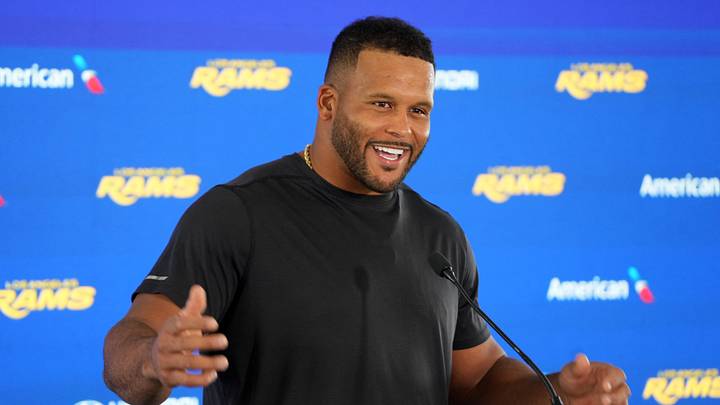
Rams and Aaron Donald
The Rams and Aaron Donald (finally!) have consummated their 2026 marriage. To celebrate that—this is a win for all of us on the outside because what a story it is—I figured we’d hit you with a what-you-need-to-know checklist on the return of the three-time NFL Defensive Player of the Year.
• The Contract: All right, so this is a common-sense deal that recognizes Donald for who he is without busting the Rams’ budget. The starting point, of course, was his original contract, which is in its final year. He had been due $30 million, but that number was knocked down to the league minimum when he retired, for cap purposes. So when he’s reinstated, he’ll come back on the minimum, meaning the Rams won’t have to move things around cap-wise.
The old contract will then be replaced with a new deal. Donald will get $10 million in base pay and another $10 million in 53-man-roster bonuses ($666,667 per game, maxing out at 15 games, which allows him to miss a couple as part of a ramp-up). Then there’s another $10 million in playing time/playoff incentives. The playing time triggers are very achievable, even if Donald is in a rotation. Getting all the way back to $30 million requires a Super Bowl, but if the Rams are just really good again, Donald should get to $25 million.
• The ramp-up: As we’ve said before, coach Sean McVay and Donald are very close and have worked out a detailed plan (Giff Smith has spearheaded some of it) to get him ready. Part of it was Donald working at the Rams’ facility in Woodland Hills, even while the team was an hour south at Loyola Marymount. The goal was to ensure Donald felt like he could be himself, and the NFL’s rules required the team to report those when he put on a helmet.
The next steps are borrowed off the team’s experience ramping up Donald when he was coming off holdouts in 2017 and ’18. Though he wasn’t coming off two years of retirement, those years he reported on Sept. 8 and Aug. 31, respectively, so there are similarities timeline-wise.
I don’t know whether he’ll play in Australia, but I don’t know that the Rams do, either.
• The deployment: The Rams are loaded on the defensive front. They have Myles Garrett, Byron Young and Josaiah Stewart on the edge, Poona Ford and Tyler Davis at nose tackle and now Donald joining Kobie Turner and Braden Fiske. That’s a tarrying level of top-end talent—and an eye-popping level of depth.
That should allow the Rams to be judicious with Donald over the course of the season. My sense is the plan would be to play him 30-40 snaps per game, which is a lot less than he played in his prime. I know how confident the staff is in him, but he’s also 35, and it’s a long year. And that’s why I kept asking if he might delay his return to October or November. The answer I got back every time was that Donald wanted to be a part of the journey in full.
Fulfilling that desire while trying to make sure he can get to the finish line at full speed at his age could be a bit of a tricky dance. And we’ve seen these things evolve in time where it just becomes impossible to keep the star off the field. But I do think the Rams are going to try to be smart, and McVay’s relationship with Donald should help in that regard.
I can’t wait to see what this looks like. Again, just the chance to see it makes the rest of us, as football fans, winners in this equation. Unless, of course, you’re rooting for one of the Rams’ rivals.
Pittsburgh Steelers
Aaron Rodgers and Mike McCarthy have a genuine appreciation for what’s in front of them. That crystallized for the Steelers coach earlier in the month when the old quarterback brought up an interesting reality of their reunion, a piece of what I like to call the “bad math” that we all experience as we get older.
Rodgers, believe it or not, is almost exactly the same age McCarthy was when the two first worked together in Green Bay two decades ago. You can look it up. McCarthy was 42 at this point in 2006, turning 43 that Nov. 10. Rodgers is 42 now, turning 43 on Dec. 3.
Surreal? Indeed.
“Very much so,” McCarthy told me. “The first day on the practice field, the mannerisms, man, it’s kind of cool to see it in the black-and-gold. Yeah, the whole reunion and pulling this thing together has been awesome. I’m definitely enjoying it, but I’m not ignorant to the amount of work that him and I have to do. It’s not just …”
The coach then smiled as he sat in a little office in Latrobe, Pa., on the day the Steelers broke camp, “He’s the easy part for me.”
Over the next week and a half, we’re going to bring you my quarterback series, with a ton of access, insight and assessments of some of the game’s biggest stars. And there’s no one more interesting going into the 2026 season, as I see it, than Rodgers.
I have two reasons for saying that.
The first, simply, is that the Steelers really have gone all-in on his final shot. The team was already older, with veterans T.J. Watt, Jalen Ramsey, Cam Heyward, Alex Highsmith, DK Metcalf and Patrick Queen, and they doubled down with Rico Dowdle, Jamel Dean and Michael Pittman Jr. coming in. Meanwhile, McCarthy and DC Patrick Graham have complex schemes to leverage all that experience.
Second, my sense is that you’re going to get a liberated, nothing-to-lose version of Rodgers this year. Why? Well, two years ago, Rodgers told me he really wanted to enjoy being a football player again after years of trying to show people he’s more than that. That last season in New York may not have meshed with that goal. But last year did—and the one thing I’ve heard consistently is how much he enjoyed the year, and the locker room.
So now, my guess is you’ll get a version of Rodgers who has a great appreciation for everything around him, with the perspective that he gave McCarthy with that math. And the cool thing is, for those two, it really is like riding a bike after they spent all those years together, one of which ended with a Lombardi Trophy, and two more with Rodgers winning MVP.
“I mean, it’s, Remember this, remember that, what about this, what about that?” McCarthy says. “We’ve played a lot of football together; 13 years is a long time. It’s not a matter of what we do. I’m more concerned about how much we do because all his ideas are good ideas. Same with our coaching staff. I mean, the guys don’t bring you bad ideas, the research they have.
“But at the end of the day, every system that I’ve ever built as a coordinator and as head coach is built around making a quarterback successful, and we will play to Aaron’s traits, his experiences. That’s just a philosophy I’ve always stayed in tune with.”
🏕️🏕️ 5⃣ from @Steelers 🏕️🏕️
— Albert Breer (@AlbertBreer) August 18, 2026
🏈 @AaronRodgers12 helping next generation.
🏈 Deep well of skill talent in place.
🏈 Right side of OL a swing factor.
🏈 Veteran crew on D fits Pat Graham.
🏈 Team's age makes depth a 🔑.https://t.co/dWE08ilbmZ
So, the logic goes, with guys like Metcalf (Year 8), Pittman (Year 7), Dowdle (Year 7), Pat Freiermuth (Year 6), and Jaylen Warren (Year 5) around him, Pittsburgh should be able to do a lot schematically, which will allow McCarthy and Co. to effectively weaponize Rodgers’s brain. And Rodgers should be able to hit the ground running when the season starts because of his encyclopedic recall of the system and what works and what doesn’t.
And camp gave everyone great momentum in that direction since Rodgers built such strong bonds in the locker room. He could add that to his experience playing for McCarthy to become a powerful torchbearer for the new program.
“It helps a lot,” McCarthy said. “It really goes back to being a quarterbacks coach and offensive coordinator, when you put a game plan together, your top salesman in a room needs to be your quarterback. It’s no different than a defensive coordinator. If key guys don’t believe in the plan? No shot. You have to have that connection as a coach. And then it’s not only the number of plans we’ve put together, but we’ve been very successful together. So yeah, it’s a tremendous asset to have him in there.”
Now, that’s not to say this is all foolproof. The roster is older, and an older roster can get worn down and banged up over the course of a season. And as much fun as last year was for the quarterback, it did end in the first round of the playoffs.
Still, I think it’s pretty cool, the unique way this is all set up.
I don’t know if it’s going to work. But I can’t wait to find out.
Dallas Cowboys
Quinnen Williams’s extension is a reflection of the Cowboys’ confidence in him. The three-year, $105.9 million extension (an average of $35.3 million per year in new money) is a really solid deal. The first two years are fully guaranteed and worth $63.35 million, which is a $16.1 million raise over what he was due in the final two years of his old deal. And the remainder of the $101 million injury guarantee vests early.
Here’s what that means …
• Williams is due $29.8 million in 2028, and all of it becomes fully guaranteed next March. Meaning that, sure, the Cowboys could bail after this year, but then they’d be paying $63.35 million for a single year of service.
• Similarly, the other $7.85 million in guarantees comes in 2029, as part of his $28 million in cash that year, and that vests in March 2028, meaning Dallas would be responsible for $93.15 million for two years if they tried to bail out of the final year.
To me, the real tell here is in comparing Williams’s deal with the one the Titans gave Jeffery Simmons, who was right there with Seattle’s Leonard Williams in the running for the NFL’s best interior D-lineman last year. Simmons had two years left, like Williams, before getting a new deal done in June. Both got three new years, and Williams wound up with a higher new-money APY, injury guarantee, full guarantee and three-year total ($93.15 million).
It shows how good Williams is, of course, but also the level of trust that the Cowboys have in him after dealing first- and second-round picks for him before the trade deadline last fall.
Bottom line: In short order, the former third overall pick has become a part of the team’s core both as a player and a leader. And given where they were coming out of the Micah Parsons trade, needing difference-makers for their defensive front, that’s an awfully big win.
Seattle Seahawks
The Seahawks have stayed active just nine days away from opening their title defense at Lumen Field, and this week, they gave us two big news items to dive into.
• On Saturday, Seattle signed troubled former first-round pick Terrion Arnold to a one-year deal. So why the fits and starts? Because the Seahawks did a lot of research on Arnold.
This story starts with the Feb. 4 incident in Tampa that led to Arnold being charged with felony kidnapping and armed robbery, with allegations that the then-22-year-old planned and orchestrated the assault of three teenagers at gunpoint after an Airbnb he’d rented days earlier was robbed. The Lions released Arnold—who faces eight felony counts that carry a potential maximum sentence of life in prison—on June 29.
At that point, the Seahawks—and a slew of other teams—dug into the background to see if Arnold would be a viable option. They consulted with Jalen Milroe (who’s close with Arnold) and Robbie Ouzts, teammates who played with Arnold at Alabama. GM John Schneider talked to Arnold’s college coach, Nick Saban, and Lions GM Brad Holmes. Ex-Seahawk Leon Washington, whose son is a half-brother of Arnold’s, was a good resource, too.
And what came back was similar to what I heard from other teams that pursued Arnold. Yes, he made some really bad decisions, but there was more to the situation that would, in time, cast a different light on the whole situation. The Seahawks also had their own predraft assessment, which showed that he was one of Saban’s favorites, and had aced all of their psychological testing. He had a rough season in 2025, his second year in the NFL, but a lot of that, per reports from Detroit, was due to him having a lot going on non-football-wise.
Anyway, Seattle reached a comfort level with the information and was one of four teams to have him in (Houston, New Orleans and the Giants were the others), and agreed to terms with the corner on Aug. 13, the day of his arraignment hearing, which was done over Zoom.
Then things got murky again. Seattle had previously been under the impression, through communication with the league office, that Arnold would be eligible to practice and play while his case was going through the courts. But soon after he signed, and after the NFL took a beating PR-wise while Arnold was on his tour (some planned visits didn’t happen as a result of that), the league reversed course and said he’d go on the exempt list.
So, that’s basically what delayed the signing for 16 days. Now it’s done and Arnold goes on the exempt list, which means he can be at the team facility and meet and work out with his teammates, but he can’t practice or play. He has another hearing in early October.
Meanwhile, the Seahawks have him for this year, plus his RFA rights for 2027. If he stays on the exempt list and loses the season, the contract tolls and the Seahawks get him for ’27 with his RFA rights for ’28. And they’re confident, based on their history with at-risk guys going back to Schneider’s start with Pete Carroll, that they’ll get Arnold turned around.
• In more uplifting news, Leonard Williams signed a three-year, $90 million extension, and the “Big Cat” deserves every penny. My piece of evidence: I made dozens of calls to coaches and personnel people putting together my AP All-Pro ballot last year, and my first-team defensive tackles wound up being the easiest choice on the board. It was Simmons, and it was Williams, who’d earned an unwavering level of respect from evaluators.
You could make a strong argument that Leonard Williams was the best defensive player the Seahawks had last year. After calling around, he became one of the easiest first-team All-Pro picks I had. This is very well-deserved. https://t.co/UnSsT3CWsY
— Albert Breer (@AlbertBreer) August 27, 2026
Yes, he’s 32. But defensive tackles tend to sustain well into their 30s—Donald and Chris Jones are great recent examples—and Williams’s value to the Seahawks goes well past what he brings on the field, where he’s a versatile, dominant chess piece. He also has emerged as a big-time leader for the team from the moment he was traded in the middle of the 2023 season.
And so this was a relatively easy one for Seattle, a team that, as we detailed in the Aug. 17 takeaways, has done a lot of business this calendar year, with cornerstones Jaxon Smith-Njigba, Charles Cross and Devon Witherspoon also locked up long term.
Commissioner’s exempt list
Arnold was one of three guys to be placed on the commissioner’s exempt list over the weekend. This is the most aggressive use of the designation we’ve seen since the NFL’s difficult autumn of 2014, when allegations/evidence against Ray Rice, Greg Hardy and Adrian Peterson made the wrong kinds of headlines for the balance of the season.
The last guy on it, and the only guy placed on it in 2025, was Jimmie Ward, a then-Texans safety who went on the exempt list last Aug. 26 for alleged domestic violence and was taken off on Sept. 22, when a grand jury declined to file criminal charges.
Three guys were on it in 2024. Browns DT Michael Hall Jr. went on it on Aug. 27 after a domestic violence charge and came off it in early October after pleading no contest (he got time served toward a five-game suspension). Patriots S Jabrill Peppers went on it that Oct. 9 after an arrest stemming from a domestic case, and came off it Nov. 25 after it was settled. And Tashaun Gipson was on it in midseason for five days that year, so the Jaguars could have him at practice as he returned from a PED suspension.
So why now do you have Arnold, Packers RB Josh Jacobs and Broncos OLB Jonathon Cooper all going on at once, especially when the teams involved weren’t necessarily expecting that?
First of all, I applaud the league for taking these cases seriously. It’s not just about the image of the league. It is about doing the right thing. That said, I do have to wonder how much the presence of video in the Jacobs case—video that even the Packers haven’t seen yet—is influencing decision-making, given what the league endured with the Rice saga a dozen years ago. And if they shelve one, they kind of have to shelve all three.
Each team is in a bit of a different spot with it. For Seattle, anything they get from Arnold this year would be a bonus, though they’re hopeful. For Denver, losing Cooper is a blow, but that outside linebacker position is one of the deepest on the roster. For Green Bay, not having Jacobs is a problem with a capital “P,” as Sunday’s trade for Kaleb Johnson would indicate. The hope is that MarShawn Lloyd, who has a ton of potential, can finally stay healthy.
Of course, this isn’t ideal for any of the teams. But I get the league being careful in proceeding here, given the nature of the cases.
Las Vegas Raiders
I understand Klint Kubiak, in his first camp as Raiders coach, wanting to make sure that every starting spot was earned—but Kirk Cousins as starting quarterback should come as no surprise to anyone paying attention. That’s no affront to first overall pick Fernando Mendoza, who has been what Vegas figured it was drafting in April. But there were always a couple different levels to when Mendoza would get on the field.
The first is his own readiness to play, and those who come from the coaching family that Kubiak does have a meticulous, detailed process for weaning quarterbacks into the system, rooted in detail in footwork and timing, and tying a player’s feet to his progressions and his eyes to his feet. That takes time, and Mendoza is moving along nicely in getting there.
The second is and always was going to be what the Raiders could put around him. Was there enough up front beyond left tackle Kolton Miller and center Tyler Linderbaum? Was the skill group far enough along, past all that tight end Brock Bowers can bring to the table (and that is a lot), to lift a young quarterback up, or would that group be better off with a veteran? How much can Ashton Jeanty, now a little nicked up, carry the offense and ease the burden on his QB?
📽️📽️ 8.28 Breer Report 📽️📽️
— Albert Breer (@AlbertBreer) August 28, 2026
⏩ Fernando Mendoza and the @Raiders QBs.
⏩ Expectations for Justin Herbert.
⏩ All that's happening with the @RamsNFL.
FULL VIDEO: https://t.co/Y27ul6w9qm pic.twitter.com/WMnBPcvFHY
To be clear, I do think Mendoza will play at some point this year. History tells us that the Raiders will want to get a look and get him some real action before his rookie season is over. But knowing what I do about Kubiak, I’d be pretty stunned if they weren’t extremely disciplined in how and when it happens. And, as the above would tell you, some of that is within Mendoza’s control and some of it is not.
Quinn Ewers
The trade of Quinn Ewers from the Dolphins to the Jaguars got me thinking again about how we anoint guys as high schoolers and how faulty doing that can be. It’s no fault of Ewers, who by all accounts is a really good guy (I’ve had good interactions with him) and still has a shot to prove himself as a player. This is more about the conclusions we jump to when so many of these guys are barely old enough to drive.
Jimmy Clausen was, at one point, dubbed the LeBron James of football by ESPN the Magazine. Matt Barkley became the first freshman ever to start at storied prep power Mater Dei and was immediately elevated to NFL prospect by some. Terrelle Pryor was a top recruit in basketball and football, then regarded as a quarterback prodigy.
All made it to the NFL, which is a heck of an accomplishment in itself. But none came close to the extraordinary expectations that were foisted on them as teenagers.
So I figured I’d run the numbers on this, just to see. I took the No. 1 prep QB in every class from 2003 to ‘22, based on the 24/7 composite, which puts together all the major recruiting services’ rankings. Those 20 QBs were, in order, Kyle Wright, Rhett Bomar, Mark Sanchez, Matthew Stafford, Clausen, Pryor, Barkley, Phillip Sims, Jeff Driskel, Jameis Winston, Max Browne, Kyle Allen, Josh Rosen, Shea Patterson, Davis Mills, Trevor Lawrence, Spencer Rattler, Bryce Young, Ewers and Cade Klubnik. Now, the results …
• Six became first-round picks, which is still a pretty good rate. Stafford, Winston, Lawrence and Young went first overall, while Sanchez was the fifth pick and Rosen went 10th.
• There was one second-rounder (Clausen), a third (Mills) and a third-rounder in the supplemental draft (Pryor).
• Two went in the fourth round (Barkley, Klubnik), two in the fifth (Bomar, Rattler), one in the sixth (Driskel) and one in the seventh (Ewers).
• The five remaining went undrafted. Sims, Wright and Patterson never made a 53-man roster. And Browne only got as far as having a tryout with the Steelers. Allen, meanwhile, has carved out a nice career for himself as a backup, and he’s heading into his ninth NFL season.
What to take from that? Well, I’d say the big thing is that a lot can change for a football player after he turns 18, which makes this particular sport very different than most others.
New York Giants
Being with the Giants last week, it was pretty clear it was a John Harbaugh outfit. It was clear in how the team practiced, with a ton of on-field coaching going on. It was clear in the length of the practice, over two hours. It was clear in that the guys were in full pads. And it was clear in the size of the team—especially in the offensive line and defensive front seven.
So I mentioned all that to Harbaugh, when we were doing our live podcast there, how his teams always have that distinct look, wanting to know where the Giants are in the process of building it after he spent the last 18 years curating those sorts of teams in Baltimore.
“Well, I appreciate you saying that,” he responded, smiling. “I think some of the fundamental things, the principles, are things that we definitely set in stone, and we’d expect from any team that we’d be coaching, the guys I’m with. So that’s part of it. But the other part of it is, the identity of the team is still forming, and is forged by the players. That’s the players you have, what they believe in, what they stand for, what they’re willing to fight for. You can’t impose that on anyone. Guys have to believe in it. It has to be their idea, too.
“I feel like that’s what we’re trying to forge, so those things going together is always a work in progress. I don’t care if you’ve been there for 18 days or 18 years. Whatever it is, it’s always going to be a work in progress and you build that. I feel like we’re in a really great place with it. I feel like our guys really understand and really want to promote what they want the team to be. And we talk about it every day together, we show it on tape, it comes up in our shared experiences every single day.
“I feel like we’re building that, we’re as far along as we could be right now, and looking forward to where we can take it the next few weeks.”
To translate that, I’d say it’s a good sign, too, that he and GM Joe Schoen have gotten on the same page, because as Harbaugh said, they had to find players that would line up with them philosophically to the point where they’d want what the coaches do intuitively.
Incredibly proud of this one. @theMMQB podcast goes LIVE from Giants training camp. @AlbertBreer and I hang with @JaxsonDart, John Harbaugh and Joe Schoen. Don’t miss it! https://t.co/TVqNh9gkWL pic.twitter.com/pBoS94YVKo
— Conor Orr (@ConorOrr) August 26, 2026
Harbaugh sees it in the vets that have been around, some of the younger guys he’s inherited—Abdul Carter was one he mentioned specifically—and the new guys they’ve brought in.
If you want more on that from Harbaugh, Schoen and Jaxson Dart, check out the pod.
Kansas City Chiefs
I’d be mildly concerned with the Chiefs’ offensive line situation. Over the weekend, Kansas City made trades with the Giants and Ravens to acquire tackles Josh Ezeudu (who has the flexibility to move inside) and Diego Pounds, respectively, sending away a 2028 seventh-round pick and a conditional ’28 sixth-rounder (that could wind up a seventh) to get them.
First question: Is this about OT Josh Simmons’s health?
My answer would be no. Kansas City was alarmed with the state of its depth through the preseason and wanted to address it aggressively. So reinforcements were coming either way. But that doesn’t mean Simmons’s health isn’t a concern, because it is.
Simmons is wildly talented, but he’s a smaller tackle who has to work to get to 300 pounds, and so the fact that his back pain has lingered to the point where he needed to get a second opinion is worth paying attention to. And while I don’t think it’s serious at this point, back issues can linger and that’s where the question of depth takes center stage, particularly in a year Patrick Mahomes is coming back from a torn ACL and LCL.
If the Chiefs are good at tackle, I think they can compete with anyone. But that position has been a trouble spot over the years when they have slipped a little off their accustomed level, so it’s always worth watching.
Quick-hitters
And here come our quick-hitting takeaways at the cutdown …
• It’s interesting (maybe only to me) that the Eagles, Vikings and Steelers kept four quarterbacks and the Browns did, too (though Dillon Gabriel will start the year on injured reserve).
• I have gotten the sense, for what it’s worth, that Vikings coach Kevin O’Connell wants to keep working with J.J. McCarthy.
• The Cowboys’ trade for Broderick Jones is interesting, as is the fact that his shot to start will be at right tackle rather than left tackle, where Tyler Guyton had to win his job back this summer.
• The Johnson trade to the Packers is interesting, too. The former second-round pick lost confidence last year after falling out of the rotation. But there’s talent to work with and, in Jacobs’s absence, some opportunity too.
• The Falcons leaving the QB job open past the cutdown tells you a little something on where Tua Tagovailoa is at right now.
• Despite all the hubbub over the Browns’ QB situation, I’d say what you should really take from it is that chances are pretty high Cleveland’s 2027 starter is not on the roster.
• Really cool seeing Odell Beckham Jr. make the Giants’ roster. It shows, above all else, that he still loves the game.
• Alec Pierce is just coming off the PUP list, and Keenan Allen, who’s near the end of his career, just got arrested on drunken driving charges. Those are two guys the Colts need right now if they’re going to match what they were offensively early on last year.
• On the Pro Bowl: With the elimination of the game, it’d be cool to see the league make it into a retreat for the stars of the sport and put that in Hawaii to give them incentive to go.
• Nine days left. Hard to believe.
 Add us as a preferred source on Google
Albert Breer is a senior writer covering the NFL for Sports Illustrated, delivering the biggest stories and breaking news from across the league. He has been on the NFL beat since 2005 and joined SI in 2016. Breer began his career covering the New England Patriots for the MetroWest Daily News and the Boston Herald from 2005 to ’07, then covered the Dallas Cowboys for the Dallas Morning News from 2007 to ’08. He worked for The Sporting News from 2008 to ’09 before returning to Massachusetts as The Boston Globe’s national NFL writer in 2009. From 2010 to 2016, Breer served as a national reporter for NFL Network. In addition to his work at Sports Illustrated, Breer regularly appears on NBC Sports Boston, 98.5 The Sports Hub in Boston, FS1 with Colin Cowherd, The Rich Eisen Show and The Dan Patrick Show. A 2002 graduate of Ohio State, Breer lives near Boston with his wife, a cardiac ICU nurse at Boston Children’s Hospital, and their three children.
Follow AlbertBreer