%20%20--%3E%0A%3Csvg%20version%3D%221.1%22%20id%3D%22Layer_1%22%20xmlns%3D%22http%3A%2F%2Fwww.w3.org%2F2000%2Fsvg%22%20xmlns%3Axlink%3D%22http%3A%2F%2Fwww.w3.org%2F1999%2Fxlink%22%20x%3D%220px%22%20y%3D%220px%22%0A%09%20width%3D%2239px%22%20height%3D%2240px%22%20viewBox%3D%220%200%2039%2040%22%20enable-background%3D%22new%200%200%2039%2040%22%20xml%3Aspace%3D%22preserve%22%3E%0A%3Cpath%20fill%3D%22%23FFFFFF%22%20d%3D%22M38.5%2C7H28.2v26h10.3V7z%22%2F%3E%0A%3Cpath%20fill-rule%3D%22evenodd%22%20clip-rule%3D%22evenodd%22%20fill%3D%22%23FFFFFF%22%20d%3D%22M26.1%2C25.5c0%2C5.8-4.1%2C7.5-12.9%2C7.5C3.9%2C33%2C0%2C31.2%2C0%2C25.2v-1.1h11.6%0A%09v2.4c0%2C0.7%2C0.1%2C1.4%2C1.2%2C1.4c1%2C0%2C1.2-0.4%2C1.2-1.3v-0.9c0-1.6-0.9-1.6-3.5-2.2C2.2%2C21.7%2C0%2C19.7%2C0%2C15.3v-0.9C0%2C9.3%2C5.5%2C7%2C12.9%2C7%0A%09c10.2%2C0%2C12.8%2C2.6%2C12.8%2C7.4v1.8h-11v-2.9c0-0.6-0.4-1.1-1.2-1.1c-0.6%2C0-1.2%2C0.4-1.2%2C1.1v0.9c0%2C1.5%2C0.9%2C2%2C3.3%2C2.5%0A%09c8%2C1.6%2C10.5%2C3.3%2C10.5%2C7.5V25.5z%22%2F%3E%0A%3C%2Fsvg%3E%0A)
Where Does Christian Pulisic Fit Into New Look USMNT?
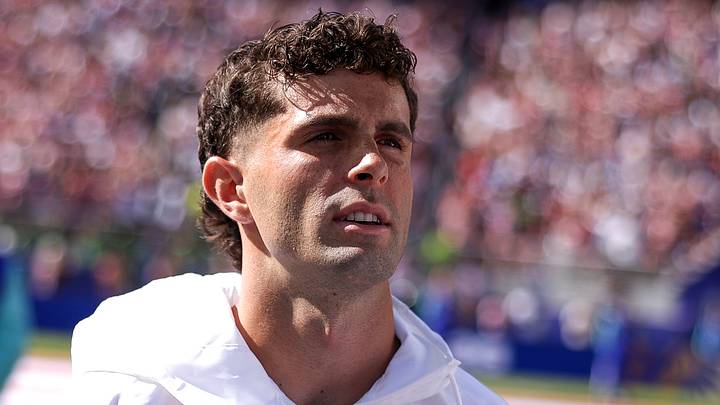
Christian Pulisic is back with the U.S. men’s national team for the Concacaf Nations League quarterfinals, entering the November international window in a rich vein of form: four goals in six Serie A starts.
His last national team appearance ended early in the World Cup round of 16, when a microfracture of the tibia and fibula in his right leg against Belgium cost him Milan's preseason and the start of the domestic campaign. By the time USMNT’s September-October roster was announced, Pulisic had just one half of first team minutes to his name, as a substitute against Lazio.
He was overlooked in the 28-man roster for the four fall friendlies. The omission was partly down to fitness and a lack of minutes, but Mauricio Pochettino was also signalling his ambition for the next World Cup cycle. The Argentine used this window to widen the pool, with burgeoning teenage talents, such as Cavan Sullivan, Julian Hall and Justin Ellis, earning meaningful minutes in the national shirt in the absence of big names.
With Pochettino reportedly high on the wanted list of Manchester United should they replace Michael Carrick imminently, as expected, Pulisic could actually have a new national manager.
But whoever leads the USMNT in this next cycle, the question remains: Where does Pulisic fit into this new edition of the USMNT? Does he, in fact, fit at all?
Pulisic Failed to Lift European-Forged Generation

For the better part of the last decade, Pulisic has been the poster boy of an American generation expected to take U.S. Soccer to unprecedented heights. With 90 caps, 33 goals and a decade at three of Europe’s biggest clubs, he remains the pool’s most experienced attacker and its biggest global star. For the 2030 World Cup cycle, though, the team is no longer being built around him.
This long-anticipated “golden generation,” which also includes the likes of Weston McKennie, Tyler Adams and Antonee Robinson, was forged in European academies, rather than domestic ones. The share of non-MLS players on the World Cup roster has climbed from 57% in 2014 to 69% in 2026, and roughly 10 members of the 2022 roster came through European academies as teenagers. Pulisic was the first to catch the eye, and his performances have been the most visible of them all.
Pochettino’s September-October camp leaned heavily into MLS, accounting for 12 of the initial 28 selections and rising to 13, or 46%, after Damion Downs replaced the injured Ricardo Pepi. But the long-term structural trajectory remains nuanced. The November roster pulled the MLS contingent back to a familiar 32%, nearly identical to the World Cup roster. The broader philosophical shift is still undeniable: three of the roster’s five selected forwards are young MLS prospects, proof that Pochettino's youth-centric recalculation of the frontline has endured.

However the pipeline shifts, the home World Cup was where the European-forged generation was expected to deliver. It began with discipline and promise and ended against Belgium in frustration and another round of 16 exit. Pulisic’s second World Cup was goalless and injury-ridden. He now has one goal in eight World Cup appearances.
For a player widely regarded as the most talented the USMNT has ever produced, that record reads as an unfulfilled promise. He is often placed alongside Landon Donovan and Clint Dempsey in stature. Has he lived up to the comparison?

Set against the two veterans, Pulisic’s case is a mixed one. Their per-cap scoring rates are near identical, and friendlies account for a similar share of each player’s goals, so none of them padded their numbers against minnows.
The gap is in the tournaments. Donovan scored 44% of his international goals in tournament finals, Dempsey 40%, Pulisic 24%. Pulisic’s scoring instead sits in qualifying, which accounts for 36% of his goals, against 23% for Donovan and 32% for Dempsey. The World Cup gap is the widest of all: Donovan and Dempsey scored 0.42 and 0.40 goals per World Cup cap, Pulisic 0.13.
The numbers go against him on the biggest stage. He has carried his side through qualifying, but World Cup goals remain unfinished business. That is where Donovan and Dempsey built their reputations, and where Pulisic has not.
Three Teenagers Come to the Fore in New Look USMNT

Where Pulisic fits in this next World Cup cycle has become a tactical puzzle.
After the November roster announcement, Pochettino explained the attack he had just picked. “I think the combination between [Folarin] Balogun, [Justin] Ellis and [Julian] Hall is perfect,” he said. Balogun, like Pulisic, had missed the September-October friendlies, and it was in his absence the teenagers made their case: Ellis, Hall and Sullivan scored half of the dozen goals across those four games, all three fully fit whereas Pepi was not.
What Pochettino praised was as much the mentality as the finishing. He called Sullivan “a fighter” and “a warrior,” singled out the group’s willingness to chase and recover the ball and paired the praise with a reminder to keep “both feet on the ground.”
The U.S. won all four friendlies by spreading the attacking load rather than isolating wingers. They played through the middle, with a group of young strikers and a set of creative playmakers behind them, and the goals came from quick, short combinations in half-spaces.
Again and again, the post-World Cup postmortems landed on the same complaint: American soccer was waiting, once more, for one player to lift the program. The autumn windows read as a deliberate attempt to break the habit.
The three teenagers in attack earned their places through their domestic form and delivered in the national shirt to justify the call-up. Hall has three goals and one assist in four caps, Sullivan pressed relentlessly and opened his account with a finish from 30 yards out and Ellis has two goals in three caps, including the game-winner against Canada.

The sample is small this early into the new European season, and comparing leagues is not straightforward, either. Still, the numbers are close: those teenagers are producing impressively, while Pulisic has made a strong start under new manager Ruben Amorim.
Pulisic may no longer be the undisputed, solitary talisman he was over the last two cycles, but his place as a starter is undeniable. He is the pool's most proven asset, and, at 28 years old, the numbers still show that he is the most productive forward at USMNT’s disposal.
The manager has been explicit that selection rewards current form, not past reputation. He inherited a pool of young players ready to step up, and after the World Cup, he made clear that he wanted to know them better, tactically and psychologically.
Pulisic Finds Greatest Success in Central Roles

Injuries have dogged Pulisic throughout his career. Of the 37 he has suffered, 22 have been muscular, accounting for 67 of his 102 games missed. Hamstrings, calves and adductors are the price a winger pays for repeated high-speed running. That workload tells in his record, and it could be the part of the job Amorim has taken off his plate.
In Milan’s 3-4-2-1, Pulisic has played as one of two No. 10s behind a target striker, Gonçalo Ramos. The wingbacks provide the width and pin the opposition’s back line, while Ramos occupies the center, leaving Pulisic to work the half-spaces between the lines. The numbers show the shift. His crossing is at its lowest since he joined Milan, while his touches and his passes into the final third have both risen. He is seeing more of the ball and more of it in central areas.
That is the central-heavy formula the USMNT trialed successfully in the fall: unlocking opponents through the middle rather than stretching them wide. It should be a seamless transition for Pulisic, who has spent more time in central areas so far this season.

The output has followed the change of role: in all four starts as the No. 10, he has produced a goal. He is averaging 0.82 goal contributions per 90, his best return in senior soccer, and he is doing it with fewer touches in the opposition box, down from 6.8 per 90 last season to 3.8. He is converting more than one in three shots into a goal, a 36% rate, and creating 0.65 big chances per 90, the most of his Milan career.
The patterns reveal a shift in his tactical role, and the early results suggest it suits his strengths.
The counterexample is former AC Milan manager Massimiliano Allegri’s experiment. Moved to center forward in December 2025, Pulisic went 18 league games without a goal. He struggles as the reference point of an attack and thrives when he is involved in the build-up to it.
The role has sharpened his work off the ball too. Pulisic is winning possession back more than four times per 90 this season, up from under three last season and his best return at Milan; in Serie A, only Alexis Saelemaekers has won the ball back more often in the final third for the club. An experienced forward who can start the press, pick his moment and read the trigger is an asset to the system being built—and one more facet this U.S. side would gain from him.
Amorim also manages his minutes carefully. Pulisic has been substituted in every Serie A start but one, and every Europa League appearance has come from the bench.

Milan have been the better side with Pulisic in the starting XI. In the six league games he has started, they have averaged 2.7 points and 2.3 goals per game; in the five he has not, 1.6 and 1.8. Their win rate is 83% with him in the lineup and 40% without. One caveat: his return coincided with Amorim finding his balance, so the split flatters him slightly. The pattern is early, but it is there.
So Pochettino (or his replacement) has a rough blueprint for getting the best out of Pulisic. There are several striker profiles to choose from, and that range, together with his own tactical flexibility, offers the option to try Pulisic in a similar role: as an inside forward or an inverted No. 10. The USMNT player pool may not have a striker with Ramos’s exact strengths, but its strikers have their own, whether holding the ball up to bring others in or stretching defenses vertically to open the middle.
The move also fits the broader shift toward funneling the attack through central overloads. The current USMNT team shape may not be a 3-4-2-1, but in modern soccer, the principles do not depend on the formation.
Haiti is where this gets tested. Pulisic has not scored a competitive goal for the USMNT since November 2024, in this same round, and the question is no longer where he starts but whether he has earned it over the younger forwards coming through. “No one can feel safe,” Pochettino said a year ago. His lineup selection, should he still be in charge, for these two games will say a lot about what this cycle will look like.
 Add us as a preferred source on Google

Sukhman Singh is a sports journalist, analyst and contributing writer for SI FC, covering the USMNT with a focus on tactics and data. His work has appeared in The Athletic, where he writes on the Premier League, the Champions League and cricket, and he previously worked in soccer analytics with Southampton FC. He splits his time between India and the U.S., which means at least one of his teams is always playing at 3 a.m.